115195
论文已发表
注册即可获取德孚的最新动态
IF 收录期刊
- 3.6 Breast Cancer (Dove Med Press)
- 4.3 Clin Epidemiol
- 2.6 Cancer Manag Res
- 3.2 Infect Drug Resist
- 4.1 Clin Interv Aging
- 6.1 Drug Des Dev Ther
- 4.1 Int J Chronic Obstr
- 8.7 Int J Nanomed
- 2.5 Int J Women's Health
- 3.2 Neuropsych Dis Treat
- 2.4 OncoTargets Ther
- 2.6 Patient Prefer Adher
- 2.6 Ther Clin Risk Manag
- 3.1 J Pain Res
- 3.5 Diabet Metab Synd Ob
- 4.5 Psychol Res Behav Ma
- 3.4 Nat Sci Sleep
- 2.4 Pharmgenomics Pers Med
- 2.6 Risk Manag Healthc Policy
- 4.6 J Inflamm Res
- 2.3 Int J Gen Med
- 3.9 J Hepatocell Carcinoma
- 3.3 J Asthma Allergy
- 2.5 Clin Cosmet Investig Dermatol
- 3.0 J Multidiscip Healthc

心电图和超声心动图诊断左心室肥厚的一致性:对上海北部地区的研究
Authors Zhang W, Zhou Y, Bai B, Yu S, Xiong J, Chi C, Teliewubai J, Li J, Blacher J, Zhang Y, Xu Y
Received 18 July 2018
Accepted for publication 14 January 2019
Published 11 March 2019 Volume 2019:14 Pages 549—556
DOI https://doi.org/10.2147/CIA.S180723
Checked for plagiarism Yes
Review by Single-blind
Peer reviewers approved by Dr Justinn Cochran
Peer reviewer comments 3
Editor who approved publication: Dr Zhi-Ying Wu
Background: Left
ventricular hypertrophy (LVH) is one of the preclinical manifestations of
hypertensive target organ damage (TOD). However, it remains unclear which
electrocardiographic criterion perform better in diagnosing LVH.
Purpose: To
investigate the consistency of LVH diagnosed by electrocardiography (ECG) and
echocardiography (ECHO). Taking LVH by ECHO as reference, to compare three
different ECG criteria (Sokolow-Lyon, Cornell and Cornell Product criteria) and
find the best ECG indicator for identifying LVH in community-based elderly
Chinese.
Patients and methods: Echocardiography
and electrocardiography were applied to define LVH in 1789 elderly Chinese aged
>65 years old in communities located at the northern Shanghai.
Echocardiographic LVH (ECHO-LVH) was defined by left ventricular mass indexed
for Body Surface Area (LVM/BSA) or for height2.7 (LVM/height2.7).
Electrocardiographic LVH (ECG-LVH) was defined by Sokolow-Lyon (SL), Cornell
and Cornell Product (CP) criteria. ECHO-LVH was defined by LVM/BSA≥125 g/m2 in male
or ≥110 g/m2 in female (LVH1); LVM/BSA≥115 g/m2 in male,
or ≥95 g/m2 in female (LVH2) and LVM/height2.7 ≥51 g/m2.7 in male
or ≥47 g/m2.7 in female (LVH3).
Results: As
compared with SL and Cornell criteria, CP had the greatest correlation
coefficient in the association with echocardiography-defined LVH, except for
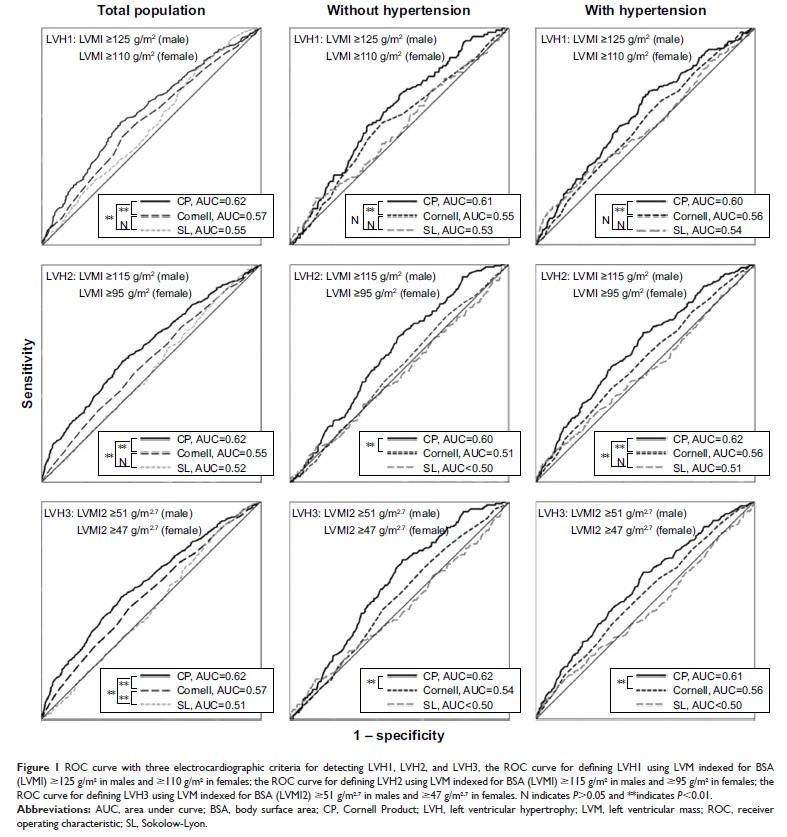
LVM/BSA in men. Of note, CP criterion had the greatest area under curve of ROC
than Cornell criterion and the SL index, not only in total population but also
in subgroups classified by blood pressure.
Conclusion: In
ECG-LVH criteria, CP criterion complies better than SL index and Cornell
criterion in assessing cardiac hypertrophy.
Keywords: left
ventricular hypertrophy, electrocardiography, echocardiography, population
study, accuracy