115195
论文已发表
注册即可获取德孚的最新动态
IF 收录期刊
- 3.6 Breast Cancer (Dove Med Press)
- 4.3 Clin Epidemiol
- 2.6 Cancer Manag Res
- 3.2 Infect Drug Resist
- 4.1 Clin Interv Aging
- 6.1 Drug Des Dev Ther
- 4.1 Int J Chronic Obstr
- 8.7 Int J Nanomed
- 2.5 Int J Women's Health
- 3.2 Neuropsych Dis Treat
- 2.4 OncoTargets Ther
- 2.6 Patient Prefer Adher
- 2.6 Ther Clin Risk Manag
- 3.1 J Pain Res
- 3.5 Diabet Metab Synd Ob
- 4.5 Psychol Res Behav Ma
- 3.4 Nat Sci Sleep
- 2.4 Pharmgenomics Pers Med
- 2.6 Risk Manag Healthc Policy
- 4.6 J Inflamm Res
- 2.3 Int J Gen Med
- 3.9 J Hepatocell Carcinoma
- 3.3 J Asthma Allergy
- 2.5 Clin Cosmet Investig Dermatol
- 3.0 J Multidiscip Healthc

内镜下经副胰管入路切开治疗难治性胰管狭窄,同时治疗老年患者胰胆管合流异常
Authors Wang T, Liu DQ, Wen XD, Zhang BY, Liu WH
Received 16 October 2018
Accepted for publication 13 January 2019
Published 12 March 2019 Volume 2019:14 Pages 557—563
DOI https://doi.org/10.2147/CIA.S191055
Checked for plagiarism Yes
Review by Single-blind
Peer reviewers approved by Dr Cristina Weinberg
Peer reviewer comments 2
Editor who approved publication: Dr Zhi-Ying Wu
Background: Although
endoscopic management of pancreatic strictures by dilation and stenting is well
established, some high-grade strictures are refractory to conventional methods.
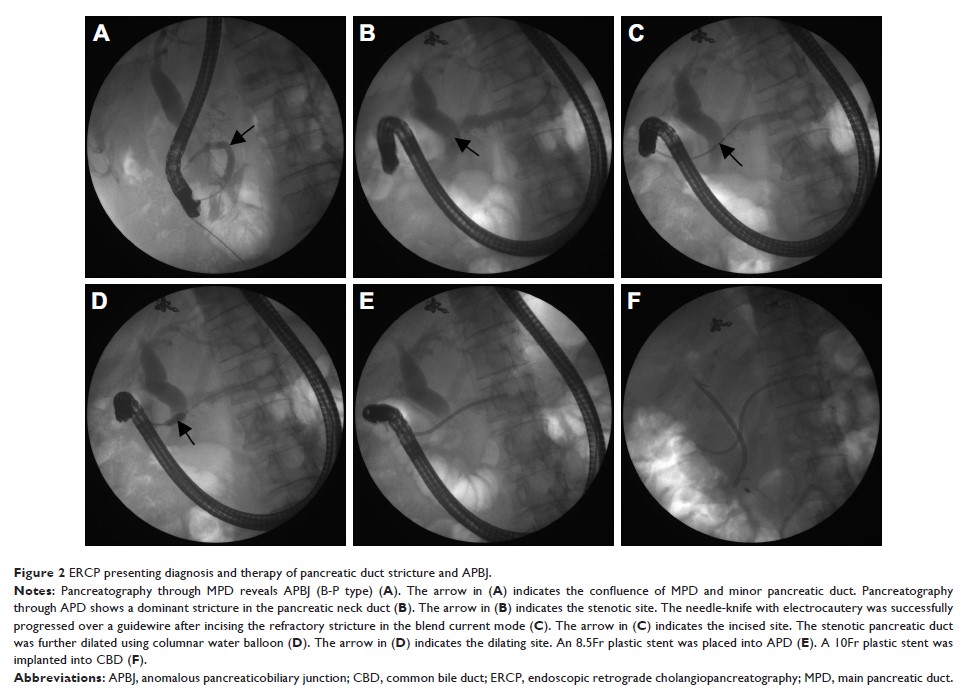
Here, we report a novel technique via accessory pancreatic duct (APD) approach
to simultaneously release chronic pancreatitis-associated pancreatic stricture
and correct anomalous pancreaticobiliary junction (APBJ). Due to APBJ and
stricture of proximal main pancreatic duct, the APD turned out to be
compensatory expansion. The stiff stenosis was dissected along the axial of APD
using needle-knife electrocautery or holmium laser ablation, and then the
supporting stent was placed into the pancreatic body duct. By doing so, the
outflow channels of pancreatic and biliary ducts were exquisitely separated.
Patients and methods: Two
patients aged 69 and 71 years underwent stricture dissection and stent
insertion for fluent drainage of pancreatic juice. The postoperative course was
marked by complete abdominal pain relief and normal blood amylase recovery. In
the first patient, wire-guided needle-knife electrocautery under fluoroscopic
control was applied to release refractory stricture. The second patient was
treated by SpyGlass pancreatoscopy-guided holmium laser ablation to lift
pancreatic stricture.
Results: Plastic
stents in APD were removed at 3 months after surgery, and magnetic resonance
imaging at 6 months showed strictly normal aspect of the pancreatic duct.
Conclusion: Although
both cases were successful without severe complications, we recommend this approach
only for selected patients with short refractory pancreatic strictures due to
chronic pancreatitis. In order to prevent severe complications (bleeding,
perforation or pancreatitis), direct-view endoscopy-guided electrotomy needs to
be developed.
Keywords: needle-knife
electrocautery, holmium laser ablation, pancreatic duct stricture, anomalous
pancreaticobiliary junction (APBJ), endoscopic retrograde
cholangiopancreatography (ERCP)