115195
论文已发表
注册即可获取德孚的最新动态
IF 收录期刊
- 3.6 Breast Cancer (Dove Med Press)
- 4.3 Clin Epidemiol
- 2.6 Cancer Manag Res
- 3.2 Infect Drug Resist
- 4.1 Clin Interv Aging
- 6.1 Drug Des Dev Ther
- 4.1 Int J Chronic Obstr
- 8.7 Int J Nanomed
- 2.5 Int J Women's Health
- 3.2 Neuropsych Dis Treat
- 2.4 OncoTargets Ther
- 2.6 Patient Prefer Adher
- 2.6 Ther Clin Risk Manag
- 3.1 J Pain Res
- 3.5 Diabet Metab Synd Ob
- 4.5 Psychol Res Behav Ma
- 3.4 Nat Sci Sleep
- 2.4 Pharmgenomics Pers Med
- 2.6 Risk Manag Healthc Policy
- 4.6 J Inflamm Res
- 2.3 Int J Gen Med
- 3.9 J Hepatocell Carcinoma
- 3.3 J Asthma Allergy
- 2.5 Clin Cosmet Investig Dermatol
- 3.0 J Multidiscip Healthc

用于止血微创手术的微通道输送药物释放系统
Authors Huang H, Liu H, Zhou H, Liang Z, Song D, Zhang Y, Huang W, Zhao X, Wu B, Ye G, Huang Y
Received 20 July 2018
Accepted for publication 7 December 2018
Published 12 March 2019 Volume 2019:13 Pages 881—896
DOI https://doi.org/10.2147/DDDT.S180842
Checked for plagiarism Yes
Review by Single-blind
Peer reviewers approved by Dr Amy Norman
Peer reviewer comments 2
Editor who approved publication: Dr Anastasios Lymperopoulos
Background: Sucrose
allyl ether (SAE) containing hemostatic drugs and a photoinitiator was
established to treat mild postpartum hemorrhage or long-term continuous
abnormal uterine bleeding in minimally invasive surgery (MIS) using a
photopolymerization method.
Methods and results: Real-time
infrared spectroscopy and rheological experiments showed that the SAE monomer
with shear-thinning characteristics could polymerize rapidly into a transparent
membrane. Cytotoxicity experiments in vitro showed that this system could
elicit a long-term hemostatic effect. Tissue adhesion was also evaluated. The
photo-stability of four delivered antifibrinolytic drugs (6-aminocaproic acid,
ethylenediaminediacetic acid, tranexamic acid and p-(aminomethyl) benzoic acid)
was tested by ultraviolet-photolysis experiments and illustrated by
time-dependent density functional theory. Sustained-release experiments
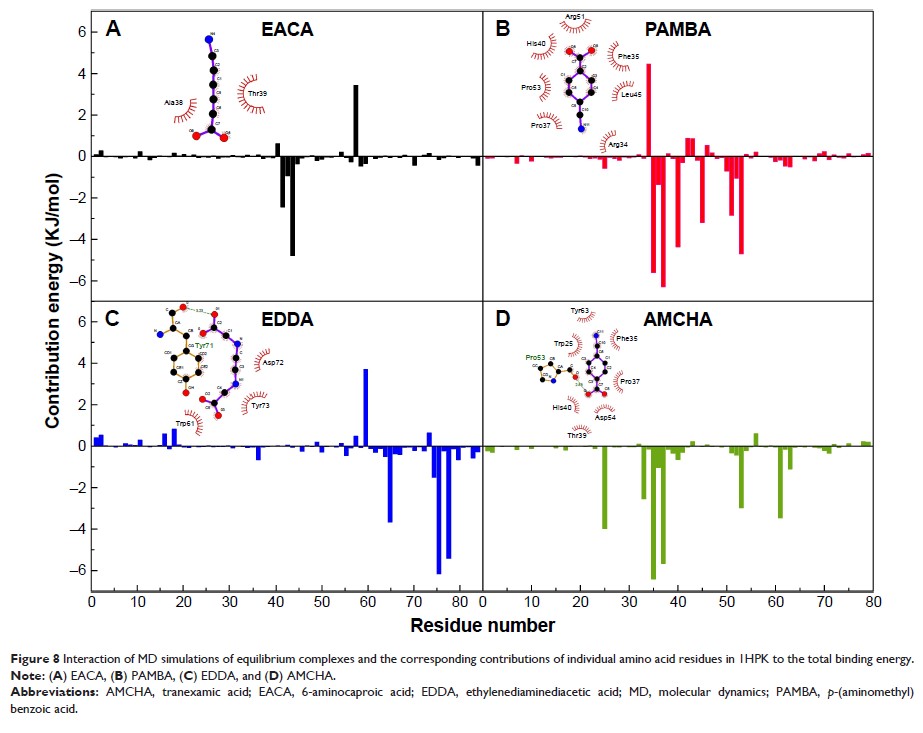
revealed that the formed film could be used as a drug carrier. Molecular
docking and molecular dynamics were done to investigate the binding mechanism
between hemostatic drugs as ligands and the human plasminogen kringle-1 (1HPK)
as a target.
Conclusion: It has
been suggested that SAE with tranexamic acid could be a drug-release system of
microchannel transport used in MIS. This system could tackle the dilemma of
fluidity and adhesion in MIS. The photo-stable tranexamic acid was the most
suitable drug according to its satisfactory binding energy, good
photo-stability, and sustained release.
Keywords: hemostasis,
photopolymerization, minimally invasive surgery, molecular simulation