115195
论文已发表
注册即可获取德孚的最新动态
IF 收录期刊
- 3.6 Breast Cancer (Dove Med Press)
- 4.3 Clin Epidemiol
- 2.6 Cancer Manag Res
- 3.2 Infect Drug Resist
- 4.1 Clin Interv Aging
- 6.1 Drug Des Dev Ther
- 4.1 Int J Chronic Obstr
- 8.7 Int J Nanomed
- 2.5 Int J Women's Health
- 3.2 Neuropsych Dis Treat
- 2.4 OncoTargets Ther
- 2.6 Patient Prefer Adher
- 2.6 Ther Clin Risk Manag
- 3.1 J Pain Res
- 3.5 Diabet Metab Synd Ob
- 4.5 Psychol Res Behav Ma
- 3.4 Nat Sci Sleep
- 2.4 Pharmgenomics Pers Med
- 2.6 Risk Manag Healthc Policy
- 4.6 J Inflamm Res
- 2.3 Int J Gen Med
- 3.9 J Hepatocell Carcinoma
- 3.3 J Asthma Allergy
- 2.5 Clin Cosmet Investig Dermatol
- 3.0 J Multidiscip Healthc

常压氧:一种治疗慢性脑循环功能不全的新方法
Authors Ding J, Zhou D, Liu C, Pan L, Ya J, Ding Y, Ji X, Meng R
Received 15 October 2018
Accepted for publication 14 January 2019
Published 14 March 2019 Volume 2019:14 Pages 565—570
DOI https://doi.org/10.2147/CIA.S190984
Checked for plagiarism Yes
Review by Single-blind
Peer reviewers approved by Dr Justinn Cochran
Peer reviewer comments 2
Editor who approved publication: Dr Zhi-Ying Wu
Abstract: Chronic
cerebral circulation insufficiency (CCCI) is viewed as an alarming state
induced by long-term reduction in cerebral perfusion, which is associated with
neurological deficits and high risk of stroke occurrence or recurrence. CCCI
accounts for a large proportion of both outpatients and inpatients with
cerebrovascular diseases, while management of CCCI remains a formidable
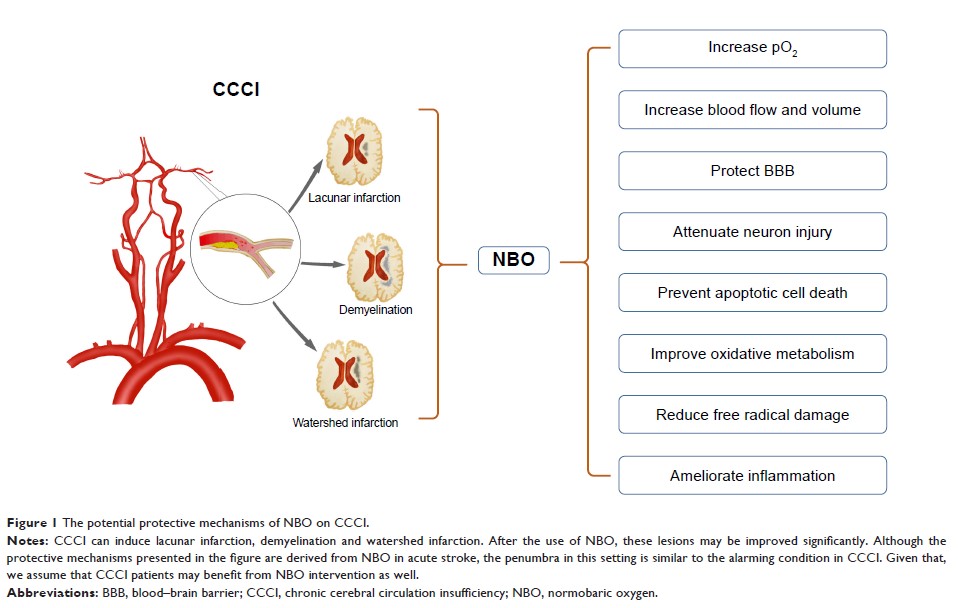
challenge to clinicians. Normobaric oxygen (NBO) is an adjuvant
hyperoxygenation intervention supplied with one atmosphere pressure (1 ATA
=101.325 kPa). A plethora of studies have demonstrated the efficacy of NBO on
the penumbra in acute stroke. NBO has been shown to increase the oxygen
pressure, raise the intracranial blood flow, protect blood–brain barrier and
enhance neuroprotective effects. As similar underlying mechanisms are shared by
the penumbra in stroke and the ischemic–hypoxic brain tissues in CCCI, we
speculate that NBO may serve as a promising therapeutic strategy for
attenuating short-term symptoms or improving long-term clinical outcomes among
patients with CCCI. Due to the scant research exploring the efficacy and safety
of NBO for treating CCCI so far, both experimental and clinical studies are
warranted to verify our hypothesis in the future.
Keywords: chronic
cerebral circulation insufficiency, normobaric oxygen, therapeutic strategy,
stroke, clinical outcome