115195
论文已发表
注册即可获取德孚的最新动态
IF 收录期刊
- 3.6 Breast Cancer (Dove Med Press)
- 4.3 Clin Epidemiol
- 2.6 Cancer Manag Res
- 3.2 Infect Drug Resist
- 4.1 Clin Interv Aging
- 6.1 Drug Des Dev Ther
- 4.1 Int J Chronic Obstr
- 8.7 Int J Nanomed
- 2.5 Int J Women's Health
- 3.2 Neuropsych Dis Treat
- 2.4 OncoTargets Ther
- 2.6 Patient Prefer Adher
- 2.6 Ther Clin Risk Manag
- 3.1 J Pain Res
- 3.5 Diabet Metab Synd Ob
- 4.5 Psychol Res Behav Ma
- 3.4 Nat Sci Sleep
- 2.4 Pharmgenomics Pers Med
- 2.6 Risk Manag Healthc Policy
- 4.6 J Inflamm Res
- 2.3 Int J Gen Med
- 3.9 J Hepatocell Carcinoma
- 3.3 J Asthma Allergy
- 2.5 Clin Cosmet Investig Dermatol
- 3.0 J Multidiscip Healthc

ABHD5 在子宫内膜癌中的致癌作用
Authors Zhou Q, Wang F, Zhou K, Huang K, Zhu Q, Luo X, Yu J, Shi Z
Received 25 September 2018
Accepted for publication 10 December 2018
Published 14 March 2019 Volume 2019:11 Pages 2139—2150
DOI https://doi.org/10.2147/CMAR.S188648
Checked for plagiarism Yes
Review by Single-blind
Peer reviewers approved by Dr Colin Mak
Peer reviewer comments 2
Editor who approved publication: Dr Antonella D'Anneo
Background: Abhydrolase
domain containing 5 (ABHD5) functions as a tumor suppressor in colorectal and
prostate cancers. The aim of this study was to investigate the roles of ABHD5
in endometrial cancer.
Materials and methods: ABHD5
expression was detected in clinical samples by immunohistochemical staining.
Cell proliferation and invasion were evaluated with the Cell Counting Kit-8 and
Transwell assay, respectively. Western blotting was performed to analyze
protein expression. Glucose uptake was assessed by 2-[N-(7-nitrobenz-2-oxa-1,3-diazol-4-yl)amino]-2-deoxyglucose.
Lactate production was detected by a lactate assay kit.
Results: In the
present study, ABHD5 was overexpressed in endometrial cancer tissues, and its
expression was closely correlated with the International Federation of
Gynecology and Obstetrics (FIGO) stage and lymph node metastasis. In addition,
we observed that the knockdown of ABHD5 inhibited cell proliferation, invasion,
glucose uptake and lactate production in HEC-1A cells, which expressed high
levels of ABHD5. Conversely, the opposite effects were observed when ABHD5 was
ectopically expressed in Ishikawa cells, which had low levels of ABHD5.
Furthermore, the changes in glycolysis regulators (enolase 1 [ENO1], glucose
transporter 1 [GLUT1] and lactate dehydrogenase A [LDHA]) and
epithelial-to-mesenchymal transition-related proteins (E-cadherin and Snail) in
HEC-1A cells with ABHD5 knockdown were consistent with the effects of ABHD5 on
glycolysis and cell invasion. Phosphatase and tensin homolog deleted on
chromosome 10 (PTEN) was increased, while the phosphorylated AKT (p-AKT) was
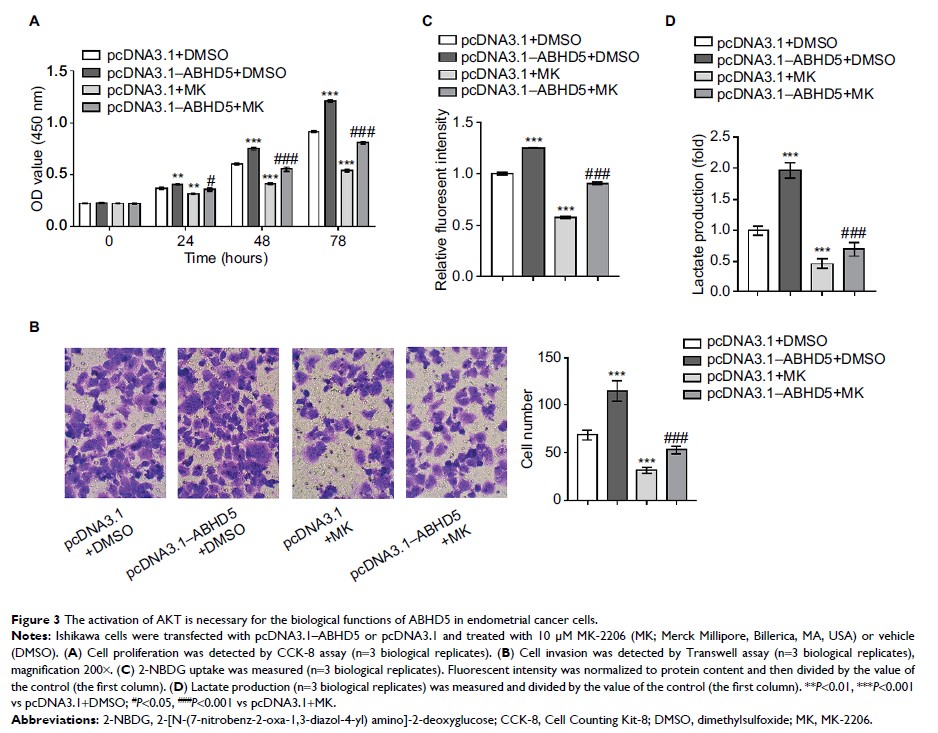
decreased when ABHD5 was downregulated. Notably, treatment with the allosteric
AKT inhibitor MK-2206 completely abolished the effects caused by ABHD5
overexpression in Ishikawa cells. Finally, ABHD5 knockdown potently suppressed
tumor growth in vivo.
Conclusion: Overall,
these results suggest that ABHD5 may play an oncogenic role in endometrial
cancer via the AKT pathway.
Keywords: ABHD5,
AKT, endometrial cancer, glycolysis