115195
论文已发表
注册即可获取德孚的最新动态
IF 收录期刊
- 3.6 Breast Cancer (Dove Med Press)
- 4.3 Clin Epidemiol
- 2.6 Cancer Manag Res
- 3.2 Infect Drug Resist
- 4.1 Clin Interv Aging
- 6.1 Drug Des Dev Ther
- 4.1 Int J Chronic Obstr
- 8.7 Int J Nanomed
- 2.5 Int J Women's Health
- 3.2 Neuropsych Dis Treat
- 2.4 OncoTargets Ther
- 2.6 Patient Prefer Adher
- 2.6 Ther Clin Risk Manag
- 3.1 J Pain Res
- 3.5 Diabet Metab Synd Ob
- 4.5 Psychol Res Behav Ma
- 3.4 Nat Sci Sleep
- 2.4 Pharmgenomics Pers Med
- 2.6 Risk Manag Healthc Policy
- 4.6 J Inflamm Res
- 2.3 Int J Gen Med
- 3.9 J Hepatocell Carcinoma
- 3.3 J Asthma Allergy
- 2.5 Clin Cosmet Investig Dermatol
- 3.0 J Multidiscip Healthc

GNL3 在骨肉瘤进展和转移中的致癌作用
Authors Li TY, Li L, Wu XY, Tian KX, Wang YZ
Received 20 November 2018
Accepted for publication 8 February 2019
Published 15 March 2019 Volume 2019:11 Pages 2179—2188
DOI https://doi.org/10.2147/CMAR.S195360
Checked for plagiarism Yes
Review by Single-blind
Peer reviewers approved by Dr Colin Mak
Peer reviewer comments 2
Editor who approved publication: Dr Chien-Feng Li
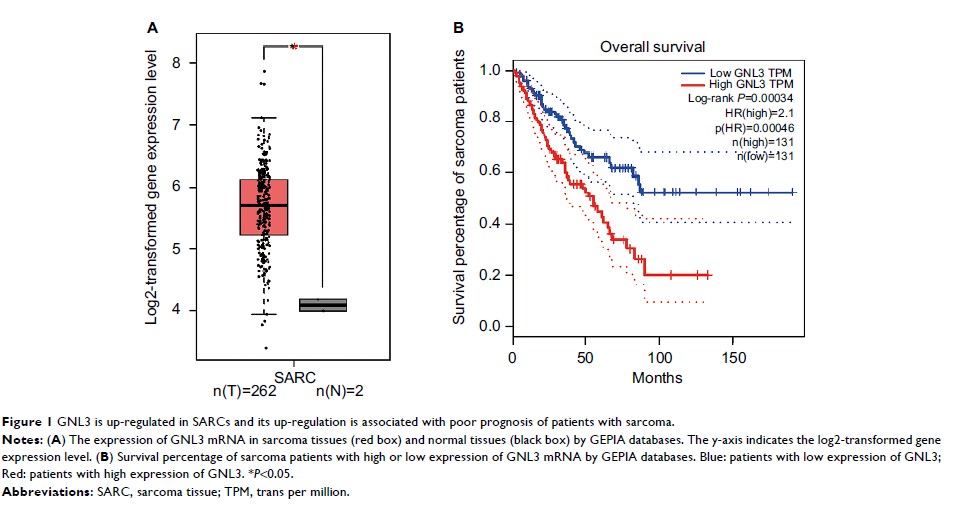
Background: GNL3 has
been reported to be up-regulated in cancers and function in tumor progression,
whereas the role of GNL3 in the progression of osteosarcoma remains
unclear.
Materials and methods: In this
study, we blocked the expression of GNL3 by siRNA interference in osteosarcoma
cell lines MG63 and U20S. CCK8, colony formation, wound-healing, Transwell,
flow cytometry, and Hoechst/PI staining assays were used to examine the effects
of GNL3 knockdown on cell proliferation, migration, invasion and apoptosis in
MG63 and U20S cells. The relative activity of MMP9 was detected using Gelatin
zymography assay. Western blot was performed to detect the expression of
related proteins.
Results: We found
that silencing of GNL3 reduced the growth, migration, and invasion abilities of
MG63 and U20S cells. Moreover, silencing GNL3 triggered cell cycle arrest in
MG63 and U20S cells, as well as promoted cell apoptosis. In addition, depletion
of GNL3 was observed to reduce the activity of MMP9 and suppress the process of
epithelial–mesenchymal transition (EMT) through up-regulation of E-cadherin and
down-regulation of N-cadherin. Furthermore, we found that X-box-binding protein
1 (XBP1) could bind to GNL3 using dual-luciferase reporter assay, and XBP1
overexpression could restore the inhibitory effects on proliferation, invasion,
and EMT in MG63 and U20S cells caused by GNL3 knockdown.
Conclusion: These
data suggest that GNL3 functions as an oncogene in the progression of
osteosarcoma by regulation of EMT, and XBP1 is also involved in its mechanism.
Keywords: G protein
nucleolar 3, GNL3, osteosarcoma, EMT, XBP1