115195
论文已发表
注册即可获取德孚的最新动态
IF 收录期刊
- 3.6 Breast Cancer (Dove Med Press)
- 4.3 Clin Epidemiol
- 2.6 Cancer Manag Res
- 3.2 Infect Drug Resist
- 4.1 Clin Interv Aging
- 6.1 Drug Des Dev Ther
- 4.1 Int J Chronic Obstr
- 8.7 Int J Nanomed
- 2.5 Int J Women's Health
- 3.2 Neuropsych Dis Treat
- 2.4 OncoTargets Ther
- 2.6 Patient Prefer Adher
- 2.6 Ther Clin Risk Manag
- 3.1 J Pain Res
- 3.5 Diabet Metab Synd Ob
- 4.5 Psychol Res Behav Ma
- 3.4 Nat Sci Sleep
- 2.4 Pharmgenomics Pers Med
- 2.6 Risk Manag Healthc Policy
- 4.6 J Inflamm Res
- 2.3 Int J Gen Med
- 3.9 J Hepatocell Carcinoma
- 3.3 J Asthma Allergy
- 2.5 Clin Cosmet Investig Dermatol
- 3.0 J Multidiscip Healthc

博士生抑郁和焦虑的患病率及相关因素:在自我效能与抑郁/焦虑的关联中师徒关系的中介效应
Authors Liu C, Wang L, Qi R, Wang W, Jia S, Shang D, Shao Y, Yu M, Zhu X, Yan S, Chang Q, Zhao Y
Received 19 November 2018
Accepted for publication 29 January 2019
Published 21 March 2019 Volume 2019:12 Pages 195—208
DOI https://doi.org/10.2147/PRBM.S195131
Checked for plagiarism Yes
Review by Single-blind
Peer reviewers approved by Dr Andrew Yee
Peer reviewer comments 2
Editor who approved publication: Professor Igor Elman
Purpose: Although
the mental health status of doctoral students deserves attention, few scholars
have paid attention to factors related to their mental health problems. We
aimed to investigate the prevalence of depression and anxiety in doctoral
students and examine possible associated factors. We further aimed to assess
whether mentoring relationships mediate the association between research
self-efficacy and depression/anxiety.
Methods: A
cross-sectional study was conducted among 325 doctoral students in a medical
university. The Patient Health Questionnaire 9 and Generalized Anxiety Disorder
7 scale were used to assess depression and anxiety. The Research Self-Efficacy
Scale was used to measure perceived ability to fulfill various research-related
activities. The Advisory Working Alliance Inventory-student version was used to
assess mentoring relationships. Linear hierarchical regression analyses were
performed to determine if any factors were significantly associated with
depression and anxiety. Asymptotic and resampling methods were used to examine
whether mentoring played a mediating role.
Results: Approximately
23.7% of participants showed signs of depression, and 20.0% showed signs of
anxiety. Grade in school was associated with the degree of depression. The
frequency of meeting with a mentor, difficulty in doctoral article publication,
and difficulty in balancing work–family–doctoral program was associated with
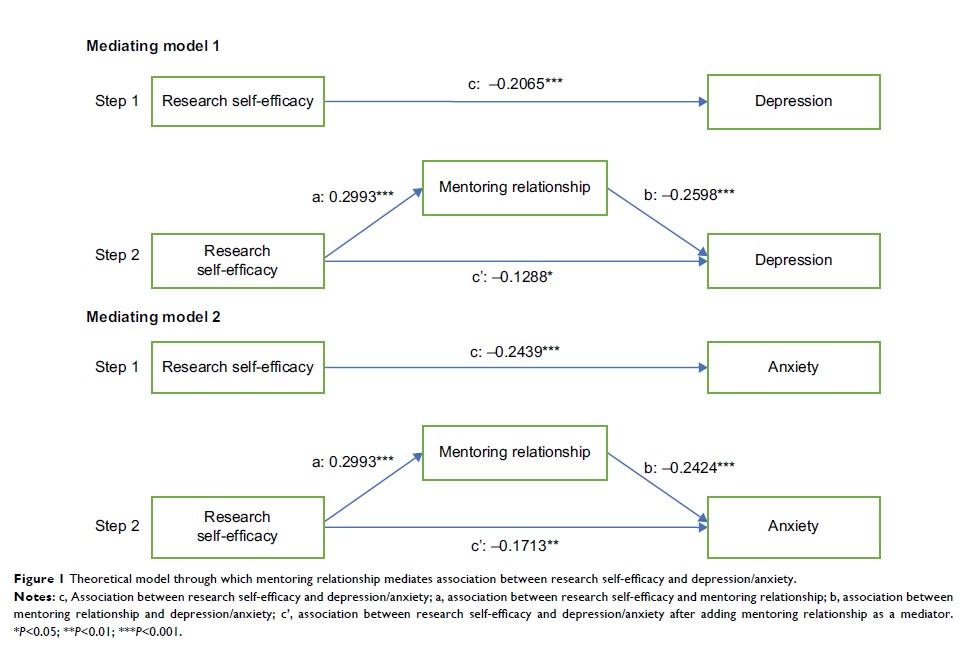
both the level of depression and anxiety. Moreover, research self-efficacy and
mentoring relationships had negative relationships with levels of depression
and anxiety. We also found that mentoring relationships mediated the
correlation between research self-efficacy and depression/anxiety.
Conclusion: The
findings suggest that educational experts should pay close attention to the mental
health of doctoral students. Active strategies and interventions that promote
research self-efficacy and mentoring relationships might be beneficial in
preventing or reducing depression and anxiety.
Keywords: mental
health, major depressive disorder, generalized anxiety disorder, Advisory
Working Alliance, research self-efficacy, doctoral students