117333
论文已发表
注册即可获取德孚的最新动态
IF 收录期刊
- 3.6 Breast Cancer (Dove Med Press)
- 4.3 Clin Epidemiol
- 2.6 Cancer Manag Res
- 3.2 Infect Drug Resist
- 4.1 Clin Interv Aging
- 6.1 Drug Des Dev Ther
- 4.1 Int J Chronic Obstr
- 8.7 Int J Nanomed
- 2.5 Int J Women's Health
- 3.2 Neuropsych Dis Treat
- 2.4 OncoTargets Ther
- 2.6 Patient Prefer Adher
- 2.6 Ther Clin Risk Manag
- 3.1 J Pain Res
- 3.5 Diabet Metab Synd Ob
- 4.5 Psychol Res Behav Ma
- 3.4 Nat Sci Sleep
- 2.4 Pharmgenomics Pers Med
- 2.6 Risk Manag Healthc Policy
- 4.6 J Inflamm Res
- 2.3 Int J Gen Med
- 3.9 J Hepatocell Carcinoma
- 3.3 J Asthma Allergy
- 2.5 Clin Cosmet Investig Dermatol
- 3.0 J Multidiscip Healthc

原发性肝细胞癌和肺转移患者的发病率、危险因素和预后:一个基于人口的研究
Authors Wu C, Ren X, Zhang Q
Received 31 October 2018
Accepted for publication 27 December 2018
Published 8 April 2019 Volume 2019:11 Pages 2759—2768
DOI https://doi.org/10.2147/CMAR.S192896
Checked for plagiarism Yes
Review by Single-blind
Peer reviewers approved by Dr Andrew Yee
Peer reviewer comments 2
Editor who approved publication: Professor Lu-Zhe Sun
Aims: The study
aims to explore the incidence, risk factors, and prognosis in patients with
primary hepatocellular carcinoma (HCC) and synchronous lung metastasis using a
large-scale population-based cancer registry database.
Patients and methods: Data of
33,177 HCC patients were retrieved from the Surveillance, Epidemiology, and End
Results (SEER) database from 2010 to 2015. Multivariate logistic and Cox
regression model analysis were applied for the recognition of risk factors and
prognostic factors associated with lung metastasis among HCC patients. The
overall survival and cancer-specific survival of HCC patients with initial
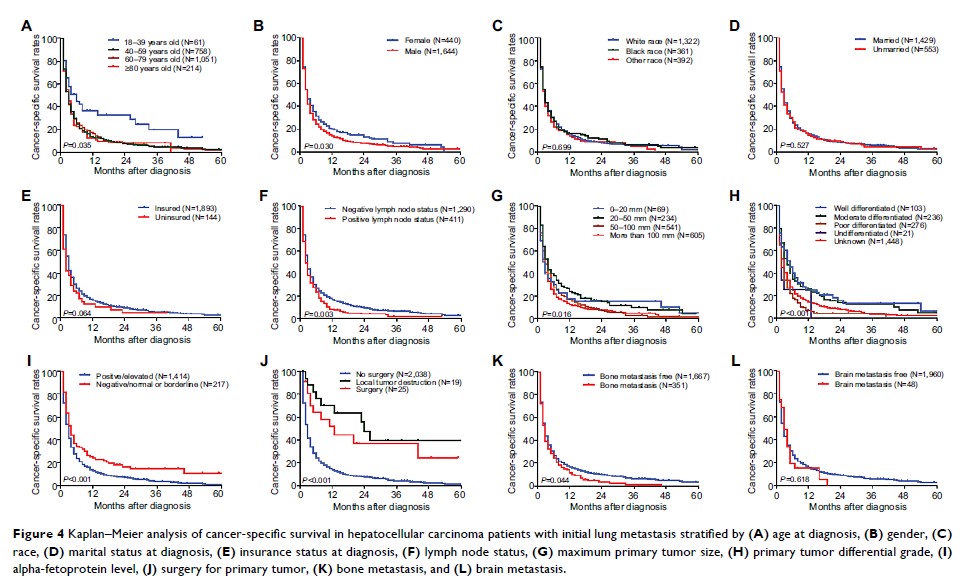
pulmonary metastasis were estimated by Kaplan–Meier analysis, and the survival
curves were compared by log-rank tests.
Results: Total
2,084 (6.28%) HCC patients diagnosed with initial pulmonary metastasis were
enrolled for analysis. Male gender, younger age, non-white race, unmarried
status, uninsured status, elevated alpha-fetoprotein, larger primary liver
tumor size, positive lymph node status, synchronal bone or brain metastasis,
and tumor poor pathological differentiation were relevant to higher risk of
lung metastasis in HCC cohort. The 1-, 3-, 5-year overall survival and
cancer-specific survival rates for HCC lung metastasis patients were 12.8% vs
15.3%, 4.0% vs 5.7%, and 1.6% versus 2.4%, respectively. The median overall and
cancer-specific survival time in HCC lung metastasis group were both 3 months,
while the corresponding time in HCC lung metastasis-free group were 19 and 25
months (P <0.05).
Older age, unmarried status, poor tumor differential grade, and absence of
surgery were identified as unfavorable prognosis factors.
Conclusion: The
survival of patients with HCC lung metastasis was dismal. Several
clinicopathological factors were found to be significantly relevant to the
development and prognosis of HCC lung metastasis. These new findings could be
useful for a precise and individualized therapeutic schedule.
Keywords: liver
cancer, lung metastasis, risk factor, prognosis factor, SEER