117333
论文已发表
注册即可获取德孚的最新动态
IF 收录期刊
- 3.6 Breast Cancer (Dove Med Press)
- 4.3 Clin Epidemiol
- 2.6 Cancer Manag Res
- 3.2 Infect Drug Resist
- 4.1 Clin Interv Aging
- 6.1 Drug Des Dev Ther
- 4.1 Int J Chronic Obstr
- 8.7 Int J Nanomed
- 2.5 Int J Women's Health
- 3.2 Neuropsych Dis Treat
- 2.4 OncoTargets Ther
- 2.6 Patient Prefer Adher
- 2.6 Ther Clin Risk Manag
- 3.1 J Pain Res
- 3.5 Diabet Metab Synd Ob
- 4.5 Psychol Res Behav Ma
- 3.4 Nat Sci Sleep
- 2.4 Pharmgenomics Pers Med
- 2.6 Risk Manag Healthc Policy
- 4.6 J Inflamm Res
- 2.3 Int J Gen Med
- 3.9 J Hepatocell Carcinoma
- 3.3 J Asthma Allergy
- 2.5 Clin Cosmet Investig Dermatol
- 3.0 J Multidiscip Healthc

长链非编码 RNA LINC00515 通过在人脑胶质瘤中模式涂抹 miR-16 和激活 PRMT5 表达促进细胞增殖并抑制细胞凋亡
Authors Wu Z, Lin Y
Received 13 December 2018
Accepted for publication 1 March 2019
Published 8 April 2019 Volume 2019:12 Pages 2595—2604
DOI https://doi.org/10.2147/OTT.S198087
Checked for plagiarism Yes
Review by Single-blind
Peer reviewers approved by Dr Amy Norman
Peer reviewer comments 2
Editor who approved publication: Dr Carlos E Vigil
Introduction: In recent
years, an increasing amount of literature has demonstrated the functional role
of long non-coding RNA (lncRNA) in human diseases. LINC00515 is a newly defined
lncRNA and is reported to act as an oncogene in multiple myeloma. However, the
function of LINC00515 in glioma is still uncertain.
Materials and methods: We
examined the expression levels of LINC00515 in human glioma tissues and cell
lines using real-time PCR analysis. In addition, we confirmed the distribution
of LINC00515 in glioma cells and suppressed LINC00515 expression with siRNAs.
CCK-8, colony formation assay and apoptosis analysis were used to study the
function of LINC00515 in glioma progression. Then, we used bioinformatics
prediction and subsequent experiments to reveal the underlying molecular
mechanism.
Results: We found
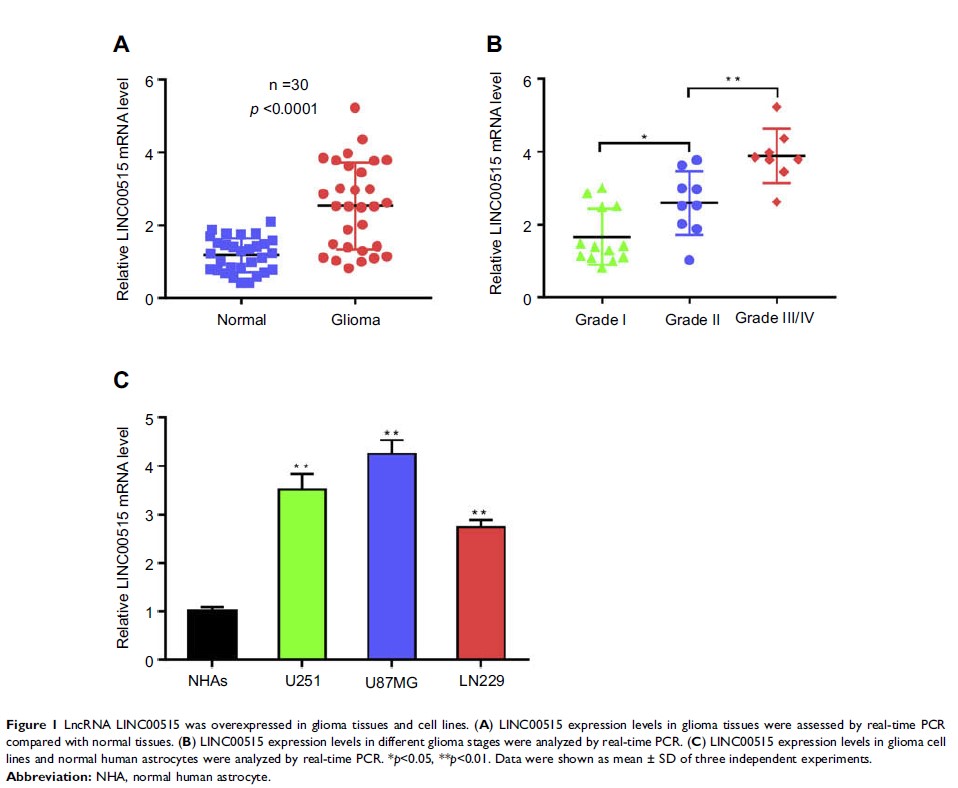
that LINC00515 was up-regulated in glioma tissues and cell lines. LINC00515 was
mainly located in the cytoplasm in glioma cells. Knockdown of LINC00515 led to
decreased proliferation and increased apoptosis of glioma cells.
Mechanistically, our data indicated that there was a LINC00515/miR-16/PRMT5
regulatory axis in glioma. LINC00515 could activate PRMT5 expression and
promote glioma progression by acting as a sponge of miR-16.
Conclusion: LINC00515
expression is elevated in human glioma and promotes growth and inhibits
apoptosis of glioma cells. The regulatory cascade LINC00515/miR-16/PRMT5 plays
a critical role in glioma progression.
Keywords: LINC00515,
miR-16, PRMT5, glioma