117333
论文已发表
注册即可获取德孚的最新动态
IF 收录期刊
- 3.6 Breast Cancer (Dove Med Press)
- 4.3 Clin Epidemiol
- 2.6 Cancer Manag Res
- 3.2 Infect Drug Resist
- 4.1 Clin Interv Aging
- 6.1 Drug Des Dev Ther
- 4.1 Int J Chronic Obstr
- 8.7 Int J Nanomed
- 2.5 Int J Women's Health
- 3.2 Neuropsych Dis Treat
- 2.4 OncoTargets Ther
- 2.6 Patient Prefer Adher
- 2.6 Ther Clin Risk Manag
- 3.1 J Pain Res
- 3.5 Diabet Metab Synd Ob
- 4.5 Psychol Res Behav Ma
- 3.4 Nat Sci Sleep
- 2.4 Pharmgenomics Pers Med
- 2.6 Risk Manag Healthc Policy
- 4.6 J Inflamm Res
- 2.3 Int J Gen Med
- 3.9 J Hepatocell Carcinoma
- 3.3 J Asthma Allergy
- 2.5 Clin Cosmet Investig Dermatol
- 3.0 J Multidiscip Healthc

依第八版肺癌 TNM 分期被确定为临床 IA 期非小细胞肺癌患者的固体和纯实体肿瘤的荟萃分析
Authors Jiang T, Li M, Lin M, Zhao M, Zhan C, Feng M
Received 30 November 2018
Accepted for publication 25 February 2019
Published 10 April 2019 Volume 2019:11 Pages 2951—2961
DOI https://doi.org/10.2147/CMAR.S196613
Checked for plagiarism Yes
Review by Single-blind
Peer reviewers approved by Dr Andrew Yee
Peer reviewer comments 2
Editor who approved publication: Professor Nakshatri
Objective: The aim
of the study was to compare the prognoses between part-solid and pure-solid
tumors for clinical stage IA non-small-cell lung cancer (NSCLC) patients in the
eighth edition TNM classification.
Methods: We
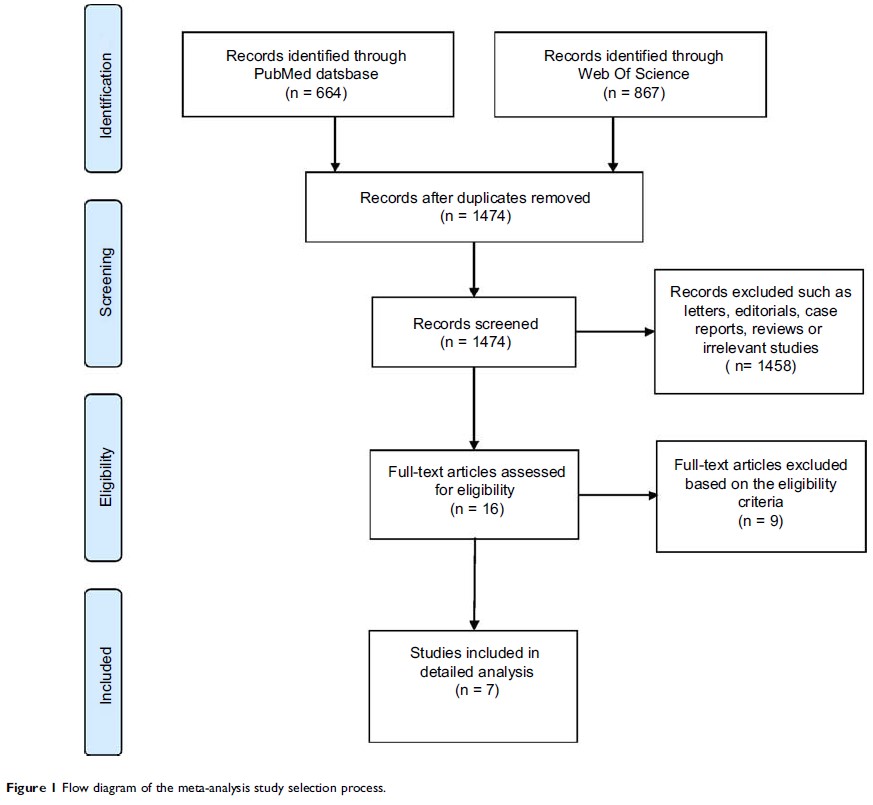
searched the literature in PubMed and Web of Science for all eligible articles
published before November 31, 2018. The pooled data included overall survival
(OS), disease-free survival (DFS) and recurrence-free survival (RFS). The
hazard ratio (HR) of OS (pure-solid/part-solid) was used as the measure of
differential effects. Pure-solid or part-solid tumors in all studies included
were matched according to the solid component size or according to the eighth
edition TNM classification.
Results: Seven
studies including 2,037 patients with c-stage IA NSCLC were pooled in the
meta-analysis. Patients with pure-solid tumors had significantly poorer OS (HR
1.69, 95% CI 1.21‒2.35, P =0.002), DFS (HR 1.27, 95% CI 1.07‒1.51, P =0.006) and RFS
(HR 1.74, 95% CI 1.08‒2.80, P =0.020). In subgroup analyses, when the meta-analysis
was limited to T1a-1b (≤2 cm) lung cancer, the prognosis for pure-solid tumors
was inferior to that for part-solid tumors regarding both OS and RFS. In
adenocarcinoma subgroup, there was no difference between the two groups in
terms of OS and RFS, but we detected a meaningful difference in DFS.
Conclusion: Part-solid
tumors may have a better prognosis than pure-solid tumors in clinical stage IA
patients according to the eighth edition TNM classification, and similar
results were found for the T1a-1b (≤2 cm) subgroup. There were no substantial
differences in OS and RFS between two groups in lung adenocarcinoma. However,
we detected a meaningful difference in DFS, which might also suggest a superior
prognosis for part-solid tumors. We propose that the part-solid and pure-solid
tumors in the same T component category be considered separately.
Keywords: part-solid,
pure-solid, stage IA, adenocarcinoma, lung cancer, meta-analysis