115195
论文已发表
注册即可获取德孚的最新动态
IF 收录期刊
- 3.6 Breast Cancer (Dove Med Press)
- 4.3 Clin Epidemiol
- 2.6 Cancer Manag Res
- 3.2 Infect Drug Resist
- 4.1 Clin Interv Aging
- 6.1 Drug Des Dev Ther
- 4.1 Int J Chronic Obstr
- 8.7 Int J Nanomed
- 2.5 Int J Women's Health
- 3.2 Neuropsych Dis Treat
- 2.4 OncoTargets Ther
- 2.6 Patient Prefer Adher
- 2.6 Ther Clin Risk Manag
- 3.1 J Pain Res
- 3.5 Diabet Metab Synd Ob
- 4.5 Psychol Res Behav Ma
- 3.4 Nat Sci Sleep
- 2.4 Pharmgenomics Pers Med
- 2.6 Risk Manag Healthc Policy
- 4.6 J Inflamm Res
- 2.3 Int J Gen Med
- 3.9 J Hepatocell Carcinoma
- 3.3 J Asthma Allergy
- 2.5 Clin Cosmet Investig Dermatol
- 3.0 J Multidiscip Healthc

包括胃癌腹膜转移的内脏脂肪区域的一个量化的风险评分系统
Authors Chen X, Chen W, Huang Y, Xu J, Zeng Y, Shi M, Xu L, Zhang W, Zhu G, Mao C, Shen X
Received 13 November 2018
Accepted for publication 26 February 2019
Published 10 April 2019 Volume 2019:11 Pages 2903—2913
DOI https://doi.org/10.2147/CMAR.S194356
Checked for plagiarism Yes
Review by Single-blind
Peer reviewers approved by Dr Andrew Yee
Peer reviewer comments 3
Editor who approved publication: Dr Chien-Feng Li
Background: Peritoneal
metastases of gastric cancer are usually detected using imaging, However, the
results of imaging modalities are not always reliable; therefore, the
prediction of prognosis based on these findings is therefore inaccurate. As
visceral obesity has been identified as a potential risk factor for cancer, the
present study aimed to evaluate the predictive value of visceral fat area
(VFA), a representative marker of visceral obesity, for peritoneal metastasis
in patients with gastric cancer and to construct a reliable preoperative
prediction system for peritoneal metastasis.
Patients and methods: We
enrolled 859 patients with gastric cancer. The VFA and other objective clinical
tumor characteristics were evaluated using receiver operating characteristic
(ROC) curves. Independent predictors of peritoneal metastasis were determined
using logistic regression analysis; a prediction system was also evaluated
using ROC curves.
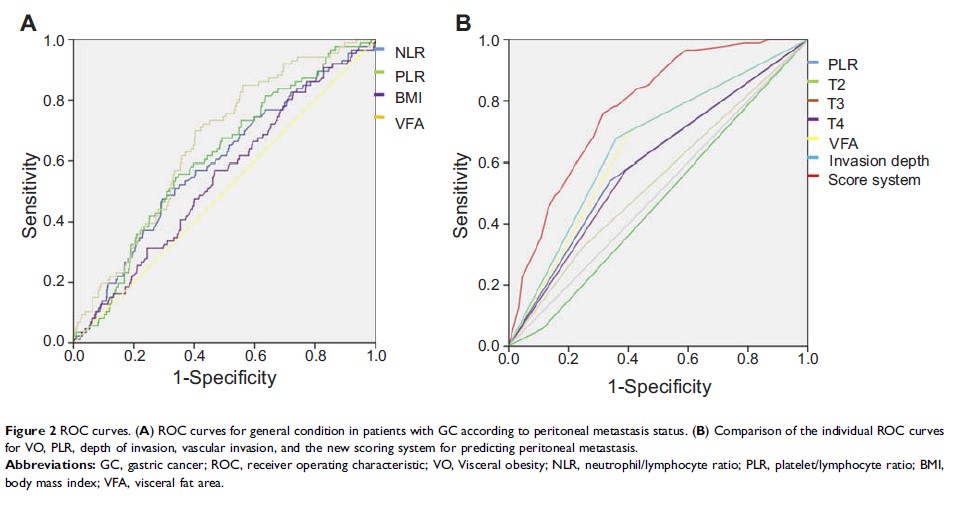
Results: The ROC
curves indicated a VFA cutoff value of 91.00 cm2 as
predictive of peritoneal metastasis. On logistic regression, visceral obesity
(VFA ≥91.00 cm2) was identified as an independent predictor of
peritoneal metastasis, with an area under the ROC curve of 0.659; the
platelet-to-lymphocyte ratio (PLR), invasion depth, and vascular invasion were
also identified as independent predictors. On integrating these predictors into
a single prediction system, peritoneal metastases were more reliably predicted
(area under the ROC curve=0.779).
Conclusions: Visceral
obesity, as defined by the VFA, effectively predicted peritoneal metastases in
our cohort. Our scoring system may be a reliable instrument for identifying
patients with peritoneal metastasis.
Keywords: gastric
cancer, peritoneal metastasis, visceral fat area, risk-scoring system