117333
论文已发表
注册即可获取德孚的最新动态
IF 收录期刊
- 3.6 Breast Cancer (Dove Med Press)
- 4.3 Clin Epidemiol
- 2.6 Cancer Manag Res
- 3.2 Infect Drug Resist
- 4.1 Clin Interv Aging
- 6.1 Drug Des Dev Ther
- 4.1 Int J Chronic Obstr
- 8.7 Int J Nanomed
- 2.5 Int J Women's Health
- 3.2 Neuropsych Dis Treat
- 2.4 OncoTargets Ther
- 2.6 Patient Prefer Adher
- 2.6 Ther Clin Risk Manag
- 3.1 J Pain Res
- 3.5 Diabet Metab Synd Ob
- 4.5 Psychol Res Behav Ma
- 3.4 Nat Sci Sleep
- 2.4 Pharmgenomics Pers Med
- 2.6 Risk Manag Healthc Policy
- 4.6 J Inflamm Res
- 2.3 Int J Gen Med
- 3.9 J Hepatocell Carcinoma
- 3.3 J Asthma Allergy
- 2.5 Clin Cosmet Investig Dermatol
- 3.0 J Multidiscip Healthc

大黄素在体外和体内增强紫杉醇对人非小细胞肺癌细胞的抗肿瘤作用
Authors Chen S, Zhang Z, Zhang J
Received 28 November 2018
Accepted for publication 4 March 2019
Published 10 April 2019 Volume 2019:13 Pages 1145—1153
DOI https://doi.org/10.2147/DDDT.S196319
Checked for plagiarism Yes
Review by Single-blind
Peer reviewers approved by Dr Andrew Yee
Peer reviewer comments 2
Editor who approved publication: Dr Qiongyu Guo
Background: Non-small-cell
lung cancer (NSCLC) was known as the most malignant tumor. Paclitaxel (PTX) is
the effective drug used for the treatment of NSCLC; however, it also exhibits
severe side effects. Emodin could induce apoptosis of NSCLC cells and serve as
a potential cancer therapeutic agent. However, the effects of combination of
emodin with PTX on NSCLC remain unclear. Thus, this study aimed to investigate
the effects of emodin in combination with PTX on A549 cells.
Materials and methods: The
effects of combination treatment on the proliferation, apoptosis and invasion
of NSCLC cells were evaluated by CCK-8, flow cytometric and TUNEL assays,
respectively. In addition, Western blotting was used to detect the expressions
of Bax, Bcl-2, active caspase 3, p-Akt and ERK in cells.
Results: Combination
of emodin with PTX synergistically inhibited the proliferation of A549 cells in
vitro. In addition, we found that emodin significantly enhanced PTX-induced
apoptosis in A549 cells via increasing the expressions of Bax and active
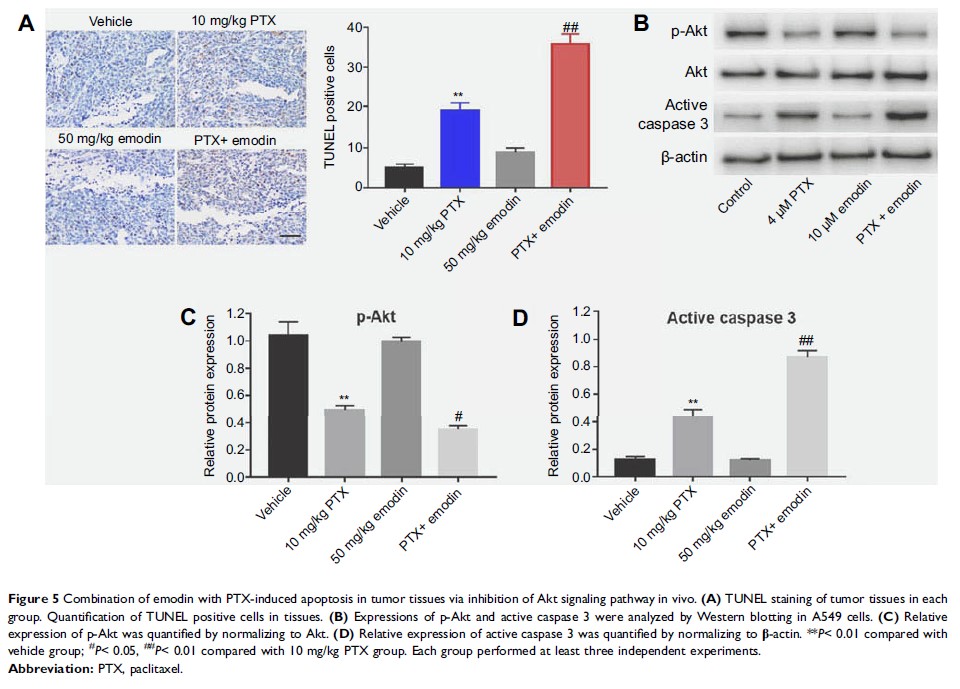
caspase 3 and decreasing the levels of Bcl-2, p-Akt and p-ERK. Moreover, emodin
markedly enhanced antitumor effect of PTX on A549 xenograft without significant
side effects in vivo.
Conclusion: Our
findings indicated that emodin could significantly enhance antitumor effect of
PTX in vitro and in vivo. Therefore, the combination of emodin with PTX may
serve as a potential strategy for the treatment of patients with NSCLC.
Keywords: non-small-cell
lung cancer, emodin, paclitaxel, apoptosis