117333
论文已发表
注册即可获取德孚的最新动态
IF 收录期刊
- 3.6 Breast Cancer (Dove Med Press)
- 4.3 Clin Epidemiol
- 2.6 Cancer Manag Res
- 3.2 Infect Drug Resist
- 4.1 Clin Interv Aging
- 6.1 Drug Des Dev Ther
- 4.1 Int J Chronic Obstr
- 8.7 Int J Nanomed
- 2.5 Int J Women's Health
- 3.2 Neuropsych Dis Treat
- 2.4 OncoTargets Ther
- 2.6 Patient Prefer Adher
- 2.6 Ther Clin Risk Manag
- 3.1 J Pain Res
- 3.5 Diabet Metab Synd Ob
- 4.5 Psychol Res Behav Ma
- 3.4 Nat Sci Sleep
- 2.4 Pharmgenomics Pers Med
- 2.6 Risk Manag Healthc Policy
- 4.6 J Inflamm Res
- 2.3 Int J Gen Med
- 3.9 J Hepatocell Carcinoma
- 3.3 J Asthma Allergy
- 2.5 Clin Cosmet Investig Dermatol
- 3.0 J Multidiscip Healthc

c-Met 过表达在膀胱癌中的临床病理学影响:来自 1,336 个病例的证据
Authors Xu X, Zhang G, He L, Zhu Y
Received 8 December 2018
Accepted for publication 19 February 2019
Published 10 April 2019 Volume 2019:12 Pages 2695—2702
DOI https://doi.org/10.2147/OTT.S197540
Checked for plagiarism Yes
Review by Single-blind
Peer reviewers approved by Dr Colin Mak
Peer reviewer comments 2
Editor who approved publication: Dr Sanjeev Srivastava
Background: The
clinicopathological impacts of c-Met overexpression in bladder cancer have been
investigated in several studies with conflicting results. We performed this
systematic review and meta-analysis to assess the pathologic and prognostic
roles of c-Met status in bladder cancer patients.
Methods: Eligible
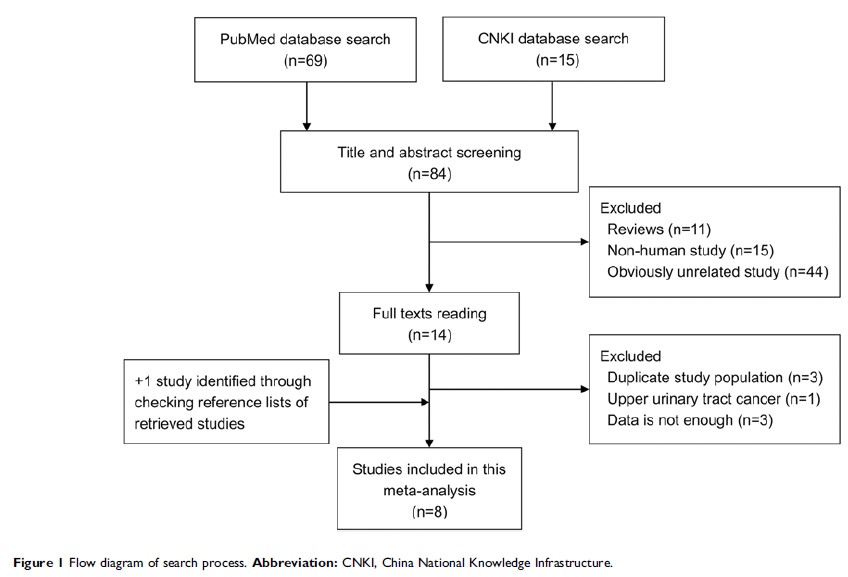
studies were searched and identified from the PubMed and China National
Knowledge Infrastructure (CNKI) databases (up until October 4, 2018). The
DerSimonian-Laird random-effects model was used to calculate the pooled risk
estimates.
Results: Eight
studies including 1,336 bladder cancer cases were eventually included in this
meta-analysis. We detected a significantly increased risk of poor overall
survival (OS) associated with the high expression of c-Met (HR=2.42, 95% CI
1.36–4.32). There was no association between c-Met status and nuclear grade
(OR=0.82, 95% CI 0.29–2.31) or tumor stage (OR=1.42, 95% CI 0.41–4.89).
Conclusion: This
study shows that the overexpression of c-Met in primary cancer tissues is
associated with a worse OS in human bladder cancer. However, larger studies
using standardized methods and criteria are warranted to verify these findings.
Keywords: bladder
cancer, c-Met, overall survival, meta-analysis