117333
论文已发表
注册即可获取德孚的最新动态
IF 收录期刊
- 3.6 Breast Cancer (Dove Med Press)
- 4.3 Clin Epidemiol
- 2.6 Cancer Manag Res
- 3.2 Infect Drug Resist
- 4.1 Clin Interv Aging
- 6.1 Drug Des Dev Ther
- 4.1 Int J Chronic Obstr
- 8.7 Int J Nanomed
- 2.5 Int J Women's Health
- 3.2 Neuropsych Dis Treat
- 2.4 OncoTargets Ther
- 2.6 Patient Prefer Adher
- 2.6 Ther Clin Risk Manag
- 3.1 J Pain Res
- 3.5 Diabet Metab Synd Ob
- 4.5 Psychol Res Behav Ma
- 3.4 Nat Sci Sleep
- 2.4 Pharmgenomics Pers Med
- 2.6 Risk Manag Healthc Policy
- 4.6 J Inflamm Res
- 2.3 Int J Gen Med
- 3.9 J Hepatocell Carcinoma
- 3.3 J Asthma Allergy
- 2.5 Clin Cosmet Investig Dermatol
- 3.0 J Multidiscip Healthc

Development and validation of the Patient’s Health Belief Questionnaire on Psychiatric Treatment
Authors De Las Cuevas C, de Leon J
Received 10 January 2019
Accepted for publication 23 February 2019
Published 10 April 2019 Volume 2019:13 Pages 527—536
DOI https://doi.org/10.2147/PPA.S201144
Checked for plagiarism Yes
Review by Single-blind
Peer reviewers approved by Ms Justinn Cochran
Peer reviewer comments 2
Editor who approved publication: Dr Johnny Chen
Background: Our
previous studies with regard to adherence to psychiatric medications measured
pharmacophobia, psychological reactance, and locus of control using a 42-item
questionnaire requiring ~1.5 hours for completion. This study aims to
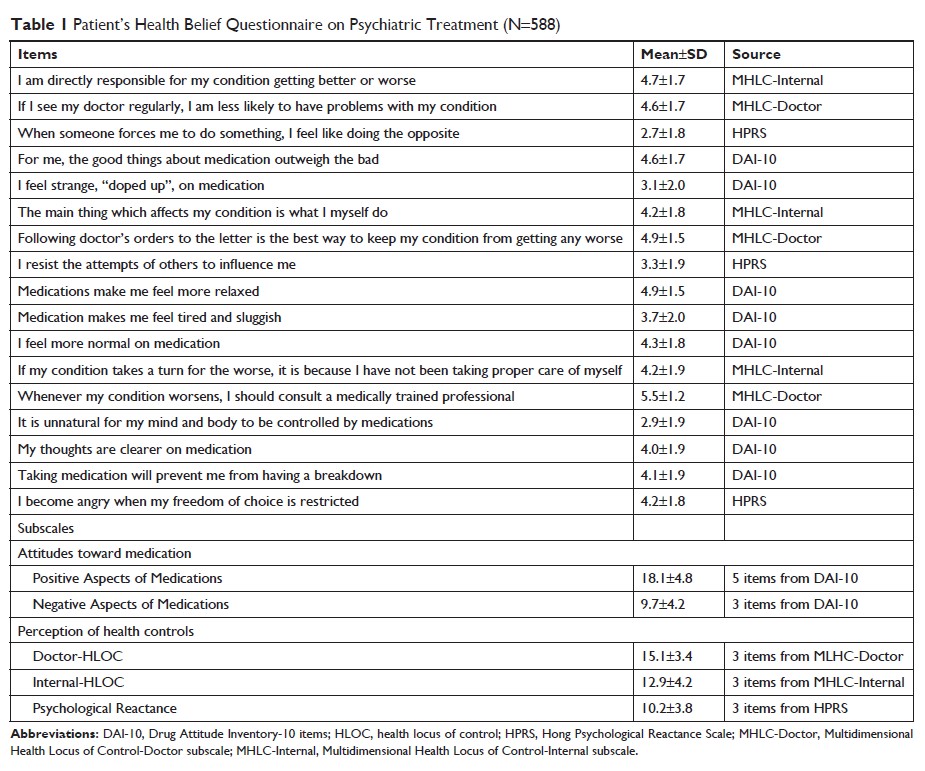
develop the Patient’s Health Belief Questionnaire on Psychiatric Treatment, a
17-item inventory which requires only 15 minutes to complete.
Methods: Our new
questionnaire with five subscales was based on 17 items from three previously
validated scales (on pharmacophobia, psychological reactance, and locus of
control). In 588 consecutive Spanish psychiatric outpatients taking 1,114
psychiatric medications, we studied the responses to the questionnaire; to
validate it, medication adherence was assessed by the Sidorkiewicz tool.
Results: Validation
of the construct was addressed by performing two exploratory factor analyses
independent of each other (one for the eight-item section measuring the
attitudes of patients toward psychotropic drugs and one for the nine-item
section measuring perceived health locus of control [HLOC]), which led to five
subscales that were called Positive and Negative Aspects of Medications,
Doctor-HLOC, Internal-HLOC, and Psychological Reactance. The five subscales
showed better internal consistency when corrected by number of items than the
original 17-item scale. Logistic regression models of the continuous scores,
dichotomized subscales, and Chi-squared Automatic Interaction Detector (CHAID)
analysis indicated that all five subscales help in predicting adequate
adherence, although the various subscales behave differently in different
analyses.
Conclusion: Future
studies need to verify and further extend the preliminary findings of this
study that the questionnaire may have construct and predictive validity.
Keywords: attitude
to health, medication adherence, health behavior, psychiatry