117333
论文已发表
注册即可获取德孚的最新动态
IF 收录期刊
- 3.6 Breast Cancer (Dove Med Press)
- 4.3 Clin Epidemiol
- 2.6 Cancer Manag Res
- 3.2 Infect Drug Resist
- 4.1 Clin Interv Aging
- 6.1 Drug Des Dev Ther
- 4.1 Int J Chronic Obstr
- 8.7 Int J Nanomed
- 2.5 Int J Women's Health
- 3.2 Neuropsych Dis Treat
- 2.4 OncoTargets Ther
- 2.6 Patient Prefer Adher
- 2.6 Ther Clin Risk Manag
- 3.1 J Pain Res
- 3.5 Diabet Metab Synd Ob
- 4.5 Psychol Res Behav Ma
- 3.4 Nat Sci Sleep
- 2.4 Pharmgenomics Pers Med
- 2.6 Risk Manag Healthc Policy
- 4.6 J Inflamm Res
- 2.3 Int J Gen Med
- 3.9 J Hepatocell Carcinoma
- 3.3 J Asthma Allergy
- 2.5 Clin Cosmet Investig Dermatol
- 3.0 J Multidiscip Healthc

胞质分裂 1 的特异性高表达对接受异基因造血干细胞移植的急性髓细胞白血病患者预后的不利影响
Authors Zhang G, Zhang J, Yang X, Zhang X, Yang S, Wang J, Hu K, Shi J, Ke X, Fu L
Received 31 October 2018
Accepted for publication 27 February 2019
Published 11 April 2019 Volume 2019:11 Pages 3053—3060
DOI https://doi.org/10.2147/CMAR.S192845
Checked for plagiarism Yes
Review by Single-blind
Peer reviewers approved by Dr Andrew Yee
Peer reviewer comments 3
Editor who approved publication: Dr Antonella D'Anneo
Background: Overexpression
of dedicator of cytokinesis 1 (DOCK 1) has been confirmed as an unfavorable prognostic
marker in acute myeloid leukemia (AML).
Purpose: This
study is to explore the clinical implications of DOCK1 on AML
patients underwent allogeneic hematopoietic stem cell transplantation
(allo-HSCT).
Patients and methods: We
analyzed 71 de novo AML patients treated with allo-HSCT and divided them into
two groups (DOCK1 high vs DOCK1 low) by the median
expression level of DOCK1 .
Results: High DOCK1 expression
was associated with older age (P =0.019), wild-type CEBPA (P =0.002), IDH1/2 mutations
(P =0.010) and RUNX1 mutation
(P =0.005).
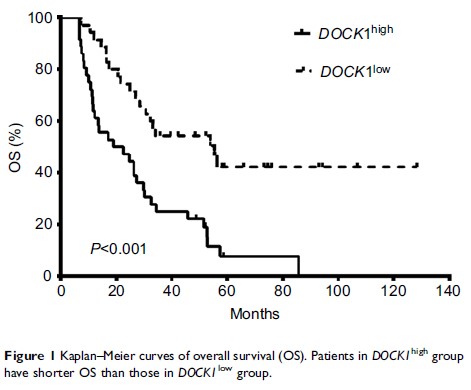
Univariate analyses showed that DOCK1 high and RUNX1 mutation
were associated with shorter OS (P <0.001, P =0.024). Multivariate analysis confirmed the negative
effect of high DOCK1 level on overall survival (P =0.010).
Conclusion: Our
results demonstrate that in AML patients who received allo-HSCT, high DOCK1 expression
might have a persistent negative prognostic impact post-transplant.
Keywords: acute
myeloid leukemia, allo-HSCT, DOCK1 , prognosis