115195
论文已发表
注册即可获取德孚的最新动态
IF 收录期刊
- 3.6 Breast Cancer (Dove Med Press)
- 4.3 Clin Epidemiol
- 2.6 Cancer Manag Res
- 3.2 Infect Drug Resist
- 4.1 Clin Interv Aging
- 6.1 Drug Des Dev Ther
- 4.1 Int J Chronic Obstr
- 8.7 Int J Nanomed
- 2.5 Int J Women's Health
- 3.2 Neuropsych Dis Treat
- 2.4 OncoTargets Ther
- 2.6 Patient Prefer Adher
- 2.6 Ther Clin Risk Manag
- 3.1 J Pain Res
- 3.5 Diabet Metab Synd Ob
- 4.5 Psychol Res Behav Ma
- 3.4 Nat Sci Sleep
- 2.4 Pharmgenomics Pers Med
- 2.6 Risk Manag Healthc Policy
- 4.6 J Inflamm Res
- 2.3 Int J Gen Med
- 3.9 J Hepatocell Carcinoma
- 3.3 J Asthma Allergy
- 2.5 Clin Cosmet Investig Dermatol
- 3.0 J Multidiscip Healthc

胶质瘤肿瘤中磷脂酶 A2 组 V 基因的过表达与患者预后不良有关
Authors Wu C, Su J, Wang X, Wang J, Xiao K, Li Y, Xiao Q, Ling M, Xiao Y, Qin C, Long W, Zhang F, Pan Y, Xiang F, Liu Q
Received 22 December 2018
Accepted for publication 17 March 2019
Published 11 April 2019 Volume 2019:11 Pages 3139—3152
DOI https://doi.org/10.2147/CMAR.S199207
Checked for plagiarism Yes
Review by Single-blind
Peer reviewers approved by Dr Amy Norman
Peer reviewer comments 2
Editor who approved publication: Professor Nakshatri
Purpose: Gliomas
are the most common primary malignant neoplasms of the central nervous system.
Secreted phospholipases A2 (sPLA2s) are known to play an important role in
various physiological processes, including bioactive lipid production, defense
mechanisms, and cell signaling. However, their roles and clinical importance in
gliomas remain unclear.
Patients and methods: In this
study, we analyzed the association between the expression of various
sPLA2-encoding genes and the clinicopathology of gliomas, using the data of
1047 patients obtained from a public database. Immunohistochemical analysis of
82 glioma tissues was also carried out to assess the relationship between
phospholipase A2 group V (PLA2G5) protein expression and the World Health
Organization (WHO) glioma grades.
Results: We found
that high PLA2G5 gene
expression was associated with unfavorable prognosis in both low-grade and
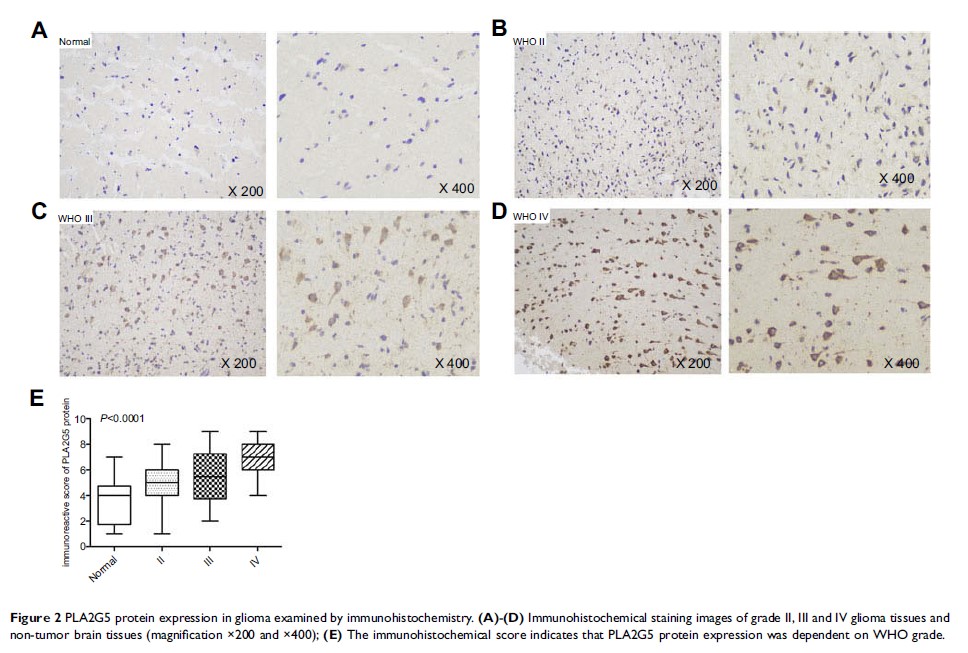
high-grade gliomas. The immunohistochemistry of the 82 glioma tissues further
confirmed that PLA2G5 protein expression was dependent on the WHO glioma grade.
In addition, we found a correlation between PLA2G5 gene
expression and both epithelial–mesenchymal transition and the isocitrate
dehydrogenase 1 mutation status in these tumors.
Conclusion: Our
results indicate that PLA2G5 could be a potential biomarker for predicting poor
prognosis in patients with gliomas.
Keywords: secretory
phospholipases A2, glioma, PLA2G5, biomarker