117333
论文已发表
注册即可获取德孚的最新动态
IF 收录期刊
- 3.6 Breast Cancer (Dove Med Press)
- 4.3 Clin Epidemiol
- 2.6 Cancer Manag Res
- 3.2 Infect Drug Resist
- 4.1 Clin Interv Aging
- 6.1 Drug Des Dev Ther
- 4.1 Int J Chronic Obstr
- 8.7 Int J Nanomed
- 2.5 Int J Women's Health
- 3.2 Neuropsych Dis Treat
- 2.4 OncoTargets Ther
- 2.6 Patient Prefer Adher
- 2.6 Ther Clin Risk Manag
- 3.1 J Pain Res
- 3.5 Diabet Metab Synd Ob
- 4.5 Psychol Res Behav Ma
- 3.4 Nat Sci Sleep
- 2.4 Pharmgenomics Pers Med
- 2.6 Risk Manag Healthc Policy
- 4.6 J Inflamm Res
- 2.3 Int J Gen Med
- 3.9 J Hepatocell Carcinoma
- 3.3 J Asthma Allergy
- 2.5 Clin Cosmet Investig Dermatol
- 3.0 J Multidiscip Healthc

肿瘤微环境中的斯钙素 1 促进卵巢癌的转移
Authors Yang Y, Yin S, Li S, Chen Y, Yang L
Received 27 November 2018
Accepted for publication 6 March 2019
Published 11 April 2019 Volume 2019:12 Pages 2789—2798
DOI https://doi.org/10.2147/OTT.S196150
Checked for plagiarism Yes
Review by Single-blind
Peer reviewers approved by Dr Andrew Yee
Peer reviewer comments 3
Editor who approved publication: Dr Leo Jen-Liang Su
Background: Tumor
metastasis is the major challenge for ovarian cancer treatment.
Cancer-associated fibroblasts (CAFs), a major component existing in tumor
microenvironment, can secrete several cytokines to interact with cancer
epithelial cells, and promote cancer metastasis. Stanniocalcin 1 (STC1), a
secretory glycoprotein hormone, has been proven to be an important factor in
ovarian tumorigenesis.
Methods: In this study,
we focused on the functional role of STC1 in ovarian cancer microenvironment, investigated
STC1’s effects on the proliferation and metastasis of ovarian cancer cells, and
explored the molecular mechanism underlying STC1-mediated cancer metastasis.
Results: By analyzing
the GEO dataset and examined STC1 expression in CAFs isolated from ovarian
cancer patients, we found that expression of STC1 was higher in ovarian cancer
stroma and CAFs than in the normal ovarian stroma and normal fibroblasts (NFs).
Addition of recombinant human STC1 (rhSTC1) promoted cell proliferation and
metastasis in ovarian cancer, while adoption of STC1 neutralizing antibody
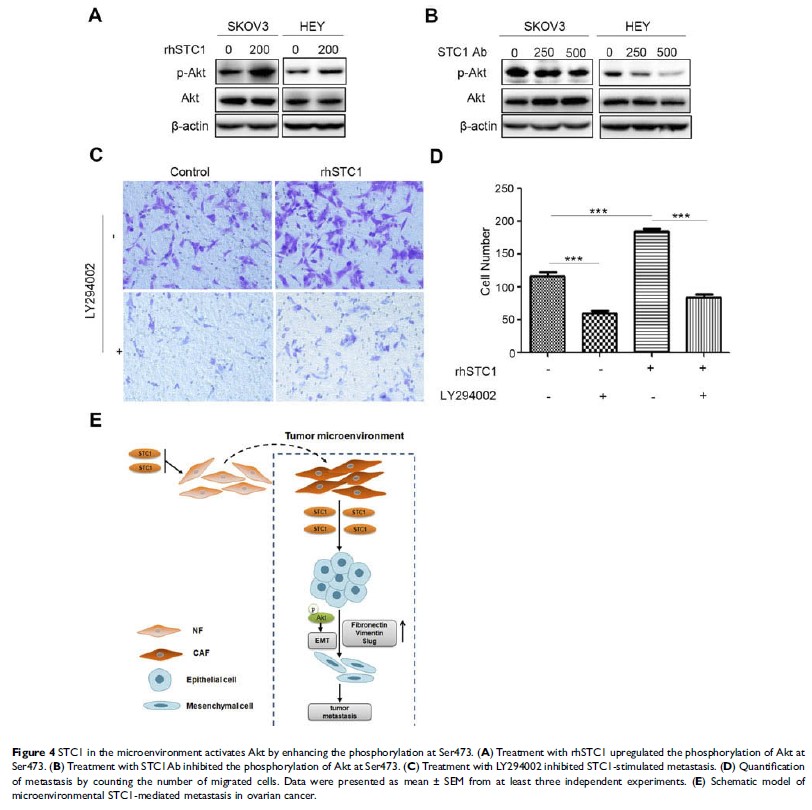
(STC1 Ab) abolished the effects. Furthermore, our results revealed that STC1
promoted the phosphorylation of Akt (Ser473), and upregulated several
epithelial–mesenchymal transition (EMT) markers including fibronectin,vimentin and slug. In addition, we demonstrated that STC1 in
tumor microenvironment could mediate the conversion of NFs to CAFs.
Conclusion: Taken together,
the study results suggested the crucial role of STC1 in tumor environment on
the metastasis of ovarian cancer.
Keywords: STC1,
tumor microenvironment, CAFs, EMT, metastasis