117333
论文已发表
注册即可获取德孚的最新动态
IF 收录期刊
- 3.6 Breast Cancer (Dove Med Press)
- 4.3 Clin Epidemiol
- 2.6 Cancer Manag Res
- 3.2 Infect Drug Resist
- 4.1 Clin Interv Aging
- 6.1 Drug Des Dev Ther
- 4.1 Int J Chronic Obstr
- 8.7 Int J Nanomed
- 2.5 Int J Women's Health
- 3.2 Neuropsych Dis Treat
- 2.4 OncoTargets Ther
- 2.6 Patient Prefer Adher
- 2.6 Ther Clin Risk Manag
- 3.1 J Pain Res
- 3.5 Diabet Metab Synd Ob
- 4.5 Psychol Res Behav Ma
- 3.4 Nat Sci Sleep
- 2.4 Pharmgenomics Pers Med
- 2.6 Risk Manag Healthc Policy
- 4.6 J Inflamm Res
- 2.3 Int J Gen Med
- 3.9 J Hepatocell Carcinoma
- 3.3 J Asthma Allergy
- 2.5 Clin Cosmet Investig Dermatol
- 3.0 J Multidiscip Healthc

SIRT6 通过活性氧物质促进乳头状甲状腺癌细胞 BCPAP 的 Warburg 效应
Authors Yu W, Yang Z, Huang R, Min Z, Ye M
Received 12 November 2018
Accepted for publication 12 March 2019
Published 15 April 2019 Volume 2019:12 Pages 2861—2868
DOI https://doi.org/10.2147/OTT.S194256
Checked for plagiarism Yes
Review by Single-blind
Peer reviewers approved by Dr Amy Norman
Peer reviewer comments 2
Editor who approved publication: Dr Gaetano Romano
Purpose: Our
previous study demonstrated that SIRT6 is upregulated in papillary thyroid
cancer (PTC) and enhances tumor aggressiveness. In this study, we further
researched its influence in the Warburg effect.
Methods: SIRT6-upregulated
and downregulated BCPAP cells and negative control BCPAP-NC groups were
generated with lentiviral vectors. In these two cell lines, reactive oxygen
species (ROS) were detected by dichlorodihydrofluorescein diacetate. Expression
of the key Warburg effect genes including GLUT1, HK2, GAPDH, PGK1, ENO1, PKM2
and LDHA was measured by quantitative real-time PCR and western blotting.
Glucose uptake, lactate production and the ATP content of cells were detected
with assay kits. The ROS scavenger N -acetylcysteine was used for treatment of
BCPAP-SIRT6, and the same measurements as described above were detected again.
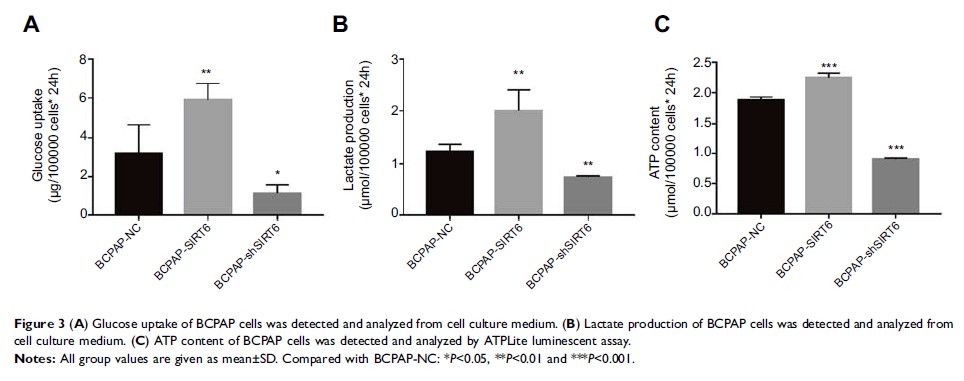
Results: Compared
with the BCPAP-NC group, expression of the key Warburg effect genes including
Glut1, HK2 and GAPDH and their protein products was upregulated in the
BCPAP-SIRT6 group, whereas BCPAP-shSIRT6 showed significant downregulation.
Meanwhile, ROS, glucose uptake, lactate production and ATP content of the
BCPAP-SIRT6 group were also significantly increased, and BCPAP-shSIRT6 showed
significant downregulation. Furthermore, upregulation of key Warburg effect
genes and glucose uptake, lactate production and ATP content were all rescued
after treatment with ROS scavenger.
Conclusion: SIRT6
promoted the Warburg effect of PTC cells via upregulation of ROS. Inhibition of
ROS in SIRT6-upregulated cells could rescue activation of the Warburg effect.
Keywords: sirtuin
6, Warburg effect, reactive oxygen species, papillary thyroid cancer