117333
论文已发表
注册即可获取德孚的最新动态
IF 收录期刊
- 3.6 Breast Cancer (Dove Med Press)
- 4.3 Clin Epidemiol
- 2.6 Cancer Manag Res
- 3.2 Infect Drug Resist
- 4.1 Clin Interv Aging
- 6.1 Drug Des Dev Ther
- 4.1 Int J Chronic Obstr
- 8.7 Int J Nanomed
- 2.5 Int J Women's Health
- 3.2 Neuropsych Dis Treat
- 2.4 OncoTargets Ther
- 2.6 Patient Prefer Adher
- 2.6 Ther Clin Risk Manag
- 3.1 J Pain Res
- 3.5 Diabet Metab Synd Ob
- 4.5 Psychol Res Behav Ma
- 3.4 Nat Sci Sleep
- 2.4 Pharmgenomics Pers Med
- 2.6 Risk Manag Healthc Policy
- 4.6 J Inflamm Res
- 2.3 Int J Gen Med
- 3.9 J Hepatocell Carcinoma
- 3.3 J Asthma Allergy
- 2.5 Clin Cosmet Investig Dermatol
- 3.0 J Multidiscip Healthc

改变原发性痛经女性低频波动幅度(ALFF)与局部脑血流量(rCBF):静息状态 fMRI 和动脉自旋标记研究
Authors Zhang YN, Huo JW, Huang YR, Hao Y, Chen ZY
Received 17 June 2018
Accepted for publication 14 February 2019
Published 16 April 2019 Volume 2019:12 Pages 1243—1250
DOI https://doi.org/10.2147/JPR.S177502
Checked for plagiarism Yes
Review by Single-blind
Peer reviewers approved by Dr Amy Norman
Peer reviewer comments 2
Editor who approved publication: Dr Michael Ueberall
Purpose: The
current study aimed to explore the central mechanism of primary dysmenorrhea
(PD) by investigating the alterations in resting state amplitude of low-frequency
fluctuation (ALFF) and regional cerebral blood flow (CBF) between PD patients
and healthy controls (HCs).
Patients and methods: A total
of 34 female subjects including 20 PD patients and 14 HCs underwent
resting-state functional magnetic resonance imaging (rs-fMRI) and arterial spin
labeling technique (ASL) MRI during menstrual phase. Subsequently, the
differences in ALFF and CBF were compared in the two groups. The visual analog
scores for pain (VAS-P) and for anxiety (VAS-A) were applied to assess cramping
pain and related symptoms in PD patients. Finally, Pearson’s correlation
analysis was performed to analyze relationships between the neuroimaging
findings and clinical characteristics.
Results: Compared
to HCs, PD patients had decreased ALFF in the right cerebellum posterior lobe,
right middle temporal gyrus, right parahippocampal gyrus, right hippocampus,
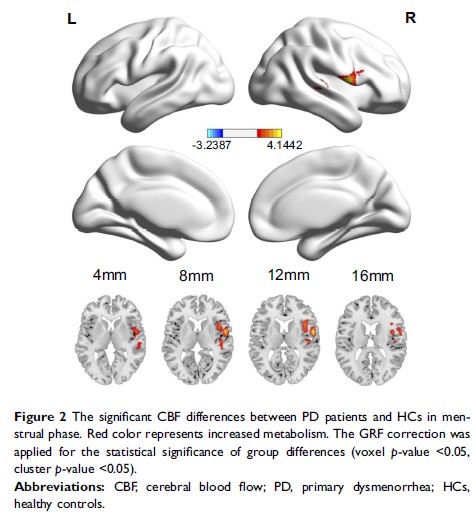
right brainstem and left parietal lobe. In addition, elevated CBF values were
observed in the right inferior frontal gyrus, right precentral gyrus, and right
superior temporal gyrus. There was no significant correlation between ALFF, CBF
values and clinical characteristics including onset age of dysmenorrhea, VAS-A,
and VAS-P in PD patients.
Conclusion: The
preliminary alterations of ALFF and CBF values in PD patients were observed in
different pain-related brain regions, which were involved in multiple
dimensions of pain and pain modulation. The combination of rs-fMRI and ASL MRI
might provide complementary information for a better understanding of the
central mechanism in PD.
Keywords: primary
dysmenorrhea, resting state functional magnetic resonance imaging, amplitude of
low frequency fluctuation, arterial spin labeling, cerebral blood flow