117333
论文已发表
注册即可获取德孚的最新动态
IF 收录期刊
- 3.6 Breast Cancer (Dove Med Press)
- 4.3 Clin Epidemiol
- 2.6 Cancer Manag Res
- 3.2 Infect Drug Resist
- 4.1 Clin Interv Aging
- 6.1 Drug Des Dev Ther
- 4.1 Int J Chronic Obstr
- 8.7 Int J Nanomed
- 2.5 Int J Women's Health
- 3.2 Neuropsych Dis Treat
- 2.4 OncoTargets Ther
- 2.6 Patient Prefer Adher
- 2.6 Ther Clin Risk Manag
- 3.1 J Pain Res
- 3.5 Diabet Metab Synd Ob
- 4.5 Psychol Res Behav Ma
- 3.4 Nat Sci Sleep
- 2.4 Pharmgenomics Pers Med
- 2.6 Risk Manag Healthc Policy
- 4.6 J Inflamm Res
- 2.3 Int J Gen Med
- 3.9 J Hepatocell Carcinoma
- 3.3 J Asthma Allergy
- 2.5 Clin Cosmet Investig Dermatol
- 3.0 J Multidiscip Healthc

胚胎干细胞微环境中 Notch 信号通路参与对结直肠癌的抑制
Authors Lan G, Lin Z, Zhang J, Liu L, Zhang J, Zheng L, Luo Q
Received 20 December 2018
Accepted for publication 13 March 2019
Published 16 April 2019 Volume 2019:12 Pages 2869—2878
DOI https://doi.org/10.2147/OTT.S199046
Checked for plagiarism Yes
Review by Single-blind
Peer reviewers approved by Dr Amy Norman
Peer reviewer comments 2
Editor who approved publication: Dr Sanjeev Srivastava
Objectives: Recently,
embryonic microenvironment is being known for its non-permissive property for
tumor growth. However, the regulatory mechanism to maintain the balance between
differentiation and tumorigenicity of cancer cell in microenvironment is not
well understood.
Materials and Methods: qRT-PCR
was performed to detect the levels of gene expression in HT29, LoVo and Caco-2
colorectal cancer cells, and Western blot was used to measure the protein
levels. Cell migration and apoptosis were measured by Transwell and flow
cytometry assays. Cancer cell markers were detected using immunohistochemical
staining. In vivo tumor formation assay was conducted by subcutaneous injection
of embryonic microenvironment-treated cancer cells.
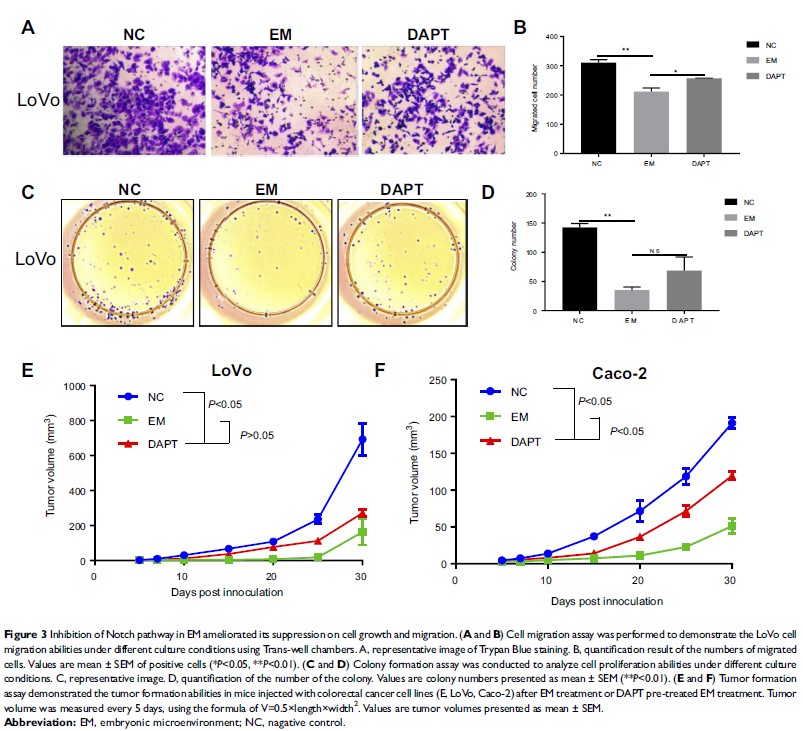
Results: Colorectal
cancer cell lines were treated with human embryonic stem cell conditioned
culture and then collected for in vivo tumor formation assay and in vitro
assays assessing the aggressive properties. We found exposure of cancer cells
in human ES cultures resulted in inhibition of growth, migration of tumor
cells. Moreover, we found that manipulation of Notch pathway in the ES cells
microenvironment could influence the stemness of tumor. We specifically
discovered that some factor in the embryonic microenvironment could suppress
Notch1 pathway in the cancer cells, leading to a reduction in tumorigenesis and
invasiveness.
Conclusions: This
study may provide another evidence to understand the crosstalk between tumor
cells and embryonic environment and may offer new therapeutic strategies to
inhibit colorectal cancer progression.
Keywords: embryonic
stem cell microenvironment, colorectal cancer, tumorigenicity, Notch pathway