117333
论文已发表
注册即可获取德孚的最新动态
IF 收录期刊
- 3.6 Breast Cancer (Dove Med Press)
- 4.3 Clin Epidemiol
- 2.6 Cancer Manag Res
- 3.2 Infect Drug Resist
- 4.1 Clin Interv Aging
- 6.1 Drug Des Dev Ther
- 4.1 Int J Chronic Obstr
- 8.7 Int J Nanomed
- 2.5 Int J Women's Health
- 3.2 Neuropsych Dis Treat
- 2.4 OncoTargets Ther
- 2.6 Patient Prefer Adher
- 2.6 Ther Clin Risk Manag
- 3.1 J Pain Res
- 3.5 Diabet Metab Synd Ob
- 4.5 Psychol Res Behav Ma
- 3.4 Nat Sci Sleep
- 2.4 Pharmgenomics Pers Med
- 2.6 Risk Manag Healthc Policy
- 4.6 J Inflamm Res
- 2.3 Int J Gen Med
- 3.9 J Hepatocell Carcinoma
- 3.3 J Asthma Allergy
- 2.5 Clin Cosmet Investig Dermatol
- 3.0 J Multidiscip Healthc

早期症状不改善和恶化与 MDD 对 SSRI 治疗的反应有关:现实世界的研究
Authors Yuan H, Zhu X, Luo Q, Halim A, Halim M, Yao H, Cai Y, Shi S
Received 30 November 2018
Accepted for publication 20 February 2019
Published 16 April 2019 Volume 2019:15 Pages 957—966
DOI https://doi.org/10.2147/NDT.S196533
Checked for plagiarism Yes
Review by Single-blind
Peer reviewers approved by Dr Colin Mak
Peer reviewer comments 2
Editor who approved publication: Dr Jun Chen
Purpose: Early improvement in major depressive
disorder is defined as a reduction of ≥20% in the 17-item Hamilton Depression
Rating Scale (HAM-D-17) score at the second week after initiation of treatment,
predicting long-term treatment response. However, there remains no effective
strategy for switching medications when a patient fails to reach early
improvement at the second week. This study focused on the predictive value of
early symptom changes in each item of the HAM-D-17 scale for treatment response
to selective serotonin reuptake inhibitor (SSRI) monotherapy and to provide a
reference for switching antidepressants to enhance early treatment efficacy.
Patients and methods: Our study was an observational, real-world study that enrolled 90
treatment-naïve patients experiencing their first episode of major depressive
disorder in the outpatient department of Huashan Hospital. Patients who did not
achieve the threshold of early improvement in the second week after starting
treatment were switched to alternative SSRI monotherapy. Patient follow-up
occurred at 2, 4, 8, and 12 weeks after the initiation of treatment. We
analyzed the relationship between the change in each symptom on the HAM-D-17
scale and treatment efficacy.
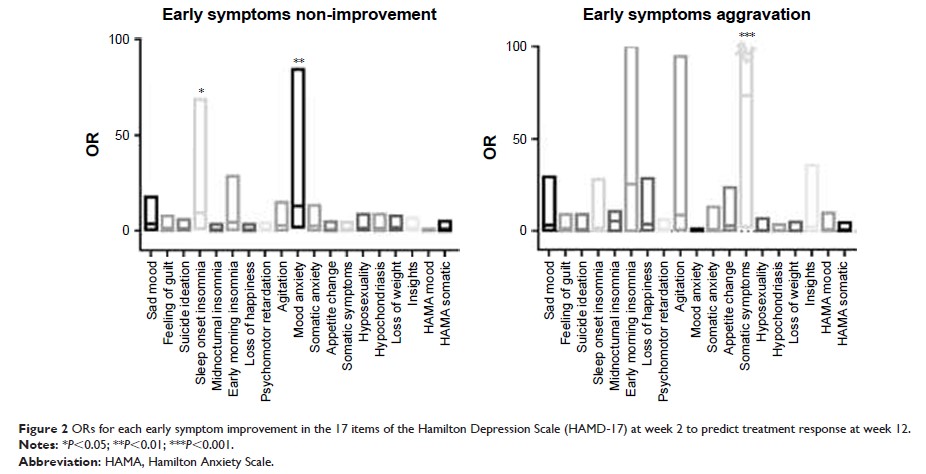
Results: Early
improvement predicted the treatment response at 12 weeks (χ 2=19.249, P <0.001), whereas early non-improvement in insomnia
and anxiety was associated with a poor response (OR =9.487, 95% CI:
1.312–68.588 and OR =12.947, 95% CI: 1.99–82.246, respectively). At week 2,
general somatic symptom aggravation was associated with a poorer response (OR
=73.337, 95% CI: 2.232->999.999); treatment-emergent headache and tremor
were associated with treatment efficacy (t=-9.521, P <0.001 and
t=3.660, P =0.001,
respectively). In addition, the increase in suicidal thoughts, once treatment
began, had no relationship with the treatment response (OR =0.821, P =0.872).
Conclusion: This
study suggested that patients with early non-improvement in insomnia and
anxiety were not suitable for switches in SSRI monotherapy. Patients with
treatment-emergent symptoms, especially headaches and tremors, were not
suitable for switching from monotherapy to another SSRI.
Keywords: early
improvement, major depressive disorder, antidepressants, selective serotonin
reuptake inhibitors