117333
论文已发表
注册即可获取德孚的最新动态
IF 收录期刊
- 3.6 Breast Cancer (Dove Med Press)
- 4.3 Clin Epidemiol
- 2.6 Cancer Manag Res
- 3.2 Infect Drug Resist
- 4.1 Clin Interv Aging
- 6.1 Drug Des Dev Ther
- 4.1 Int J Chronic Obstr
- 8.7 Int J Nanomed
- 2.5 Int J Women's Health
- 3.2 Neuropsych Dis Treat
- 2.4 OncoTargets Ther
- 2.6 Patient Prefer Adher
- 2.6 Ther Clin Risk Manag
- 3.1 J Pain Res
- 3.5 Diabet Metab Synd Ob
- 4.5 Psychol Res Behav Ma
- 3.4 Nat Sci Sleep
- 2.4 Pharmgenomics Pers Med
- 2.6 Risk Manag Healthc Policy
- 4.6 J Inflamm Res
- 2.3 Int J Gen Med
- 3.9 J Hepatocell Carcinoma
- 3.3 J Asthma Allergy
- 2.5 Clin Cosmet Investig Dermatol
- 3.0 J Multidiscip Healthc

MiR-145 通过靶向人胶质母细胞瘤中的 Smad2 抑制 EGF 诱导的上皮 - 间质转化
Authors Chen W, Huang B, Wang E, Wang X
Received 18 January 2019
Accepted for publication 7 March 2019
Published 23 April 2019 Volume 2019:12 Pages 3099—3107
DOI https://doi.org/10.2147/OTT.S202129
Checked for plagiarism Yes
Review by Single-blind
Peer reviewers approved by Ms Rachel Predeepa
Peer reviewer comments 2
Editor who approved publication: Dr Federico Perche
Background/Aims: MiR-145
and Smad2 have been widely reported in the development and progression of human
malignancies. In the present study, we investigated the correlation between
miR-145 and Smad2 in human glioblastoma multiforme (GBM).
Methods: The
epithelial–mesenchymal transition (EMT) biomarkers and Smad2 were assessed by
Western blot. The silencing of Smad2 was conducted by transfection of Smad2
siRNAs. The cell migration and invasion were evaluated using Transwell assays,
respectively. The dual luciferase reporter assay was performed to identify
whether Smad2 is a direct target of miR-145.
Results: The
epidermal growth factor (EGF) activated the phosphorylation of Smad2 in U87 and
U251 cells in a time- and dose-dependent manner. However, treatment with
silencing of Smad2 or overexpression of miR-145 significantly inhibited the
expressions of total Smad2, N-cadherin, Vimentin and matrix metallopeptidase 9,
but induced the expression of E-cadherin. In addition, silencing of Smad2 or
overexpression of miR-145 also inhibited the migration and invasion of U87 and
U251 cells. Mechanistically, Smad2 was confirmed to be a target gene of miR-145
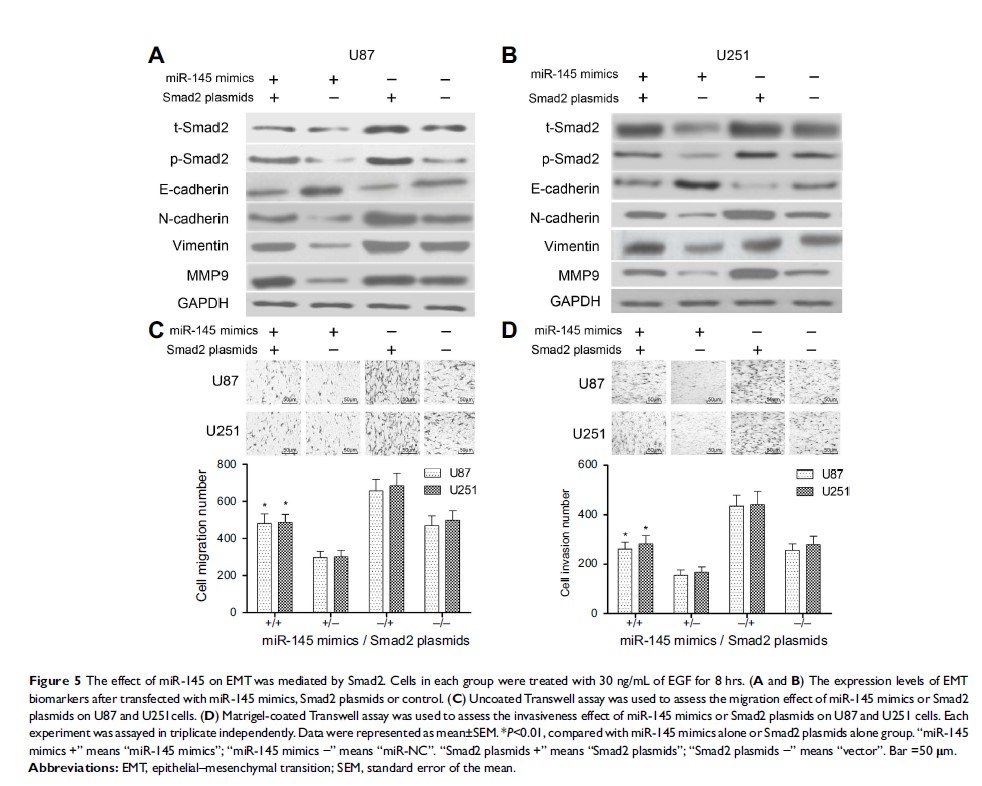
by bioinformatics analysis and luciferase reporter assay. Restored Smad2
expression also reversed miR-145-induced inhibition of EMT in U87 and U251
cells.
Conclusion: MiR-145
inhibits EGF-induced EMT via targeting Smad2 in human GBM. Therefore, miR-145
may be a promising biomarker and therapeutic target for GBM patients.
Keywords: MiR-145,
Smad2, EGF, GBM, EMT