117333
论文已发表
注册即可获取德孚的最新动态
IF 收录期刊
- 3.6 Breast Cancer (Dove Med Press)
- 4.3 Clin Epidemiol
- 2.6 Cancer Manag Res
- 3.2 Infect Drug Resist
- 4.1 Clin Interv Aging
- 6.1 Drug Des Dev Ther
- 4.1 Int J Chronic Obstr
- 8.7 Int J Nanomed
- 2.5 Int J Women's Health
- 3.2 Neuropsych Dis Treat
- 2.4 OncoTargets Ther
- 2.6 Patient Prefer Adher
- 2.6 Ther Clin Risk Manag
- 3.1 J Pain Res
- 3.5 Diabet Metab Synd Ob
- 4.5 Psychol Res Behav Ma
- 3.4 Nat Sci Sleep
- 2.4 Pharmgenomics Pers Med
- 2.6 Risk Manag Healthc Policy
- 4.6 J Inflamm Res
- 2.3 Int J Gen Med
- 3.9 J Hepatocell Carcinoma
- 3.3 J Asthma Allergy
- 2.5 Clin Cosmet Investig Dermatol
- 3.0 J Multidiscip Healthc

SNHG1 在人类癌症中的表达水平和临床意义:荟萃分析
Authors Yu Y, Yang J, Yang S, Li Q, Zhang M, Wang L, Ji G, Miao L
Received 21 August 2018
Accepted for publication 11 March 2019
Published 24 April 2019 Volume 2019:12 Pages 3119—3127
DOI https://doi.org/10.2147/OTT.S184803
Checked for plagiarism Yes
Review by Single-blind
Peer reviewers approved by Dr Colin Mak
Peer reviewer comments 3
Editor who approved publication: Dr Sanjeev Srivastava
Background: As
reported by numerous research studies, the expression levels of SNHG1 (small
nucleolar RNA host gene 1) are increased in different kinds of tumours,
revealing that SNHG1 is likely to perform a crucial function in
cancer prevalence and progression. Moreover, a mounting degree of evidence suggests
that increased SNHG1 expression also has an association with
poor medical outcomes among cancer patients.
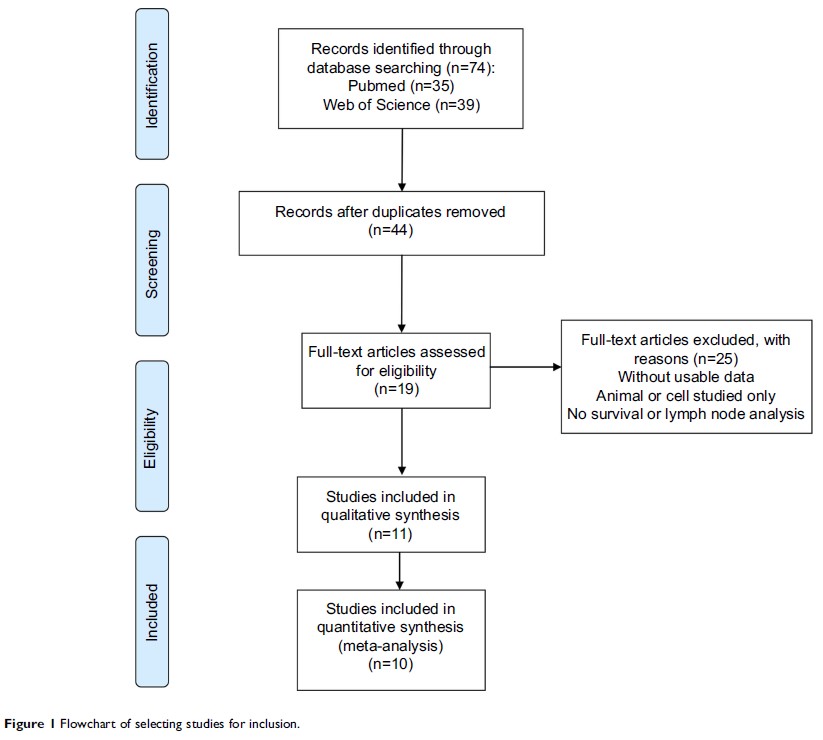
Materials and methods: Collection
of qualifying research studies was performed through the retrieval of keywords
in PubMed and Web of Science, up to March 20, 2018. This quantitative
meta-analysis was carried out using Stata SE12.0 software and aimed at
exploring the connection between the expression level of SNHG1 and
clinicopathology.
Results: Ten
research studies, involving an aggregate of 715 patients, met the inclusion
criteria. As suggested by the findings of the current meta-analysis, with
regard to prognosis, the patients with high expression of SNHG1 had
poorer overall survival (OS) (HR =3.36, 95% CI: 2.42, 4.67) and, with
regard to their clinicopathology, increased SNHG1 was
associated with advanced TNM stage (RR =1.88, 95% CI: 1.58, 2.24), poorly
differentiated histological grade (RR =1.38, 95% CI:1.09, 1.76), and positive
lymph node metastasis (RR =1.80, 95% CI: 1.42, 2.29).
Conclusion: As
revealed by this meta-analysis, elevated SNHG1 expression
is typical in various types of cancer. In addition, elevated SNHG1 expression
is likely to function as an advanced predictive element of poor prognosis and
lymph node metastasis in various cancer types. Nonetheless, to date, it remains
essential to carry out larger-size and better-designed research studies for the
confirmation of our findings.
Keywords: SNHG1,
cancer, prognosis, meta-analysis