117333
论文已发表
注册即可获取德孚的最新动态
IF 收录期刊
- 3.6 Breast Cancer (Dove Med Press)
- 4.3 Clin Epidemiol
- 2.6 Cancer Manag Res
- 3.2 Infect Drug Resist
- 4.1 Clin Interv Aging
- 6.1 Drug Des Dev Ther
- 4.1 Int J Chronic Obstr
- 8.7 Int J Nanomed
- 2.5 Int J Women's Health
- 3.2 Neuropsych Dis Treat
- 2.4 OncoTargets Ther
- 2.6 Patient Prefer Adher
- 2.6 Ther Clin Risk Manag
- 3.1 J Pain Res
- 3.5 Diabet Metab Synd Ob
- 4.5 Psychol Res Behav Ma
- 3.4 Nat Sci Sleep
- 2.4 Pharmgenomics Pers Med
- 2.6 Risk Manag Healthc Policy
- 4.6 J Inflamm Res
- 2.3 Int J Gen Med
- 3.9 J Hepatocell Carcinoma
- 3.3 J Asthma Allergy
- 2.5 Clin Cosmet Investig Dermatol
- 3.0 J Multidiscip Healthc

脆弱与心踝血管指数之间的关联
Authors Xue Q, Qin MZ, Jia J, Liu JP, Wang Y
Received 18 November 2018
Accepted for publication 17 February 2019
Published 26 April 2019 Volume 2019:14 Pages 735—742
DOI https://doi.org/10.2147/CIA.S195109
Checked for plagiarism Yes
Review by Single-blind
Peer reviewers approved by Ms Justinn Cochran
Peer reviewer comments 2
Editor who approved publication: Dr Zhi-Ying Wu
Purpose: Frailty
and atherosclerotic diseases are prevalent among the older people and usually
present the same pathogenesis and risk factors. Therefore, the aim of this
study was to determine the association between frailty and atherosclerosis.
Patients and methods: The
enrolled participants were 171 patients aged 60–96 years in Beijing
Tongren Hospital. Data that were collected included sex, age, height, weight,
calculated body mass index (BMI), past medical history, comorbidities
(including hypertension, coronary heart disease [CHD], and diabetes), ability
to perform activities of daily living (ADL) as measured using the Barthel
index, handgrip strength, 15-feet (4.57 m) walking speed, body composition
features determined by bioelectrical impedance analysis, the ankle–brachial
index (ABI), and atherosclerosis determined by the cardio-ankle vascular index
(CAVI). Patients were divided into frail, pre-frail, and non-frail groups using
Fried’s frailty index. ANOVA was used to assess the differences among these
groups. Linear correlation analysis was used to examine the relationship
between the CAVI and frailty phenotype. Ordinal multivariate logistic
regression analysis was used to examine the factors affecting frailty and the
relationship between frailty and atherosclerosis.
Results: The
population was categorized as 21.3% frail, 38.4% pre-frail, and 40.3%
non-frail. Patients in the frail group were older, had lower handgrip strength,
slower walking speed, and a lower ABI and a higher proportion of carotid
intima-media thickening with values of at least 1 mm compared with those
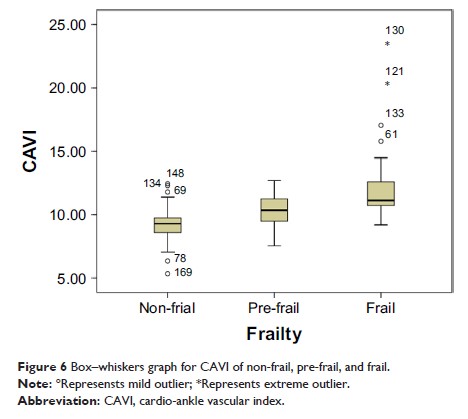
in the pre-frail and non-frail groups. The CAVI score was higher in the frail
group than that in the other two groups. There were significant inverse linear
correlations between grip strength, walking speed, and the CAVI. CAVI showed an
independent risk factor for frailty (OR: 2.013, 95% CI 1.498–2.703, p <0.001).
Conclusion: Our study
shows that arterial stiffness is associated with frailty in older patients,
even when adjusting for multiple factors.
Keywords: frailty,
atherosclerosis, CAVI, age