117333
论文已发表
注册即可获取德孚的最新动态
IF 收录期刊
- 3.6 Breast Cancer (Dove Med Press)
- 4.3 Clin Epidemiol
- 2.6 Cancer Manag Res
- 3.2 Infect Drug Resist
- 4.1 Clin Interv Aging
- 6.1 Drug Des Dev Ther
- 4.1 Int J Chronic Obstr
- 8.7 Int J Nanomed
- 2.5 Int J Women's Health
- 3.2 Neuropsych Dis Treat
- 2.4 OncoTargets Ther
- 2.6 Patient Prefer Adher
- 2.6 Ther Clin Risk Manag
- 3.1 J Pain Res
- 3.5 Diabet Metab Synd Ob
- 4.5 Psychol Res Behav Ma
- 3.4 Nat Sci Sleep
- 2.4 Pharmgenomics Pers Med
- 2.6 Risk Manag Healthc Policy
- 4.6 J Inflamm Res
- 2.3 Int J Gen Med
- 3.9 J Hepatocell Carcinoma
- 3.3 J Asthma Allergy
- 2.5 Clin Cosmet Investig Dermatol
- 3.0 J Multidiscip Healthc

在颈部环电切除术中的人体乳头瘤病毒 DNA 手术烟雾及其对外科医生的影响
Authors Zhou Q, Hu X, Zhou J, Zhao M, Zhu XJ, Zhu X
Received 17 January 2019
Accepted for publication 25 March 2019
Published 29 April 2019 Volume 2019:11 Pages 3643—3654
DOI https://doi.org/10.2147/CMAR.S201975
Checked for plagiarism Yes
Review by Single-blind
Peer reviewers approved by Dr Colin Mak
Peer reviewer comments 2
Editor who approved publication: Dr Chien-Feng Li
Objective: The
purpose of this study was to explore whether human papillomavirus (HPV) DNA is
present in surgical smoke generated by loop electrosurgical excision procedures
(LEEPs). Furthermore, we investigated the impact of this HPV DNA on surgeons.
Methods: A total
of 134 outpatients with persistent HPV infections treated with LEEP for
cervical intraepithelial neoplasia between 2015 and 2016, along with the
corresponding LEEP operators, were included. The flow fluorescence in situ
hybridization technique was used to detect HPV DNA in exfoliated cervical cells
from the patients, in surgical smoke and in nasal epithelial cells from the
surgeons before and after LEEP.
Results: The
positive rates of HPV DNA in the three types of samples mentioned above were
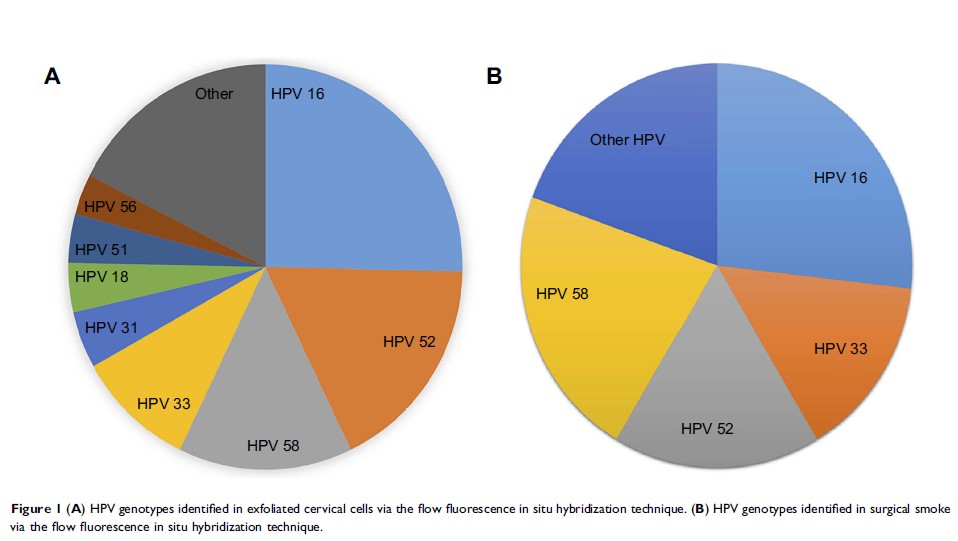
94.8%, 29.9% and 1.5%, respectively. The distribution of HPV subtypes in
surgical smoke was identical to that in the cervical specimens. The positive
rate of HPV DNA in surgical smoke was significantly increased for greater
distances of the suction device from the surgical site. The nasal epithelial
cells of two surgeons were positive for HPV DNA, and the genotypes were
consistent with those in the corresponding surgical smoke. After a 3–6-month
follow-up, the nasal swabs from these two doctors tested negative for HPV
DNA.
Conclusions: This
study demonstrated the presence of HPV DNA in surgical smoke produced by LEEP
and the risk of airborne transmission of HPV DNA during the operation.
Fortunately, the HPV DNA in the nasopharynx of the operators was not
persistent.
Keywords: HPV, loop
electrosurgical excision procedure, surgical smoke, nasal swab