117333
论文已发表
注册即可获取德孚的最新动态
IF 收录期刊
- 3.6 Breast Cancer (Dove Med Press)
- 4.3 Clin Epidemiol
- 2.6 Cancer Manag Res
- 3.2 Infect Drug Resist
- 4.1 Clin Interv Aging
- 6.1 Drug Des Dev Ther
- 4.1 Int J Chronic Obstr
- 8.7 Int J Nanomed
- 2.5 Int J Women's Health
- 3.2 Neuropsych Dis Treat
- 2.4 OncoTargets Ther
- 2.6 Patient Prefer Adher
- 2.6 Ther Clin Risk Manag
- 3.1 J Pain Res
- 3.5 Diabet Metab Synd Ob
- 4.5 Psychol Res Behav Ma
- 3.4 Nat Sci Sleep
- 2.4 Pharmgenomics Pers Med
- 2.6 Risk Manag Healthc Policy
- 4.6 J Inflamm Res
- 2.3 Int J Gen Med
- 3.9 J Hepatocell Carcinoma
- 3.3 J Asthma Allergy
- 2.5 Clin Cosmet Investig Dermatol
- 3.0 J Multidiscip Healthc

高密度脂蛋白对结直肠癌患者眼转移的预测价值
Authors Zhu PW, Gong YX, Min YL, Lin Q, Li B, Shi WQ, Yuan Q, Ye L, Shao Y
Received 14 November 2018
Accepted for publication 22 February 2019
Published 29 April 2019 Volume 2019:11 Pages 3511—3519
DOI https://doi.org/10.2147/CMAR.S194637
Checked for plagiarism Yes
Review by Single-blind
Peer reviewers approved by Dr Colin Mak
Peer reviewer comments 2
Editor who approved publication: Dr Rituraj Purohit
Purpose: Colorectal
cancer (CRC) is a common tumor of the digestive tract that tends to metastasize
and leads to high mortality. Ocular metastases (OM) from colorectal cancer are
being increasingly diagnosed, and they can lead to a poor prognosis. Serum
lipids are a known risk factor for cardiovascular disease, and are also
relevant to the occurrence of CRC. In this study, we examined the levels of
serum lipids and tried to determine whether there were correlations with the
occurrence of OM in patients with colorectal cancer, in order to determine
whether serum lipid levels may be a risk factor for OM in this patient
population.
Patients and methods: Records from
a total of 703 patients treated for colorectal cancer from August 2005 to
August 2017 were involved in this study. Student’s t -tests,
nonparametric rank sum tests, and Chi-square tests were applied to describe
whether there were significant differences between the OM group and non-ocular
metastases (NOM) group. We used binary logistic regression analysis to
determine the risk factors and receiver operating curve (ROC) analyses to
assess the diagnostic value for OM in CRC patients.
Results: There
were no significant differences in gender, age, histopathology type, or tumor
classifications between the OM and NOM groups. The levels of serum TC, HDL, and
LDL were significantly different between patients with and without lymph node
metastases as well as male and female patients. The OM group had higher serum
HDL levels compared to the NOM group. Binary logistic regression indicated that
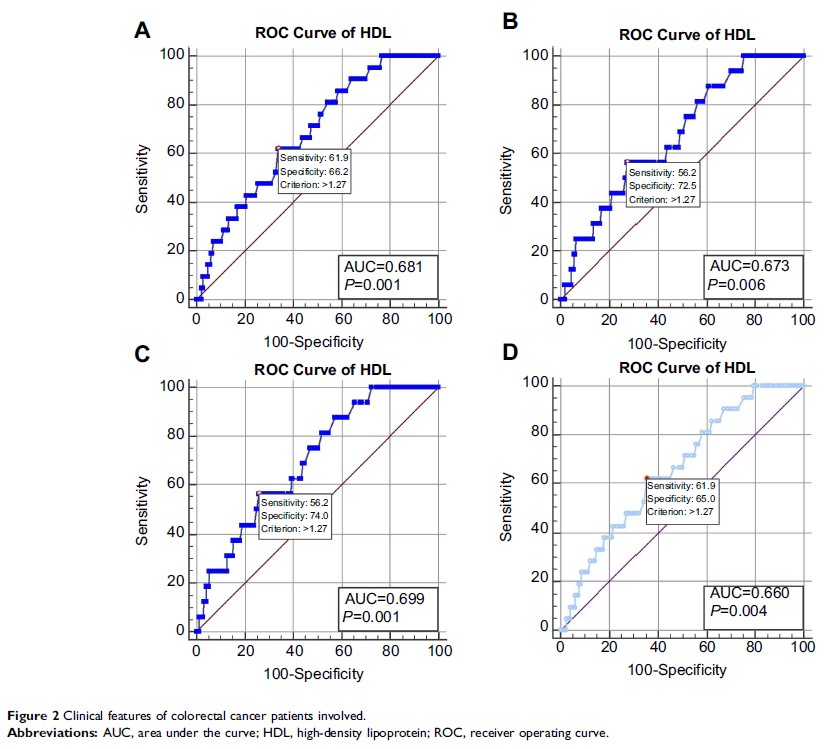
HDL was a risk factor for OM in colorectal cancer patients. The ROC curves
showed that the AUC of HDL was 0.660. The cutoff value of HDL was
1.27 mmol/L, with a sensitivity of 0.619 and a specificity of 0.650.
Conclusion: HDL
levels are correlated with ocular metastases in colorectal cancer patients.
Keywords: high-density
lipoprotein, ocular metastases, colorectal cancer, independent risk factor