117333
论文已发表
注册即可获取德孚的最新动态
IF 收录期刊
- 3.6 Breast Cancer (Dove Med Press)
- 4.3 Clin Epidemiol
- 2.6 Cancer Manag Res
- 3.2 Infect Drug Resist
- 4.1 Clin Interv Aging
- 6.1 Drug Des Dev Ther
- 4.1 Int J Chronic Obstr
- 8.7 Int J Nanomed
- 2.5 Int J Women's Health
- 3.2 Neuropsych Dis Treat
- 2.4 OncoTargets Ther
- 2.6 Patient Prefer Adher
- 2.6 Ther Clin Risk Manag
- 3.1 J Pain Res
- 3.5 Diabet Metab Synd Ob
- 4.5 Psychol Res Behav Ma
- 3.4 Nat Sci Sleep
- 2.4 Pharmgenomics Pers Med
- 2.6 Risk Manag Healthc Policy
- 4.6 J Inflamm Res
- 2.3 Int J Gen Med
- 3.9 J Hepatocell Carcinoma
- 3.3 J Asthma Allergy
- 2.5 Clin Cosmet Investig Dermatol
- 3.0 J Multidiscip Healthc

混合模型在中国人群结核病发病率预测中的应用
Authors Li Z, Wang Z, Song H, Liu Q, He B, Shi P, Ji Y, Xu D, Wang J
Received 10 October 2018
Accepted for publication 4 April 2019
Published 29 April 2019 Volume 2019:12 Pages 1011—1020
DOI https://doi.org/10.2147/IDR.S190418
Checked for plagiarism Yes
Review by Single-blind
Peer reviewers approved by Dr Cristina Weinberg
Peer reviewer comments 2
Editor who approved publication: Dr Eric Nulens
Objective: To
investigate suitable forecasting models for tuberculosis (TB) in a Chinese
population by comparing the predictive value of the autoregressive integrated
moving average (ARIMA) model and the ARIMA-generalized regression neural
network (GRNN) hybrid model.
Methods: We used
the monthly incidence rate of TB in Lianyungang city from January 2007 through
June 2016 to construct a fitting model, and we used the incidence rate from
July 2016 to December 2016 to evaluate the forecasting accuracy. The root mean
square error (RMSE), mean absolute percentage error (MAPE), mean absolute error
(MAE) and mean error rate (MER) were used to assess the performance of these
models in fitting and forecasting the incidence of TB.
Results: The ARIMA
(10, 1, 0) (0, 1, 1)12 model was selected from plausible ARIMA
models, and the optimal spread value of the ARIMA-GRNN hybrid model was 0.23.
For the fitting dataset, the RMSE, MAPE, MAE and MER were 0.5594, 11.5000,
0.4202 and 0.1132, respectively, for the ARIMA (10, 1, 0) (0, 1, 1)12 model,
and 0.5259, 11.2181, 0.3992 and 0.1075, respectively, for the ARIMA-GRNN hybrid
model. For the forecasting dataset, the RMSE, MAPE, MAE and MER were 0.2805,
8.8797, 0.2261 and 0.0851, respectively, for the ARIMA (10, 1, 0) (0, 1, 1)12 model,
and 0.2553, 5.7222, 0.1519 and 0.0571, respectively, for the ARIMA-GRNN hybrid
model.
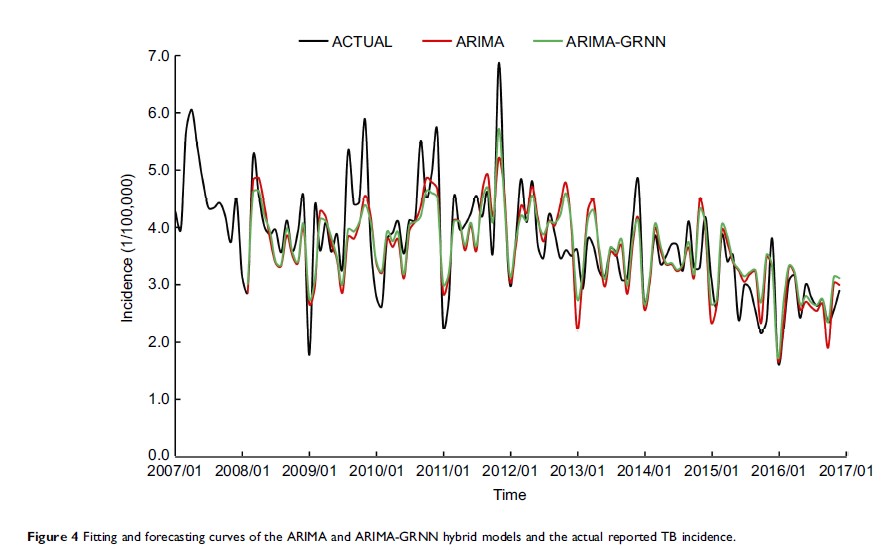
Conclusions: The ARIMA-GRNN
hybrid model was shown to be superior to the single ARIMA model in predicting
the short-term TB incidence in the Chinese population, especially in fitting
and forecasting the peak and trough incidence.
Keywords: model,
ARIMA, GRNN, tuberculosis, incidence, forecasting