117333
论文已发表
注册即可获取德孚的最新动态
IF 收录期刊
- 3.6 Breast Cancer (Dove Med Press)
- 4.3 Clin Epidemiol
- 2.6 Cancer Manag Res
- 3.2 Infect Drug Resist
- 4.1 Clin Interv Aging
- 6.1 Drug Des Dev Ther
- 4.1 Int J Chronic Obstr
- 8.7 Int J Nanomed
- 2.5 Int J Women's Health
- 3.2 Neuropsych Dis Treat
- 2.4 OncoTargets Ther
- 2.6 Patient Prefer Adher
- 2.6 Ther Clin Risk Manag
- 3.1 J Pain Res
- 3.5 Diabet Metab Synd Ob
- 4.5 Psychol Res Behav Ma
- 3.4 Nat Sci Sleep
- 2.4 Pharmgenomics Pers Med
- 2.6 Risk Manag Healthc Policy
- 4.6 J Inflamm Res
- 2.3 Int J Gen Med
- 3.9 J Hepatocell Carcinoma
- 3.3 J Asthma Allergy
- 2.5 Clin Cosmet Investig Dermatol
- 3.0 J Multidiscip Healthc

通过 RGD-PEG-DSPE/DOPA/CaP 纳米粒子对 GRP78 siRNA 和多西紫杉醇进行代码检测,用于治疗去势抵抗性前列腺癌
Authors Zhang X, He Z, Xiang L, Li L, Zhang H, Lin F, Cao H
Received 16 December 2018
Accepted for publication 5 March 2019
Published 29 April 2019 Volume 2019:13 Pages 1357—1372
DOI https://doi.org/10.2147/DDDT.S198400
Checked for plagiarism Yes
Review by Single-blind
Peer reviewers approved by Dr Colin Mak
Peer reviewer comments 2
Editor who approved publication: Professor Manfred Ogris
Background: Castration-resistant
prostate cancer (CRPC) accounts for the majority of prostate cancer deaths, and
patients with CRPC are prone to developing drug resistance. Therefore, there is
a need to develop effective therapeutics to treat CRPC, especially
drug-resistant CRPC. Although various nanoparticles have been developed for
drug or gene delivery and control release, approaches to reproducibly formulate
the optimal treatment with nanoparticles that could effectively target CRPC and
bone metastasis remain suboptimal. Recently, codelivery of a chemotherapeutic
agent and a small interfering RNA (siRNA) has become a promising strategy for
the treatment of drug-resistant prostate cancer.
Methods: In
a previous study, we prepared a novel RGD-PEG-DSPE/CaP nanoparticle as an
effective and biocompatible drug and gene delivery system. In this study, we
further modify the nanoparticle to obtain the LCP-RGD nanoparticle, which
contains a calcium phosphate (CaP) core, dioleoyl phosphatidic acid (DOPA) and
RGD modified poly(ethylene glycol)-conjugated distearoyl
phosphatidylethanolamine (RGD-PEG-DSPE). This drug delivery system was used for
codelivery of GRP78 siRNA and docetaxel (DTXL) for the treatment of the PC-3
CRPC.
Results: The
nanoparticles contain the CaP core, which can effectively compress the
negatively charged siRNA, while the DOPA and RGD-PEG-DSPE component can
effectively carry DTXL. The arginine-glycine-aspartic acid (RGD) segment can
target the prostate cancer site, as the cancer site is neovascularized. This
novel nanoparticle has good stability, excellent biocompatibility, high drug
and siRNA loading capacity, and an in vitro sustainable release profile.
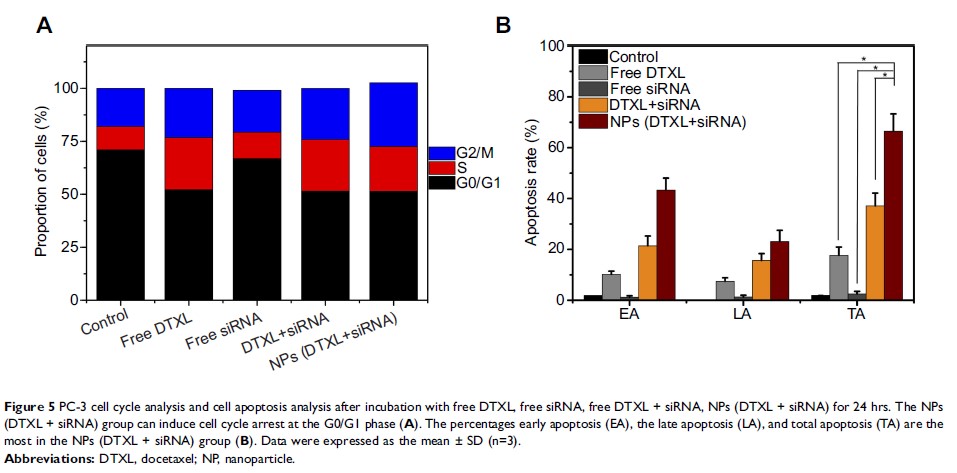
Conclusion: Codelivery of DTXL and GRP78 siRNA has enhanced in vitro and in vivo
anti-prostate cancer effects which are much greater than using free DTXL and
free GRP78 siRNA together. Our study also indicated that codelivery of DTXL and
GRP78 siRNA have an in vitro and in vivo combinational anti-prostate cancer
effect and also could effectively sensitize the cell-killing effect of DTXL;
this method may be especially suitable for drug-resistant CRPC treatment.
Keywords: codelivery,
docetaxel, RANK, siRNA, nanoparticles