117333
论文已发表
注册即可获取德孚的最新动态
IF 收录期刊
- 3.6 Breast Cancer (Dove Med Press)
- 4.3 Clin Epidemiol
- 2.6 Cancer Manag Res
- 3.2 Infect Drug Resist
- 4.1 Clin Interv Aging
- 6.1 Drug Des Dev Ther
- 4.1 Int J Chronic Obstr
- 8.7 Int J Nanomed
- 2.5 Int J Women's Health
- 3.2 Neuropsych Dis Treat
- 2.4 OncoTargets Ther
- 2.6 Patient Prefer Adher
- 2.6 Ther Clin Risk Manag
- 3.1 J Pain Res
- 3.5 Diabet Metab Synd Ob
- 4.5 Psychol Res Behav Ma
- 3.4 Nat Sci Sleep
- 2.4 Pharmgenomics Pers Med
- 2.6 Risk Manag Healthc Policy
- 4.6 J Inflamm Res
- 2.3 Int J Gen Med
- 3.9 J Hepatocell Carcinoma
- 3.3 J Asthma Allergy
- 2.5 Clin Cosmet Investig Dermatol
- 3.0 J Multidiscip Healthc

睾酮在高血压绝经后妇女高血压和靶器官损害中的潜在作用
Authors Li N, Ma R, Wang S, Zhao Y, Wang P, Yang Z, Jin L, Zhang P, Ding H, Bai F, Yu J
Received 21 November 2018
Accepted for publication 27 February 2019
Published 29 April 2019 Volume 2019:14 Pages 743—752
DOI https://doi.org/10.2147/CIA.S195498
Checked for plagiarism Yes
Review by Single-blind
Peer reviewers approved by Dr Cristina Weinberg
Peer reviewer comments 3
Editor who approved publication: Dr Zhi-Ying Wu
Objective: The aim
of this study was to confirm the potential role of testosterone in hypertension
and target organ damage (TOD) in hypertensive postmenopausal women.
Methods: A matched
group study was conducted. One hundred sixty-one hypertensive postmenopausal
women between 45 and 65 years of age were enrolled as group 1. Another 161
age-matched hypertensive men were enrolled as group 2. Ambulatory blood
pressure monitoring, echocardiographic imaging, vascular function, sex hormones
and clinical characteristics were evaluated. Quantitative data were analyzed
using independent Student’s t -test and multiple regression analysis.
Results: The mean
and load level of blood pressure were lower in women than in men (P <0.05), except
for the mean level and load of the nocturnal systolic blood pressure (SBP)
(123.77±15.72 mmHg vs 126.35±15.64 mmHg, and 50.43±30.31% vs
55.35±28.51%, P >0.05). However, the carotid-femoral pulse wave
velocity (cf-PWV) in women was higher than that in men (9.68±2.23 m/s vs
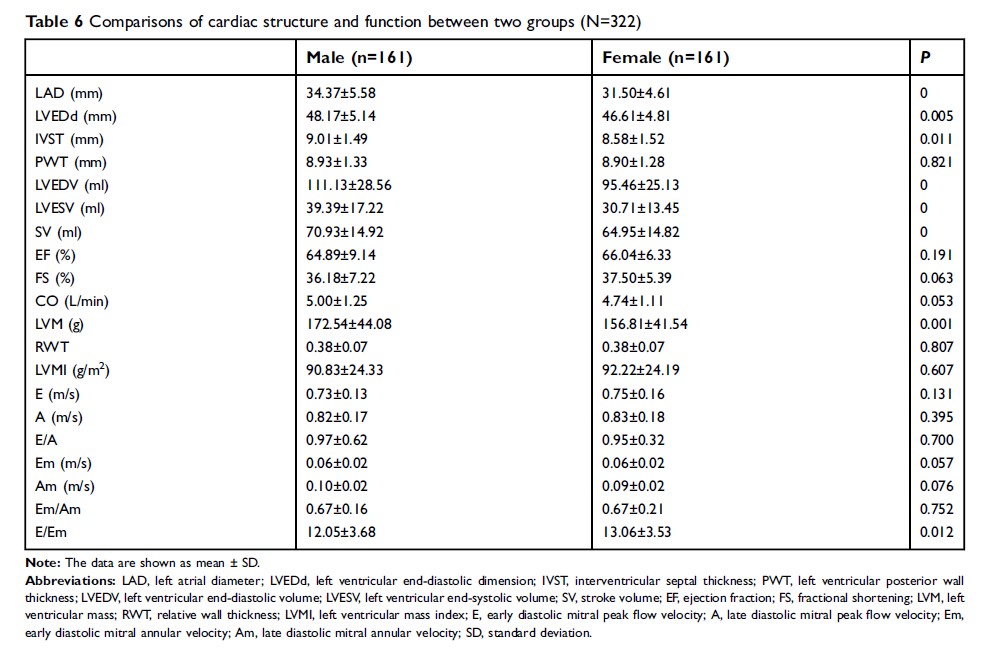
8.03±2.82 m/s, P <0.05). The ratio of the early diastolic mitral
peak flow velocity to early diastolic mitral annular velocity (E/Em) was
obviously impaired (13.06±3.53 vs 12.05±3.68, P <0.05) in
women. Furthermore, in women, a positive correlation was found between
testosterone and cf-PWV (γ=0.157, P =0.046), and Cf-PWV was positively related to the
mean level of nighttime SBP (γ=0.210, P =0.008). Moreover, nocturnal SBP was a risk factor
for E/Em (γ=0.156, P =0.048, P <0.05).
Conclusion: Testosterone
may play a role in the correlation between hypertension and TOD in hypertensive
postmenopausal women.
Clinical Trial number: This
research study was registered under the ClinicalTrials.gov PRS Website
(NCT03451747).
Keywords: postmenopausal
women, hypertensive, left ventricular diastolic function, carotid-femoral pulse
wave velocity, testosterone