117333
论文已发表
注册即可获取德孚的最新动态
IF 收录期刊
- 3.6 Breast Cancer (Dove Med Press)
- 4.3 Clin Epidemiol
- 2.6 Cancer Manag Res
- 3.2 Infect Drug Resist
- 4.1 Clin Interv Aging
- 6.1 Drug Des Dev Ther
- 4.1 Int J Chronic Obstr
- 8.7 Int J Nanomed
- 2.5 Int J Women's Health
- 3.2 Neuropsych Dis Treat
- 2.4 OncoTargets Ther
- 2.6 Patient Prefer Adher
- 2.6 Ther Clin Risk Manag
- 3.1 J Pain Res
- 3.5 Diabet Metab Synd Ob
- 4.5 Psychol Res Behav Ma
- 3.4 Nat Sci Sleep
- 2.4 Pharmgenomics Pers Med
- 2.6 Risk Manag Healthc Policy
- 4.6 J Inflamm Res
- 2.3 Int J Gen Med
- 3.9 J Hepatocell Carcinoma
- 3.3 J Asthma Allergy
- 2.5 Clin Cosmet Investig Dermatol
- 3.0 J Multidiscip Healthc

MicroRNA-145 通过靶向 PI3K/Akt signaling 途径抑制喉鳞状细胞癌的生长
Authors Ye D, Zhou C, Deng H, Lin L, Zhou S
Received 23 December 2018
Accepted for publication 1 April 2019
Published 30 April 2019 Volume 2019:11 Pages 3801—3812
DOI https://doi.org/10.2147/CMAR.S199291
Checked for plagiarism Yes
Review by Single-blind
Peer reviewers approved by Dr Andrew Yee
Peer reviewer comments 2
Editor who approved publication: Dr Kenan Onel
Purpose: In this
study, we used a nude mouse model of human laryngeal squamous cell carcinoma
(LSCC) to investigate inhibition of tumor growth by microRNA-145 (miR-145) and
the mechanisms underlying this inhibition.
Methods: Tumors
were established in nude mice by transplantation of the LSCC AMC-HN-8 cell
line. Forty-eight nude mice were randomly divided into groups of eight mice
each and treated with high (1.0 optical density [OD]) or low (0.5 OD) doses of
miR-145, or relevant control treatments. Tumor growth was observed in each
group and used to calculate the inhibition rate. Routine pathological and
electron microscopic examinations were used to determine tumor apoptosis and
proliferation. Changes in levels of miR-145 and PI3K and Akt protein levels
were also analyzed.
Results: MiR-145
inhibited LSCC growth in a dose-dependent manner, as tumor growth was significantly
inhibited in mice injected intratumorally with high-dose miR-145 compared with
both the untreated and low-dose miR-145 groups (p <0.05).
Pathological examination showed increased tumor necrotic and apoptotic changes
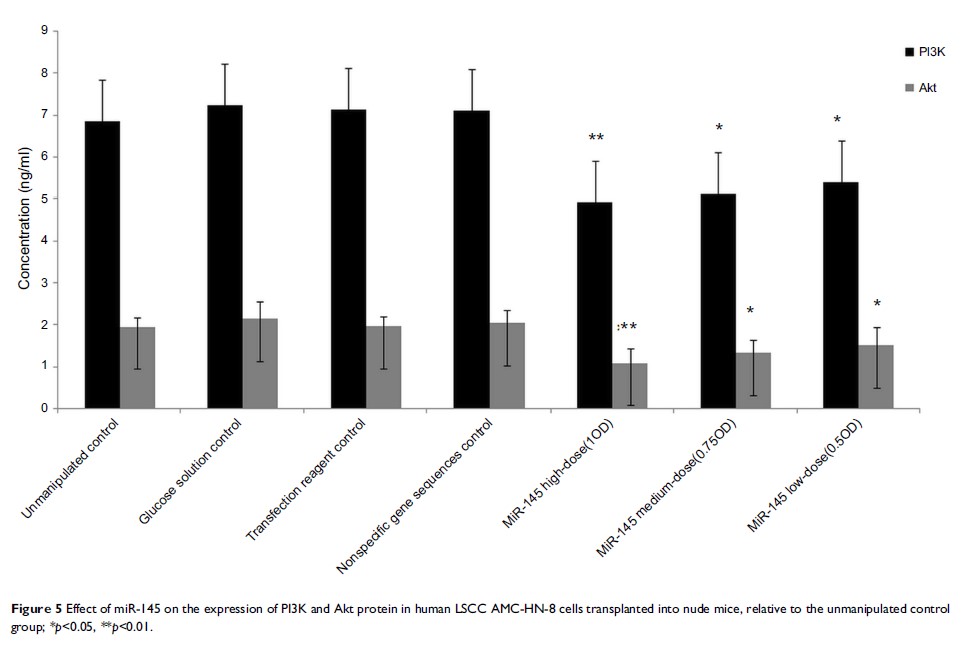
in treated mice, which was confirmed by electron microscopy. PI3K and Akt
protein expression were significantly lower in tumors treated with high-dose
miR-145 group compared with those in the untreated and low-dose miR-145 groups
(p <0.05).
Conclusions: MiR-145
was associated with inhibited tumor growth in a nude mouse model of LSCC. The
underlying mechanism may be inhibition of the PI3K/Akt signaling pathway, which
regulates tumor growth, invasion, and metastasis and also plays an important
role in tumor angiogenesis and proliferation of tumor stem cells. MiR-145 may
act as a tumor suppressor gene and is a promising candidate for cancer
treatment.
Keywords: laryngeal
squamous cell carcinoma, animal model, miRNA-145, oncology, treatment,
mechanism