117333
论文已发表
注册即可获取德孚的最新动态
IF 收录期刊
- 3.6 Breast Cancer (Dove Med Press)
- 4.3 Clin Epidemiol
- 2.6 Cancer Manag Res
- 3.2 Infect Drug Resist
- 4.1 Clin Interv Aging
- 6.1 Drug Des Dev Ther
- 4.1 Int J Chronic Obstr
- 8.7 Int J Nanomed
- 2.5 Int J Women's Health
- 3.2 Neuropsych Dis Treat
- 2.4 OncoTargets Ther
- 2.6 Patient Prefer Adher
- 2.6 Ther Clin Risk Manag
- 3.1 J Pain Res
- 3.5 Diabet Metab Synd Ob
- 4.5 Psychol Res Behav Ma
- 3.4 Nat Sci Sleep
- 2.4 Pharmgenomics Pers Med
- 2.6 Risk Manag Healthc Policy
- 4.6 J Inflamm Res
- 2.3 Int J Gen Med
- 3.9 J Hepatocell Carcinoma
- 3.3 J Asthma Allergy
- 2.5 Clin Cosmet Investig Dermatol
- 3.0 J Multidiscip Healthc

在对大鼠进行的使用炭黑纳米粒子的 90 天慢性吸入研究中产生的肺部毒性与系统免疫效应有关
Authors Chu C, Zhou L, Xie H, Pei Z, Zhang M, Wu M, Zhang S, Wang L, Zhao C, Shi L, Zhang N, Niu Y, Zheng Y, Zhang R
Received 15 December 2018
Accepted for publication 7 March 2019
Published 30 April 2019 Volume 2019:14 Pages 2995—3013
DOI https://doi.org/10.2147/IJN.S198376
Checked for plagiarism Yes
Review by Single-blind
Peer reviewers approved by Dr Govarthanan Muthusamy
Peer reviewer comments 2
Editor who approved publication: Dr Linlin Sun
Background: Recent years, there occurs heavy haze
pollution in northern China during wintertime. The potential influence of
airborne particulate matter (PM) on human health attracts great concern. The
fuel-derived PM in the inhalable size range is dominated by aggregates of
nanoparticles of Carbon black (CB). However, there are still lack of evidences
especially regarding long-term exposure to explain the chronic effects of
nanoscaled CB and the relative mechanism.
Purpose: The
objective of this study was to identify the potential mechanism of chronic
effects of nanoscale CB. The systemic toxicity, immune suppression or activity
and local toxicity were evaluated.
Methods: 32
rats were divided into 2 groups: 30 mg/m3 CB exposure (nose only, 90 d, 6h/d)
and control (clean air). Half of rats were scarified after exposure and another
half of rats recovered for 14 days. Eight rats in each group were executed the
lung function tests using a ventilated bias flow whole body plethysmograph
(WBP). SDS-PAGE protocol was used to detect the deposition and retention of CB
in lung of rats. HE staining was used to observe the changes of histopathology.
Cell apoptosis was examined by TUNEL assay or flow cytometry. The levels of
IL-6, IL-8, IL-17 and TNF-α in serum and lung tissue were evaluated with
commercially available ELISA kit. The peripheral blood cell counts were
detected by Auto 5-diff hematology analyzer.
Results: The
lung burden of CB was 16 mg in lung of rats after a 90-day exposure by MPPD.
Fourteen percentages of the amount of CB accumulated at the end of the exposure
period was cleared from the lung during the 14 dys recovery period. The lung
function was significantly decreased and could not recover after a short time
recovery. The fibroblasts and granuloma formation were found in lung. The
levels of apoptosis and DNA damages were significantly increased in lung cells
after CB inhalation. The cytokines levels in lung but not in serum were
significantly increased in CB exposure group. The cell counts of WBC, monocytes
and neutrophils had 1.72, 3.13, and 2.73-fold increases after CB exposure,
respectively. The percentages of CD4+ lymphocytes and the rates of CD4+/CD8+
were statistically increased after CB exposure. The stimulation indexes of the
peripheral blood lymphocytes were significantly decreased after CB exposure. In
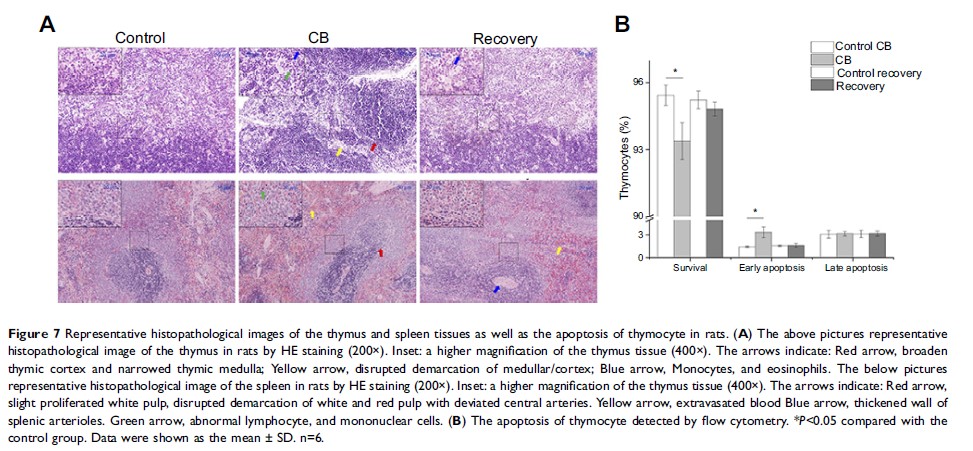
the CB exposure group, the disrupted histomorphology of thymus and spleen were
found as well as the early apoptotic thymocytes had a 2.36-fold increase.
Conclusion: CB
induced the localized or direct toxicity and systemic immune toxicity. The
direct and systemic immune responses had a combined effect on the lung damages
caused by CB.
Keywords: nanoscale
CB particles, pulmonary toxicology, immune toxicity, chronic toxicity,
inhalation