117333
论文已发表
注册即可获取德孚的最新动态
IF 收录期刊
- 3.6 Breast Cancer (Dove Med Press)
- 4.3 Clin Epidemiol
- 2.6 Cancer Manag Res
- 3.2 Infect Drug Resist
- 4.1 Clin Interv Aging
- 6.1 Drug Des Dev Ther
- 4.1 Int J Chronic Obstr
- 8.7 Int J Nanomed
- 2.5 Int J Women's Health
- 3.2 Neuropsych Dis Treat
- 2.4 OncoTargets Ther
- 2.6 Patient Prefer Adher
- 2.6 Ther Clin Risk Manag
- 3.1 J Pain Res
- 3.5 Diabet Metab Synd Ob
- 4.5 Psychol Res Behav Ma
- 3.4 Nat Sci Sleep
- 2.4 Pharmgenomics Pers Med
- 2.6 Risk Manag Healthc Policy
- 4.6 J Inflamm Res
- 2.3 Int J Gen Med
- 3.9 J Hepatocell Carcinoma
- 3.3 J Asthma Allergy
- 2.5 Clin Cosmet Investig Dermatol
- 3.0 J Multidiscip Healthc

仿生压电纳米复合膜协同增强脱蛋白牛骨移植物的成骨作用
Authors Bai Y, Dai X, Yin Y, Wang J, Sun X, Liang W, Li Y, Deng X, Zhang X
Received 11 December 2018
Accepted for publication 3 April 2019
Published 30 April 2019 Volume 2019:14 Pages 3015—3026
DOI https://doi.org/10.2147/IJN.S197824
Checked for plagiarism Yes
Review by Single-blind
Peer reviewers approved by Dr Govarthanan Muthusamy
Peer reviewer comments 2
Editor who approved publication: Dr Linlin Sun
Purpose: The
combination of a bone graft with a barrier membrane is the classic method for
guided bone regeneration (GBR) treatment. However, the insufficient
osteoinductivity of currently-available barrier membranes and the consequent limited
bone regeneration often inhibit the efficacy of bone repair. In this study, we
utilized the piezoelectric properties of biomaterials to enhance the
osteoinductivity of barrier membranes.
Methods: A
flexible nanocomposite membrane mimicking the piezoelectric properties of
natural bone was utilized as the barrier membrane. Its therapeutic efficacy in
repairing critical-sized rabbit mandible defects in combination with xenogenic
grafts of deproteinized bovine bone (DBB) was explored. The nanocomposite membranes
were fabricated with a homogeneous distribution of piezoelectric BaTiO3 nanoparticles
(BTO NPs) embedded within a poly(vinylidene fluoridetrifluoroethylene)
(P(VDF-TrFE)) matrix.
Results: The
piezoelectric coefficient of the polarized nanocomposite membranes was close to
that of human bone. The piezoelectric coefficient of the polarized
nanocomposite membranes was highly stable, with more than 90% of the original
piezoelectric coefficient (d33) remaining up to 28 days after immersion
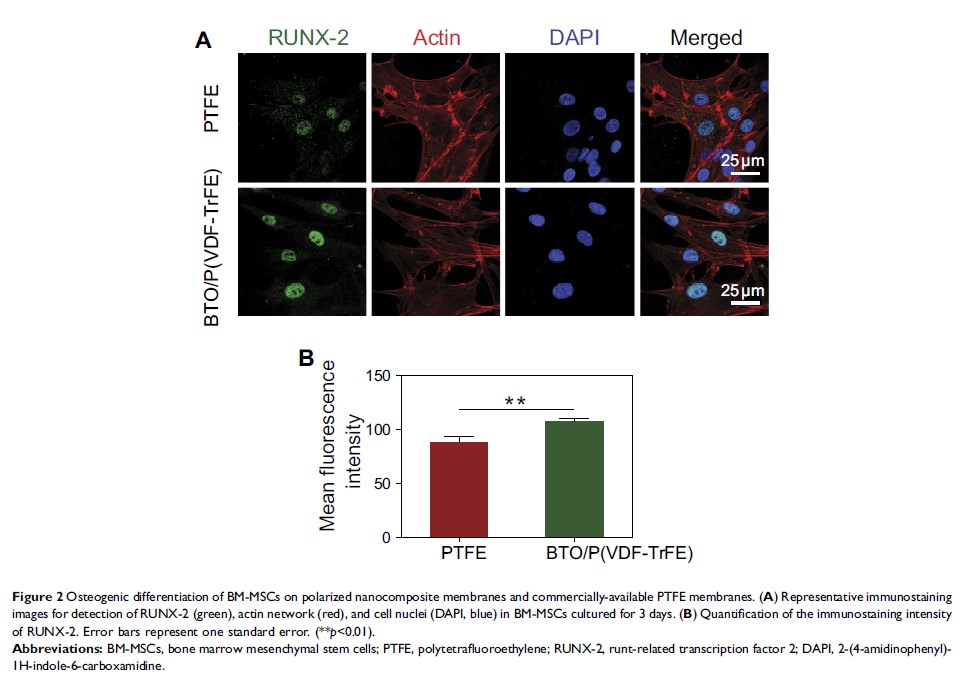
in culture medium. Compared with commercially-available polytetrafluoroethylene
(PTFE) membranes, the polarized BTO/P(VDF-TrFE) nanocomposite membranes
exhibited higher osteoinductivity (assessed by immunofluorescence staining for
runt-related transcription factor 2 (RUNX-2) expression) and induced
significantly earlier neovascularization and complete mature bone-structure
formation within the rabbit mandible critical-sized defects after implantation
with DBB Bio-Oss® granules.
Conclusion: Our
findings thus demonstrated that the piezoelectric BTO/P(VDF-TrFE) nanocomposite
membranes might be suitable for enhancing the clinical efficacy of GBR.
Keywords: guided
bone regeneration, nanocomposite membrane, piezoelectric effect, osteoinduction