117333
论文已发表
注册即可获取德孚的最新动态
IF 收录期刊
- 3.6 Breast Cancer (Dove Med Press)
- 4.3 Clin Epidemiol
- 2.6 Cancer Manag Res
- 3.2 Infect Drug Resist
- 4.1 Clin Interv Aging
- 6.1 Drug Des Dev Ther
- 4.1 Int J Chronic Obstr
- 8.7 Int J Nanomed
- 2.5 Int J Women's Health
- 3.2 Neuropsych Dis Treat
- 2.4 OncoTargets Ther
- 2.6 Patient Prefer Adher
- 2.6 Ther Clin Risk Manag
- 3.1 J Pain Res
- 3.5 Diabet Metab Synd Ob
- 4.5 Psychol Res Behav Ma
- 3.4 Nat Sci Sleep
- 2.4 Pharmgenomics Pers Med
- 2.6 Risk Manag Healthc Policy
- 4.6 J Inflamm Res
- 2.3 Int J Gen Med
- 3.9 J Hepatocell Carcinoma
- 3.3 J Asthma Allergy
- 2.5 Clin Cosmet Investig Dermatol
- 3.0 J Multidiscip Healthc

载有 LL37 的二氧化钛纳米孔的体外和体内抗菌和成骨性能
Authors Shen X, Al-Baadani MA, He H, Cai L, Wu Z, Yao L, Wu X, Wu S, Chen M, Zhang H, Liu J
Received 17 December 2018
Accepted for publication 4 March 2019
Published 30 April 2019 Volume 2019:14 Pages 3043—3054
DOI https://doi.org/10.2147/IJN.S198583
Checked for plagiarism Yes
Review by Single-blind
Peer reviewers approved by Dr Govarthanan Muthusamy
Peer reviewer comments 2
Editor who approved publication: Dr Mian Wang
Background: Many studies
have shown that the size of nanotube (NT) can significantly affect the behavior
of osteoblasts on titanium-based materials. But the weak bonding strength
between NT and substrate greatly limits their application.
Purpose: The
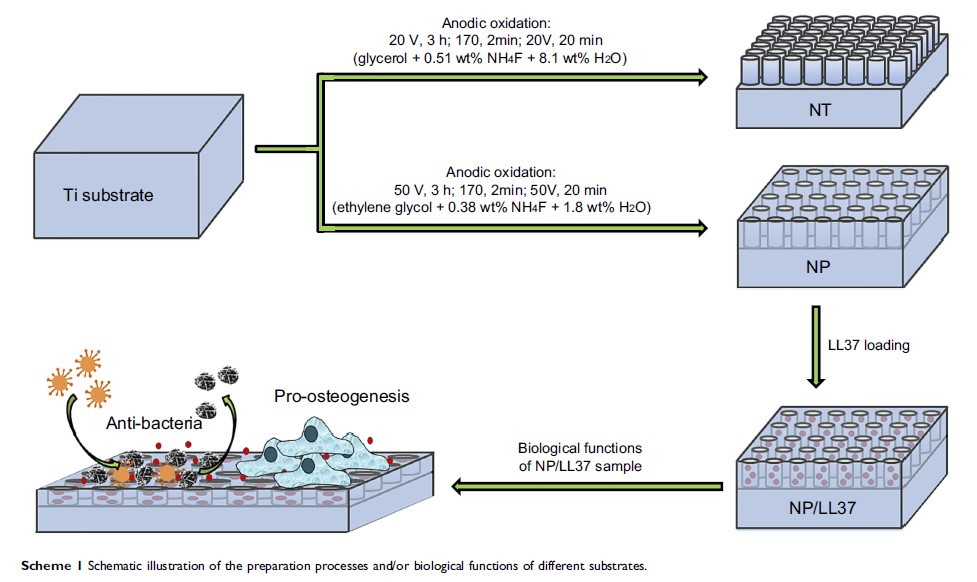
objective of this study was to compare the stability of NT and nanopore (NP)
coatings, and further prepare antibacterial titanium-based materials by loading
LL37 peptide in NP structures.
Methods: The
adhesion strength of NT and NP layers was investigated using a scratch tester.
The proliferation and differentiation of MC3T3-E1 cells on different substrates
were evaluated in vitro by CCK8, alkaline phosphatase activity, mineralization
and polymerase chain reaction assays. The antibacterial rates of NP and NP/LL37
were also measured by spread plate method. Moreover, the osteogenesis around NP
and NP/LL373 in vivo was further evaluated using uninfected and infected
models.
Results: Scratch
test proved that the NP layers had stronger bonding strength with the
substrates due to their continuous pore structures and thicker pipe walls than
the independent NT structures. In vitro, cell results showed that MC3T3-E1
cells on NP substrates had better early adhesion, spreading and osteogenic
differentiation than those of NT group. In addition, based on the drug
reservoir characteristics of porous materials, the NP substrates were also used
to load antibacterial LL37 peptide. After loading LL37, the antibacterial and
osteogenic induction abilities of NP were further improved, thus significantly
promoting osteogenesis in both uninfected and infected models.
Conclusion: We
determined that the NP layers had stronger bonding strength than NT structures,
and the corresponding NP materials might be more suitable than NT for preparing
drug-device combined titanium implants for bone injury treatment.
Keywords: titanium,
nanotubes, nanopores, LL37 peptide, antibacterial, osteogenesis