117333
论文已发表
注册即可获取德孚的最新动态
IF 收录期刊
- 3.6 Breast Cancer (Dove Med Press)
- 4.3 Clin Epidemiol
- 2.6 Cancer Manag Res
- 3.2 Infect Drug Resist
- 4.1 Clin Interv Aging
- 6.1 Drug Des Dev Ther
- 4.1 Int J Chronic Obstr
- 8.7 Int J Nanomed
- 2.5 Int J Women's Health
- 3.2 Neuropsych Dis Treat
- 2.4 OncoTargets Ther
- 2.6 Patient Prefer Adher
- 2.6 Ther Clin Risk Manag
- 3.1 J Pain Res
- 3.5 Diabet Metab Synd Ob
- 4.5 Psychol Res Behav Ma
- 3.4 Nat Sci Sleep
- 2.4 Pharmgenomics Pers Med
- 2.6 Risk Manag Healthc Policy
- 4.6 J Inflamm Res
- 2.3 Int J Gen Med
- 3.9 J Hepatocell Carcinoma
- 3.3 J Asthma Allergy
- 2.5 Clin Cosmet Investig Dermatol
- 3.0 J Multidiscip Healthc

CD157/BST1 多态性与帕金森病易感性的关系:荟萃分析
Authors Li J, Luo J, Liu L, Fu H, Tang L
Received 15 October 2018
Accepted for publication 29 December 2018
Published 30 April 2019 Volume 2019:15 Pages 1089—1102
DOI https://doi.org/10.2147/NDT.S190935
Checked for plagiarism Yes
Review by Single-blind
Peer reviewers approved by Dr Andrew Yee
Peer reviewer comments 2
Editor who approved publication: Professor Jun Chen
Background: Different
studies have provided some evidence for the association between BST1
polymorphisms and Parkinson’s disease (PD). The extent to which these genetic
effects are consistent across different populations is unknown.
Methods: A
meta-analysis of PD case-control studies using a common set of three variants
was conducted. Published reports were obtained from electronic databases
including Pubmed, Embase, Chinese National Knowledge Infrastructure (CNKI) and
Cochrane Library databases between August 2010 and January 2018.
Results: A total
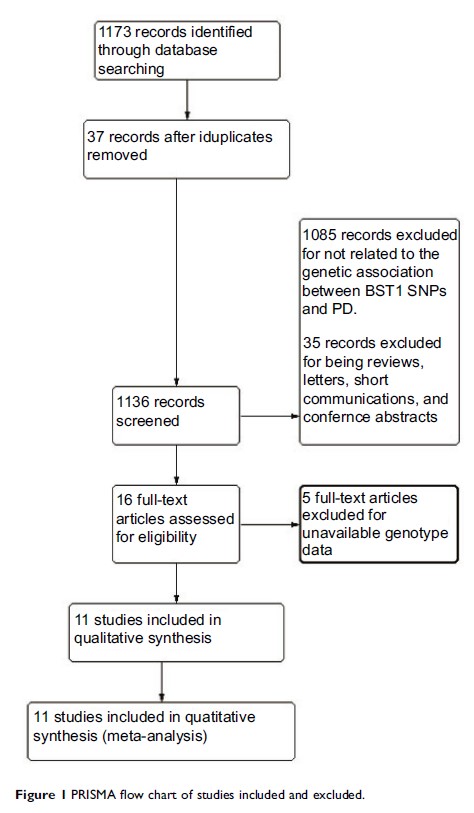
of 11 individual studies with 8,725 cases and 17,079 controls were included.
The results showed statistically significant association between the dominant
model of rs11931532 and PD risk in Asian populations (P =0.006, OR [95%
CI]=1.22 [1.06–1.41]). Significant association was also detected between the
allelic, dominant, and recessive models of rs4698412 and PD risk in Asian
populations (allelic model: P <0.00001, OR [95% CI]=1.22 [1.16–1.29]; dominant
model: P <0.00001,
OR [95%CI]=1.35 [1.20–1.52]; recessive model; P =0.0003, OR [95%
CI]=1.30 [1.13–1.50]). Nevertheless, the pooled analyses suggested that no
significant association was uncovered between rs11724635 and PD risk (P >0.05).
Conclusion: The
meta-analysis suggests that the rs11931532 and rs4698412, but not rs11724635
might be risk factors for PD in Asian populations.
Keywords: BST1,
Parkinson’s disease, polymorphisms, risk factor