117333
论文已发表
注册即可获取德孚的最新动态
IF 收录期刊
- 3.6 Breast Cancer (Dove Med Press)
- 4.3 Clin Epidemiol
- 2.6 Cancer Manag Res
- 3.2 Infect Drug Resist
- 4.1 Clin Interv Aging
- 6.1 Drug Des Dev Ther
- 4.1 Int J Chronic Obstr
- 8.7 Int J Nanomed
- 2.5 Int J Women's Health
- 3.2 Neuropsych Dis Treat
- 2.4 OncoTargets Ther
- 2.6 Patient Prefer Adher
- 2.6 Ther Clin Risk Manag
- 3.1 J Pain Res
- 3.5 Diabet Metab Synd Ob
- 4.5 Psychol Res Behav Ma
- 3.4 Nat Sci Sleep
- 2.4 Pharmgenomics Pers Med
- 2.6 Risk Manag Healthc Policy
- 4.6 J Inflamm Res
- 2.3 Int J Gen Med
- 3.9 J Hepatocell Carcinoma
- 3.3 J Asthma Allergy
- 2.5 Clin Cosmet Investig Dermatol
- 3.0 J Multidiscip Healthc

KRAS 突变和 ALK 融合的肺肉瘤样癌预后不良
Authors Chen F, Gu Q, Hu C, Cai X, Lei S
Received 2 December 2018
Accepted for publication 21 February 2019
Published 1 May 2019 Volume 2019:12 Pages 3321—3325
DOI https://doi.org/10.2147/OTT.S196751
Checked for plagiarism Yes
Review by Single-blind
Peer reviewers approved by Ms Justinn Cochran
Peer reviewer comments 2
Editor who approved publication: Dr Takuya Aoki
Abstract: Pulmonary
sarcomatoid carcinoma (PSC) is a rare subtype of poorly differentiated
non-small-cell lung cancer (NSCLC), and no effective treatment is available in
clinical practice currently. In the present report, a 61-year-old male patient was
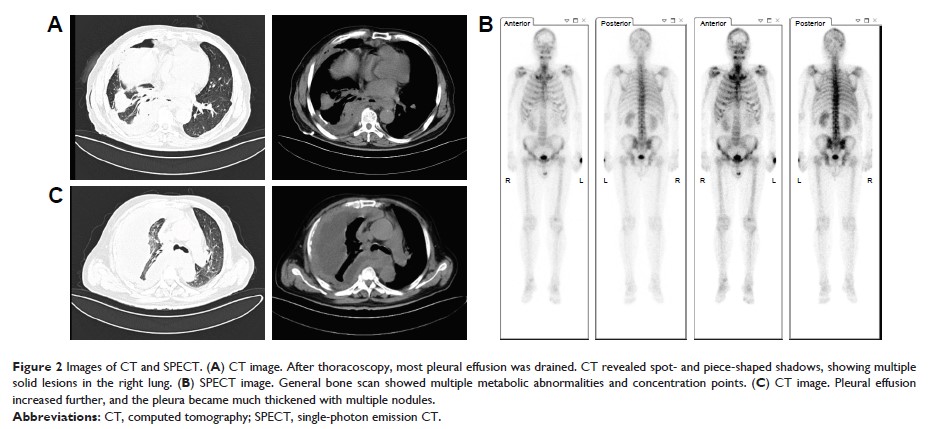
hospitalized due to cough, dyspnea, and right chest pain. Computed tomography
(CT) showed spot- and piece-shaped shadows. The patient became very weak and
had breathing difficulty after preliminary anti-pneumonia treatment with
cefoperazone–sulbactam. Physical examination revealed dull sound by percussion
and decreased breath sounds in the right lateral lung areas by auscultation. A
second CT scan revealed a large amount of pleural effusion, and the patient was
diagnosed with bloody pleural effusion through pleural space puncture. Multiple
nodular lesions were found in the right pleural cavity under thoracoscopy. PSC
was confirmed by biopsy and histopathology in combination with
immunohistochemistry (IHC). Single-photon emission CT (SPECT) scan indicated
multiple bone metastases. KRAS exon 2 mutation and EML4-ALK fusion
were identified in carcinoma tissue by IHC and amplification refractory
mutation system (ARMS)-PCR. The patient received one cycle of first-line
combination chemotherapy of cisplatin and paclitaxel liposomes. However, the
patient did not respond to the platinum-based combination chemotherapy within
3 weeks and was thus administered oral crizotinib instead of chemotherapy.
Unfortunately, he still had rapid disease progression and died 2 weeks
after the initiation of crizotinib treatment. Collectively, our results suggest
that a PSC patient with coexistent KRAS mutation and ALK rearrangement
would not benefit from chemotherapy and tyrosine kinase inhibitor (TKI)
treatment.
Keywords: pulmonary
sarcomatoid carcinoma, KRAS mutation, ALK rearrangement,
chemotherapy, crizotinib, targeted therapy