117333
论文已发表
注册即可获取德孚的最新动态
IF 收录期刊
- 3.6 Breast Cancer (Dove Med Press)
- 4.3 Clin Epidemiol
- 2.6 Cancer Manag Res
- 3.2 Infect Drug Resist
- 4.1 Clin Interv Aging
- 6.1 Drug Des Dev Ther
- 4.1 Int J Chronic Obstr
- 8.7 Int J Nanomed
- 2.5 Int J Women's Health
- 3.2 Neuropsych Dis Treat
- 2.4 OncoTargets Ther
- 2.6 Patient Prefer Adher
- 2.6 Ther Clin Risk Manag
- 3.1 J Pain Res
- 3.5 Diabet Metab Synd Ob
- 4.5 Psychol Res Behav Ma
- 3.4 Nat Sci Sleep
- 2.4 Pharmgenomics Pers Med
- 2.6 Risk Manag Healthc Policy
- 4.6 J Inflamm Res
- 2.3 Int J Gen Med
- 3.9 J Hepatocell Carcinoma
- 3.3 J Asthma Allergy
- 2.5 Clin Cosmet Investig Dermatol
- 3.0 J Multidiscip Healthc

MEX3C 通过 JNK 途径调节脂质代谢以促进膀胱肿瘤发生
Authors Chao H, Deng L, Xu F, Yu Z, Xu X, Huang J, Zeng T
Received 27 December 2018
Accepted for publication 2 March 2019
Published 1 May 2019 Volume 2019:12 Pages 3285—3294
DOI https://doi.org/10.2147/OTT.S199667
Checked for plagiarism Yes
Review by Single-blind
Peer reviewers approved by Ms Aruna Narula
Peer reviewer comments 2
Editor who approved publication: Dr XuYu Yang
Purpose: Bladder
cancer (BC) is the most common urinary cancer among men with a high rate of
deaths despite the improved medical technology and treatment. Recent evidence
demonstrated that Mex-3 RNA-Binding Family Member C (MEX3C) plays various roles
in different biological activities, but its molecular mechanisms underlying the
pathogenesis of BC remain unclear yet. The aim of this research was to explore
the expression patterns of MEX3C and its biological functions in human BC.
Materials and methods: The
Cancer Genome Atlas (TCGA) and Oncomine databases were jointly used to analyze
the expression of MEX3C in BC and its correlation with the clinicopathological
features, while real-time PCR and immunohistochemistry analysis were used to
verify the predicted results. Wound-healing assay, Matrigel invasion assay,
BODIPY staining and Western blot analysis were used in a cell model to assess
the effect of MEX3C on the lipid metabolism, invasion and migration of BC and
its mechanisms.
Results: MEX3C was
highly expressed in BC tissues and cells compared with their normal
counterparts, and its expression was positively correlated with the
clinicopathological features, especially the invasiveness phenotype.
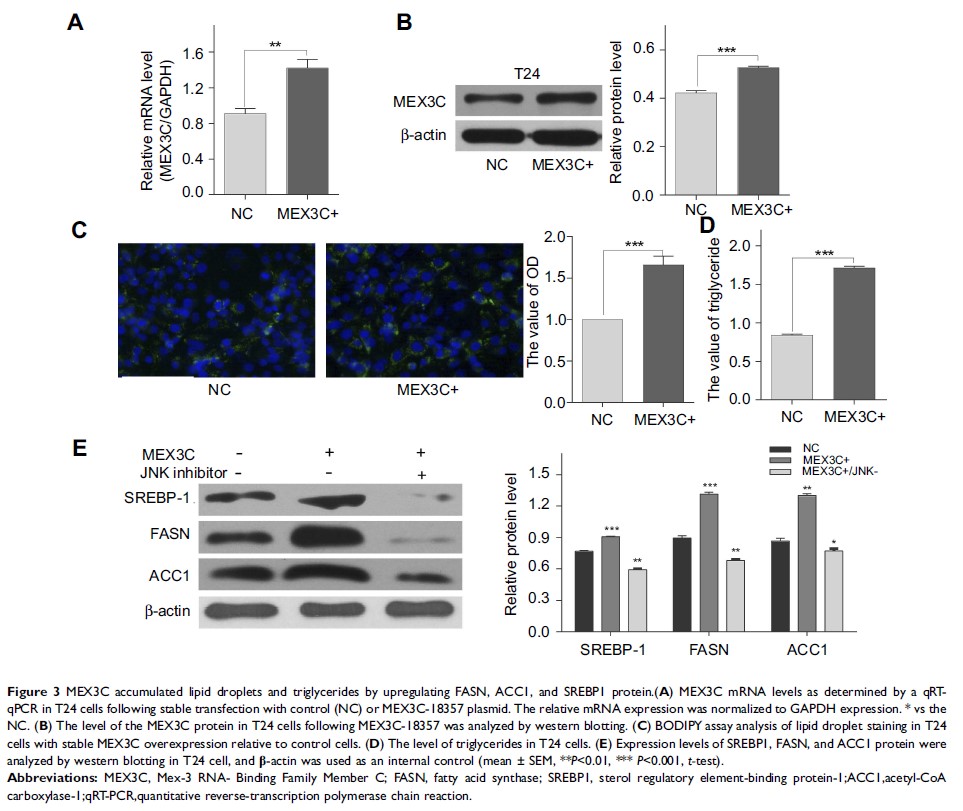
Overexpression of MEX3C accumulated lipid droplets and promoted cell adhesion,
invasion and migration. We further demonstrated that MEX3C regulated lipid
metabolism and promoted tumor development and progression through activation of
JNK signaling and upregulating the JNK downstream protein levels of sterol
regulatory element-binding proteins-1, fatty acid synthase and acetyl-CoA
carboxylase-1.
Conclusion: Here we
identified MEX3C as a new oncogene to promote bladder tumorigenesis by
regulating lipid metabolism through Mitogen-activated protein kinase/c-Jun
N-terminal kinase (MAPK/JNK) pathway. These findings suggest a new role of
MEX3C in promoting BC tumorigenesis and provide a novel biomarker or molecular
target for diagnosis or treating BC.
Keywords: MEX3C,
lipid metabolism, tumorigenesis, JNK pathway, bladder cancer