117333
论文已发表
注册即可获取德孚的最新动态
IF 收录期刊
- 3.6 Breast Cancer (Dove Med Press)
- 4.3 Clin Epidemiol
- 2.6 Cancer Manag Res
- 3.2 Infect Drug Resist
- 4.1 Clin Interv Aging
- 6.1 Drug Des Dev Ther
- 4.1 Int J Chronic Obstr
- 8.7 Int J Nanomed
- 2.5 Int J Women's Health
- 3.2 Neuropsych Dis Treat
- 2.4 OncoTargets Ther
- 2.6 Patient Prefer Adher
- 2.6 Ther Clin Risk Manag
- 3.1 J Pain Res
- 3.5 Diabet Metab Synd Ob
- 4.5 Psychol Res Behav Ma
- 3.4 Nat Sci Sleep
- 2.4 Pharmgenomics Pers Med
- 2.6 Risk Manag Healthc Policy
- 4.6 J Inflamm Res
- 2.3 Int J Gen Med
- 3.9 J Hepatocell Carcinoma
- 3.3 J Asthma Allergy
- 2.5 Clin Cosmet Investig Dermatol
- 3.0 J Multidiscip Healthc

代谢组学揭示了自然发生的猕猴抑郁模型中外周和中枢短链脂肪酸和氨基酸功能障碍
Authors Deng F, Pan J, Zheng P, Xia J, Yin B, Liang W, Li Y, Wu J, Xu F, Wu Q, Qu C, Li W, Wang H, Xie P
Received 1 September 2018
Accepted for publication 14 February 2019
Published 1 May 2019 Volume 2019:15 Pages 1077—1088
DOI https://doi.org/10.2147/NDT.S186071
Checked for plagiarism Yes
Review by Single-blind
Peer reviewers approved by Prof. Dr. Roumen Kirov
Peer reviewer comments 2
Editor who approved publication: Professor Jun Chen
Purpose: Depression
is a complex psychiatric disorder. Various depressive rodent models are usually
constructed based on different pathogenesis hypotheses.
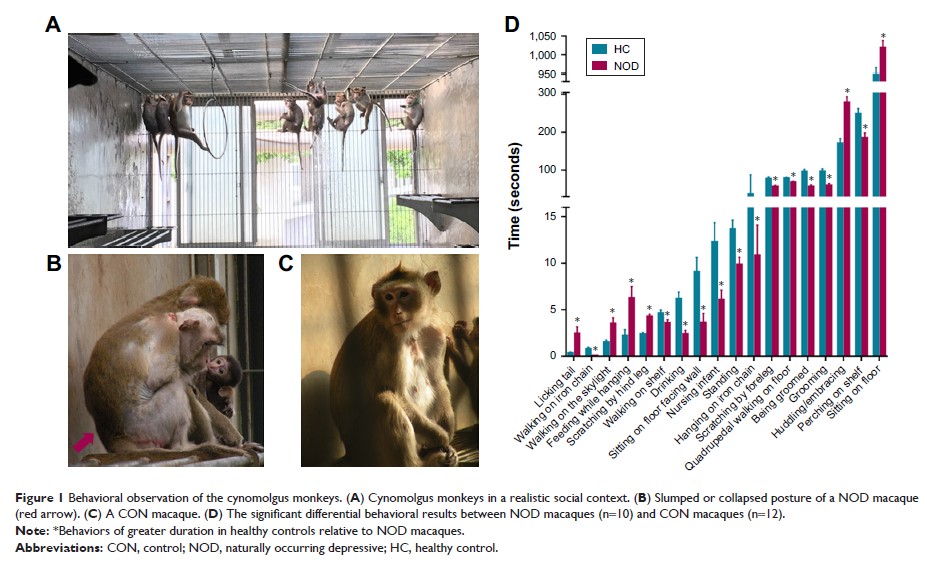
Materials and methods: Herein,
using our previously established naturally occurring depressive (NOD) model in
a non-human primate (cynomolgus monkey, Macaca fascularis), we performed
metabolomics analysis of cerebrospinal fluid (CSF) from NOD female macaques
(N=10) and age- and gender-matched healthy controls (HCs) (N=12). Multivariate
statistical analysis was used to identify the differentially expressed
metabolites between the two groups. Ingenuity Pathways Analysis and
MetaboAnalyst were applied for predicted pathways and biological functions
analysis.
Results: Totally,
37 metabolites responsible for discriminating the two groups were identified.
The NOD macaques were mainly characterized by perturbations of fatty acid
biosynthesis, ABC transport system, and amino acid metabolism (eg, aspartate,
glycine, serine, and threonine metabolism). Interestingly, we found that eight
altered CSF metabolites belonging to short-chain fatty acids and amino acids
were also observed in the serum of NOD macaques (N=13 per group).
Conclusion: Our
findings suggest that peripheral and central short-chain fatty acids and amino
acids are implicated in the onset of depression.
Keywords: naturally
occurring depressive, depression, non-human primate, metabonomics,
cerebrospinal fluid, short-chain fatty acid