117333
论文已发表
注册即可获取德孚的最新动态
IF 收录期刊
- 3.6 Breast Cancer (Dove Med Press)
- 4.3 Clin Epidemiol
- 2.6 Cancer Manag Res
- 3.2 Infect Drug Resist
- 4.1 Clin Interv Aging
- 6.1 Drug Des Dev Ther
- 4.1 Int J Chronic Obstr
- 8.7 Int J Nanomed
- 2.5 Int J Women's Health
- 3.2 Neuropsych Dis Treat
- 2.4 OncoTargets Ther
- 2.6 Patient Prefer Adher
- 2.6 Ther Clin Risk Manag
- 3.1 J Pain Res
- 3.5 Diabet Metab Synd Ob
- 4.5 Psychol Res Behav Ma
- 3.4 Nat Sci Sleep
- 2.4 Pharmgenomics Pers Med
- 2.6 Risk Manag Healthc Policy
- 4.6 J Inflamm Res
- 2.3 Int J Gen Med
- 3.9 J Hepatocell Carcinoma
- 3.3 J Asthma Allergy
- 2.5 Clin Cosmet Investig Dermatol
- 3.0 J Multidiscip Healthc

高迁移率 A2 过表达对胰腺癌上皮-间质转化的影响
Authors Gong J, Wang Y, Jiang B, Xu B, Hu C
Received 23 December 2018
Accepted for publication 22 March 2019
Published 3 May 2019 Volume 2019:11 Pages 4075—4084
DOI https://doi.org/10.2147/CMAR.S199289
Checked for plagiarism Yes
Review by Single-blind
Peer reviewers approved by Dr Amy Norman
Peer reviewer comments 2
Editor who approved publication: Dr Kenan Onel
Background: Tumor
metastasis causes high mortality in patients with malignancies. In carcinomas,
overexpression of high-mobility-group A2 (HMGA2) in cancer cells would lead to
tumor development and epithelial to mesenchymal transition (EMT), promoting
metastasis. This study evaluated HMGA2 overexpression for its effects on pancreatic
cancer (PC).
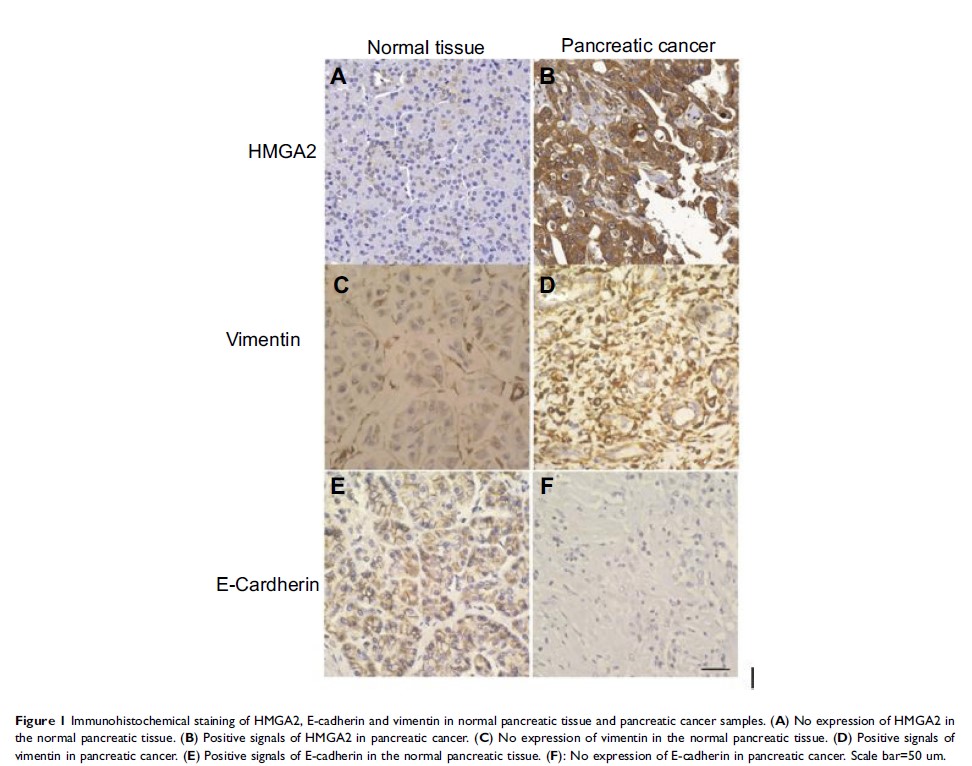
Methods: HMGA2
protein levels were immunohistochemically assessed in human PC tissue specimens
and evaluated for associations with patients’ clinicopathological findings. In
human PC CAPAN 1 cells after HMGA2 expression was silenced or overexpressed,
Transwell migration and invasion assays were performed, and EMT marker levels
(E-cadherin, N-cadherin and Vimentin) were determined by immunoblot.
Results: HMGA2
and Vimentin were found in 43% and 45% of PC tissue samples, respectively,
while E-cadherin was absent in 60%. HMGA2 expression, loss of E-cadherin and
Vimentin expression were significantly associated with clinical stage, tumor
differentiation and lymph node metastasis. More importantly, univariate and
multivariate analysis demonstrated that HMGA2 expression is an independent
prognostic factor for patients with pancreatic cancer. Meanwhile,
HMGA2-silenced CAPAN 1 cells showed reduced migration and invasion ability
while HMGA2-overexpressed CAPAN 1 cells showed increased migration and invasion
ability. Increased E-cadherin (epithelial marker) and reduced N-cadherin and
Vimentin (mesenchymal markers) were found in HMGA2-silenced cells, while
reduced E-cadherin and increased N-cadherin and Vimentin were found in
HMGA2-overexpressed cells. Furthermore, Snail and Zeb1 (transcriptional
factors) were reduced in HMGA2-silenced cells and increased in
HMGA2-overexpressed cells.
Conclusion: Our
findings demonstrate that HMGA2 expression correlates with advanced tumor
grades, lymph node metastasis and poor prognosis and may be a novel
prognosis/therapeutic marker for PC.
Keywords: HMGA2,
human pancreatic cancer, prognosis, EMT