117333
论文已发表
注册即可获取德孚的最新动态
IF 收录期刊
- 3.6 Breast Cancer (Dove Med Press)
- 4.3 Clin Epidemiol
- 2.6 Cancer Manag Res
- 3.2 Infect Drug Resist
- 4.1 Clin Interv Aging
- 6.1 Drug Des Dev Ther
- 4.1 Int J Chronic Obstr
- 8.7 Int J Nanomed
- 2.5 Int J Women's Health
- 3.2 Neuropsych Dis Treat
- 2.4 OncoTargets Ther
- 2.6 Patient Prefer Adher
- 2.6 Ther Clin Risk Manag
- 3.1 J Pain Res
- 3.5 Diabet Metab Synd Ob
- 4.5 Psychol Res Behav Ma
- 3.4 Nat Sci Sleep
- 2.4 Pharmgenomics Pers Med
- 2.6 Risk Manag Healthc Policy
- 4.6 J Inflamm Res
- 2.3 Int J Gen Med
- 3.9 J Hepatocell Carcinoma
- 3.3 J Asthma Allergy
- 2.5 Clin Cosmet Investig Dermatol
- 3.0 J Multidiscip Healthc

摄取人参皂苷 Rg3,选择细胞因子的分析研究和直肠息肉的发展
Authors Xie J, Luo S, Mi H, Du Y, Bao G, Zhou J, Xi Y, Li C
Received 5 December 2018
Accepted for publication 27 February 2019
Published 6 May 2019 Volume 2019:11 Pages 4059—4064
DOI https://doi.org/10.2147/CMAR.S197097
Checked for plagiarism Yes
Review by Single-blind
Peer reviewers approved by Dr Amy Norman
Peer reviewer comments 2
Editor who approved publication: Professor Lu-Zhe Sun
Background: Rectal polyps
is a major risk factor for rectal cancer. There is a need to explore a panel of
preventive measures, as well as reliable biomarkers for screening of rectal
polyps.
Patients and methods: We conducted a
case control study which aimed to explore the effects of regular consumption of
ginsenoside Rg3, profiling of selected cytokines, and development of rectal
polyps in a Chinese population.
Results: Significantly
higher levels of IL-4, MIP-1β, FasL, TGF-β1, and RANTES were detected in rectal
polyp cases. Further, we found significant dose-response relationships between
quartile-categorized levels of IL-4, MIP-1β, FasL, and TGF-β1, and risk of
rectal polyps. The strongest associations for IL-4, MIP-1β, FasL, and TGF-β1 were
observed for the highest quartile vs the lowest quartile with an OR of 1.78,
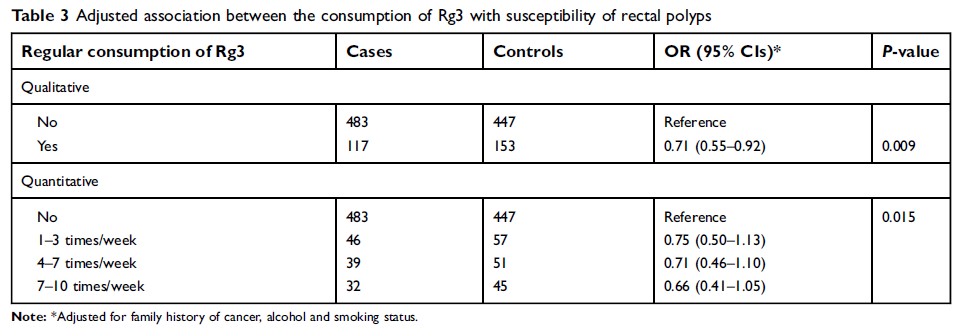
2.70, 1.49, and 2.36, respectively. Compared with non-Rg3 consumers, regular
Rg3 consumers had a significantly lower risk of rectal polyps (OR =0.71; 95%
CI: 0.55–0.92; P=0.009). We also found that Rg3 consumers had
significantly lower levels of IL-4, MIP-1β, FasL, and TGF-β1 than non-Rg3
consumers, in both rectal polyp cases and healthy controls.
Conclusion: These results
indicate that regular consumption of Rg3 might prevent the occurrence of rectal
polyps through decreasing the serum level of selected cytokines, including
IL-4, MIP-1β, FasL, and TGF-β1. Further clinical trials and prospective cohort
studies with larger sample sizes are warranted to validate the anti-inflammatory
activity and the anti-tumorigenic role of Rg3.
Keywords: cytokine,
Rg3, rectal polyps, IL-4, MIP-1β, FasL, TGF-β1