117333
论文已发表
注册即可获取德孚的最新动态
IF 收录期刊
- 3.6 Breast Cancer (Dove Med Press)
- 4.3 Clin Epidemiol
- 2.6 Cancer Manag Res
- 3.2 Infect Drug Resist
- 4.1 Clin Interv Aging
- 6.1 Drug Des Dev Ther
- 4.1 Int J Chronic Obstr
- 8.7 Int J Nanomed
- 2.5 Int J Women's Health
- 3.2 Neuropsych Dis Treat
- 2.4 OncoTargets Ther
- 2.6 Patient Prefer Adher
- 2.6 Ther Clin Risk Manag
- 3.1 J Pain Res
- 3.5 Diabet Metab Synd Ob
- 4.5 Psychol Res Behav Ma
- 3.4 Nat Sci Sleep
- 2.4 Pharmgenomics Pers Med
- 2.6 Risk Manag Healthc Policy
- 4.6 J Inflamm Res
- 2.3 Int J Gen Med
- 3.9 J Hepatocell Carcinoma
- 3.3 J Asthma Allergy
- 2.5 Clin Cosmet Investig Dermatol
- 3.0 J Multidiscip Healthc

在诊断为血液系统恶性肿瘤的患者中,CD19 靶向嵌合抗原受体T细胞疗法的生存结果和疗效:系统评价和荟萃分析
Authors Drokow EK, Ahmed HAW, Amponsem-Boateng C, Akpabla GS, Song J, Shi M, Sun K
Received 5 February 2019
Accepted for publication 20 March 2019
Published 6 May 2019 Volume 2019:15 Pages 637—646
DOI https://doi.org/10.2147/TCRM.S203822
Checked for plagiarism Yes
Review by Single-blind
Peer reviewers approved by Ms Justinn Cochran
Peer reviewer comments 2
Editor who approved publication: Professor Deyun Wang
Purpose: Chimeric
Antigen Receptor T(CAR-T) cell therapy is an immunotherapy approach used in
treating cancer which has seen rapid development over the decades. It becomes
the preferred treatment choice after patients have failed conventional
chemotherapy.
Methods: We
conducted a meta-analysis in 320 patients from 14 studies to estimate the
survival outcome, response rate and toxicity of autologous CD19 CAR-T cell
therapy and predict other factors associated with a better prognosis.
Results: The
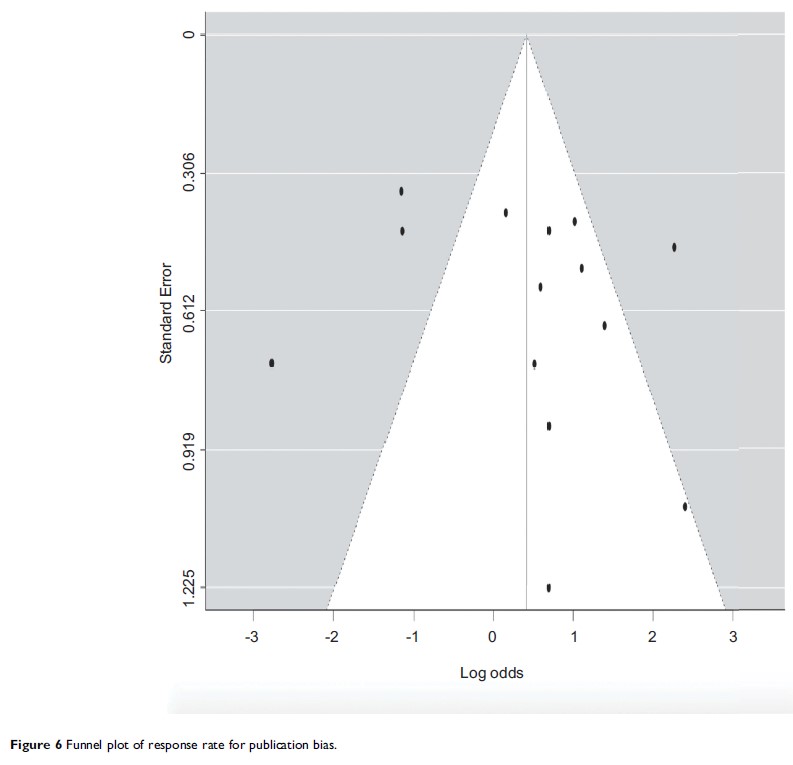
overall response rate was 71.88% (95% CI: 61.34–80.46%, p <0.01) and CRS
toxicity was 60.15% (95% CI: 42.87–75.22%, p <0.01).
Patients who received lymphodepletion was associated with a better response
rate (77%, 95%CI: 67–83%; p -value =0.001) in comparison to the other patients
who did not (66%, 95%CI: 41–83%).
Conclusion: Lymphodepletion
regimen may play a crucial role in predicting the prognosis of patients with
hematological malignancies. Lymphodepletion patients had better progression-free
survival than those who did not.
Keywords: autologous,
CD19, CAR-T, hematological malignancies, response rate