117333
论文已发表
注册即可获取德孚的最新动态
IF 收录期刊
- 3.6 Breast Cancer (Dove Med Press)
- 4.3 Clin Epidemiol
- 2.6 Cancer Manag Res
- 3.2 Infect Drug Resist
- 4.1 Clin Interv Aging
- 6.1 Drug Des Dev Ther
- 4.1 Int J Chronic Obstr
- 8.7 Int J Nanomed
- 2.5 Int J Women's Health
- 3.2 Neuropsych Dis Treat
- 2.4 OncoTargets Ther
- 2.6 Patient Prefer Adher
- 2.6 Ther Clin Risk Manag
- 3.1 J Pain Res
- 3.5 Diabet Metab Synd Ob
- 4.5 Psychol Res Behav Ma
- 3.4 Nat Sci Sleep
- 2.4 Pharmgenomics Pers Med
- 2.6 Risk Manag Healthc Policy
- 4.6 J Inflamm Res
- 2.3 Int J Gen Med
- 3.9 J Hepatocell Carcinoma
- 3.3 J Asthma Allergy
- 2.5 Clin Cosmet Investig Dermatol
- 3.0 J Multidiscip Healthc

靶向维持治疗对新确诊的上皮性卵巢癌的疗效比较:一项网络荟萃分析
Authors Xu X, Yin S, Guo H, Li M, Qian Z, Tian X, Li T
Received 11 September 2018
Accepted for publication 4 April 2019
Published 7 May 2019 Volume 2019:11 Pages 4119—4128
DOI https://doi.org/10.2147/CMAR.S187119
Checked for plagiarism Yes
Review by Single-blind
Peer reviewers approved by Dr Colin Mak
Peer reviewer comments 2
Editor who approved publication: Dr Beicheng Sun
Background: The
number of published randomized clinical trials (RCTs) using targeted
maintenance therapy for newly diagnosed epithelial ovarian cancer is
increasing. Our objective was to evaluate the comparative effectiveness of each
maintenance therapy using a network meta-analysis.
Materials and methods: A
systematic search for RCTs was conducted using Medline, Embase, and CENTRAL
databases followed by a Bayesian network meta-analysis. The primary outcome was
progression-free survival (PFS) and the secondary outcome was overall survival
(OS). Pooled hazard ratios (HRs) with 95% credible intervals (95% CrIs) were
used to estimate outcomes.
Results: A total
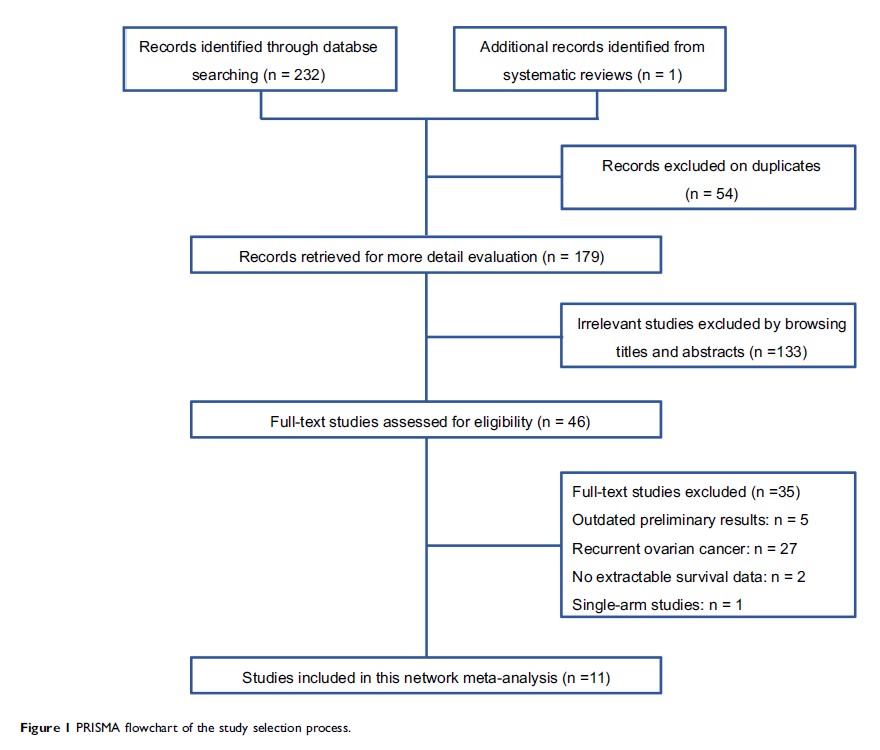
of 11 RCTs involving 6631 patients were included. Network meta-analysis showed
that pure maintenance therapy with pazopanib resulted in a significantly better
PFS compared with placebo (HR, 0.77; 95% CrI, 0.65–0.92).
Bevacizumab-throughout treatment was also associated with a better PFS (HR,
0.76, 95% CrI, 0.69–0.84). However, anti-CA-125 monoclonal antibodies
(abagovomab and oregovomab) showed no significant survival benefit. Moreover,
combined analysis showed that targeted-throughout was not significantly
superior to pure targeted maintenance therapy for PFS and OS. Stratified
analysis showed paralleled results with no significant difference between
pazopanib pure maintenance and bevacizumab-throughout treatments.
Conclusion: Our study
showed a survival advantage conferred by pazopanib and bevacizumab as
maintenance therapy in newly diagnosed epithelial ovarian cancer. Further
clinical trials are essential to both determine the effect of bevacizumab in
the maintenance stage and identify the specific subgroup(s) that benefit.
Keywords: targeted
treatment, maintenance therapy, ovarian cancer, network meta-analysis