117333
论文已发表
注册即可获取德孚的最新动态
IF 收录期刊
- 3.6 Breast Cancer (Dove Med Press)
- 4.3 Clin Epidemiol
- 2.6 Cancer Manag Res
- 3.2 Infect Drug Resist
- 4.1 Clin Interv Aging
- 6.1 Drug Des Dev Ther
- 4.1 Int J Chronic Obstr
- 8.7 Int J Nanomed
- 2.5 Int J Women's Health
- 3.2 Neuropsych Dis Treat
- 2.4 OncoTargets Ther
- 2.6 Patient Prefer Adher
- 2.6 Ther Clin Risk Manag
- 3.1 J Pain Res
- 3.5 Diabet Metab Synd Ob
- 4.5 Psychol Res Behav Ma
- 3.4 Nat Sci Sleep
- 2.4 Pharmgenomics Pers Med
- 2.6 Risk Manag Healthc Policy
- 4.6 J Inflamm Res
- 2.3 Int J Gen Med
- 3.9 J Hepatocell Carcinoma
- 3.3 J Asthma Allergy
- 2.5 Clin Cosmet Investig Dermatol
- 3.0 J Multidiscip Healthc

INPP4B 抑制人肝细胞癌的细胞增殖、侵袭和化疗耐药
Authors Tang W, Yang L, Yang T, Liu M, Zhou Y, Lin J, Wang K, Ding C
Received 3 December 2018
Accepted for publication 29 March 2019
Published 7 May 2019 Volume 2019:12 Pages 3491—3507
DOI https://doi.org/10.2147/OTT.S196832
Checked for plagiarism Yes
Review by Single-blind
Peer reviewers approved by Ms Justinn Cochran
Peer reviewer comments 3
Editor who approved publication: Dr Federico Perche
Background: Inositol
polyphosphate 4-phosphatase type II (INPP4B) has been identified as a negative
regulator of phosphatidyl inositol 3-kinase (PI3K)/Akt signaling in human
several cancers. However, the expression, clinical significance and biological
function of INPP4B in human hepatocellular carcinoma (HCC) clinical tissues and
cell lines are little known.
Materials and methods: We
evaluated the expression of INPP4B in 86 cases of paired human HCC samples by
immunohistochemistry, and the clinical significance of INPP4B expression was
analyzed. The expression of INPP4B in five HCC cell lines was detected through
using quantitative reverse transcription polymerase chain reaction (qRT-PCR)
and western blot analyses. The role of INPP4B gene on HCC cell proliferation, apoptosis,
migration, invasion as well as epithelial-to-mesenchymal transition (EMT) and
chemoresistance was examined via INPP4B mammalian expression vector and small
interfering RNA (siRNA) transfection in vitro. Western blot analysis was used
to explore the downstream molecules modulated by INPP4B.
Results: Immunohistochemistry
analysis revealed that INPP4B was significantly downregulated in HCC tissues
compared with the corresponding normal tissues. The rate of INPP4B-positive
staining was markedly lower in metastatic samples than in those of
non-metastatic samples. Univariate analysis showed that INPP4B expression was
indicated to have a marked association with histological grades, tumor size and
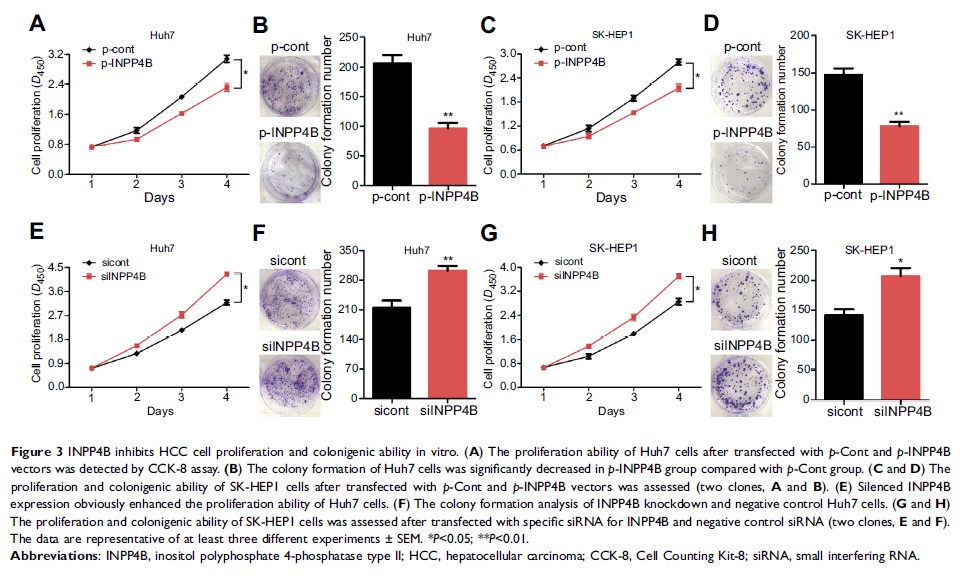
tumor metastasis. Moreover, INPP4B overexpression suppressed cell
proliferation, migration, invasion and EMT, but induced cell apoptosis and
chemosensitivity in human HCC cell lines. In contrast, INPP4B knockdown had the
opposite effects on the biological behaviors of HCC cells. Furthermore, INPP4B
was found to inhibit the activation of PI3K/Akt signaling in HCC cells.
Conclusion: Our
findings suggest that INPP4B is a tumor suppressing gene in human HCC, and
might act as a novel therapeutic target for HCC patients.
Keywords: INPP4B,
hepatocellular carcinoma, proliferation, invasion, chemoresistance