117333
论文已发表
注册即可获取德孚的最新动态
IF 收录期刊
- 3.6 Breast Cancer (Dove Med Press)
- 4.3 Clin Epidemiol
- 2.6 Cancer Manag Res
- 3.2 Infect Drug Resist
- 4.1 Clin Interv Aging
- 6.1 Drug Des Dev Ther
- 4.1 Int J Chronic Obstr
- 8.7 Int J Nanomed
- 2.5 Int J Women's Health
- 3.2 Neuropsych Dis Treat
- 2.4 OncoTargets Ther
- 2.6 Patient Prefer Adher
- 2.6 Ther Clin Risk Manag
- 3.1 J Pain Res
- 3.5 Diabet Metab Synd Ob
- 4.5 Psychol Res Behav Ma
- 3.4 Nat Sci Sleep
- 2.4 Pharmgenomics Pers Med
- 2.6 Risk Manag Healthc Policy
- 4.6 J Inflamm Res
- 2.3 Int J Gen Med
- 3.9 J Hepatocell Carcinoma
- 3.3 J Asthma Allergy
- 2.5 Clin Cosmet Investig Dermatol
- 3.0 J Multidiscip Healthc

miR-125a-5p 通过靶向 TAZ 抑制结直肠癌细胞上皮 - 间质转化、侵袭和迁移
Authors Tang L, Zhou L, Wu S, Shi X, Jiang G, Niu S, Ding D
Received 17 October 2018
Accepted for publication 26 February 2019
Published 7 May 2019 Volume 2019:12 Pages 3481—3489
DOI https://doi.org/10.2147/OTT.S191247
Checked for plagiarism Yes
Review by Single-blind
Peer reviewers approved by Ms Justinn Cochran
Peer reviewer comments 4
Editor who approved publication: Dr Gaetano Romano
Background: miR-125a-5p
regulated biological processes in various types of cancer, including colorectal
cancer (CRC). TAZ, a vital transcriptional coactivators of the Hippo pathway,
was found to be overexpressed in various cancers.
Objectives: This
study aims to study the effect of miR-125a-5p on the progression of CRC by
regulating TAZ expression.
Methods: In this study,
miR-125a-5p and TAZ expression in CRC tissue and cell lines were detected by
real-time polymerase chain reaction (RT-PCR). Luciferase reporter assay was
applied to detect whether TAZ was a target of miR-125a-5p. Cell migration and
invasion were detected in vitro by wound-healing assay and cell invasion assay.
Western blot was used to detect the expression of epithelial-mesenchymal
transition (EMT)-related proteins.
Findings: The
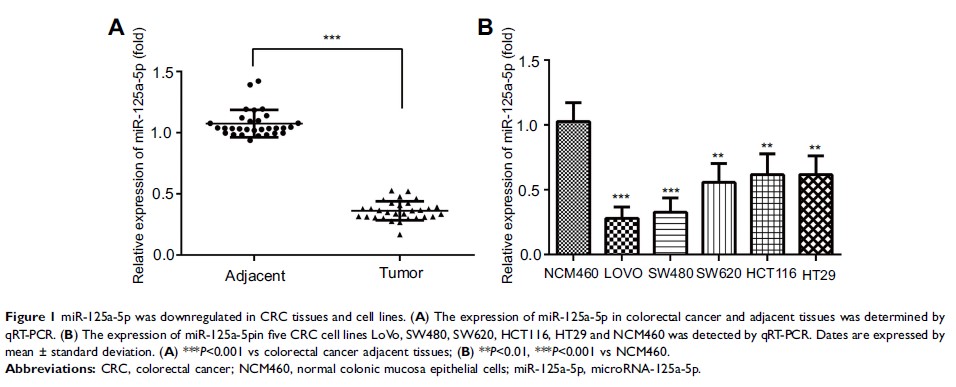
results revealed downregulation of miR-125a-5p, as well as upregulation of TAZ
in CRC tissue and cell lines. TAZ was identified as a direct target of
miR-125a-5p, and its expression was negatively regulated by miR-125a-5p in CRC
cell lines. The functional studies revealed that overexpression of miR-125a-5p
inhibited the migration, invasion and EMT of CRC cells, while upregulation of
TAZ reversed the inhibitory effect caused by miR-125a-5p.
Conclusion: Our data
suggest that miR-125a-5p inhibits CRC cell migration, invasion and EMT by
targeting TAZ. These results suggest that miR-125a-5p serves as a potential
therapeutic biomarker for CRC patients.
Keywords: miR-125a-5p,
TAZ, colorectal cancer, epithelial–mesenchymal transition, migration, invasion