117333
论文已发表
注册即可获取德孚的最新动态
IF 收录期刊
- 3.6 Breast Cancer (Dove Med Press)
- 4.3 Clin Epidemiol
- 2.6 Cancer Manag Res
- 3.2 Infect Drug Resist
- 4.1 Clin Interv Aging
- 6.1 Drug Des Dev Ther
- 4.1 Int J Chronic Obstr
- 8.7 Int J Nanomed
- 2.5 Int J Women's Health
- 3.2 Neuropsych Dis Treat
- 2.4 OncoTargets Ther
- 2.6 Patient Prefer Adher
- 2.6 Ther Clin Risk Manag
- 3.1 J Pain Res
- 3.5 Diabet Metab Synd Ob
- 4.5 Psychol Res Behav Ma
- 3.4 Nat Sci Sleep
- 2.4 Pharmgenomics Pers Med
- 2.6 Risk Manag Healthc Policy
- 4.6 J Inflamm Res
- 2.3 Int J Gen Med
- 3.9 J Hepatocell Carcinoma
- 3.3 J Asthma Allergy
- 2.5 Clin Cosmet Investig Dermatol
- 3.0 J Multidiscip Healthc

一种用于骨组织再生的铜掺杂后纳米缺钙羟基磷灰石/多(氨基酸)共聚物的新型复合支架
Authors Mou P, Peng H, Zhou L, Li L, Li H, Huang Q
Received 13 December 2018
Accepted for publication 12 March 2019
Published 7 May 2019 Volume 2019:14 Pages 3331—3343
DOI https://doi.org/10.2147/IJN.S195316
Checked for plagiarism Yes
Review by Single-blind
Peer reviewers approved by Dr Govarthanan Muthusamy
Peer reviewer comments 2
Editor who approved publication: Dr Linlin Sun
Background and methods: A
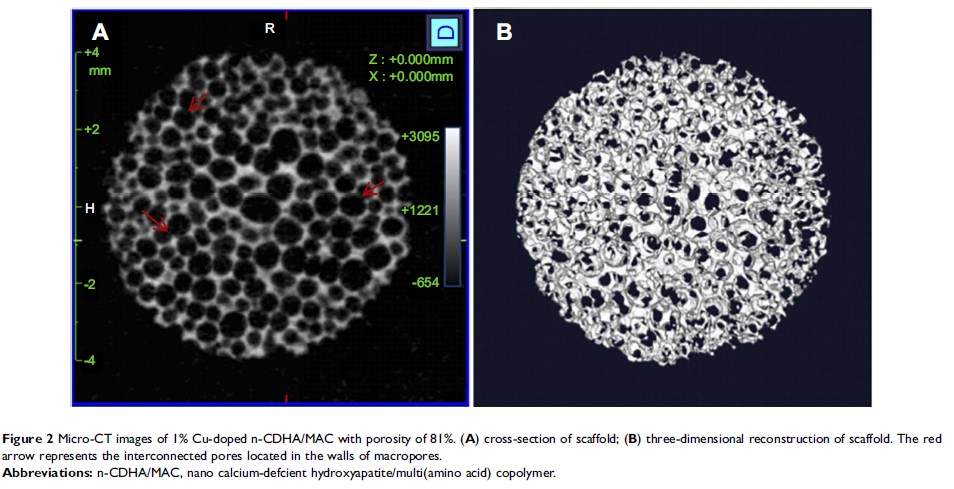
Cu-doped composite scaffold of nano calcium-deficient hydroxyapatite
(n-CDHA)/multi(amino acid) copolymer (MAC) was prepared. The structure,
porosity, morphology and compressive strength of the scaffolds were
characterized, the in vitro degradability in phosphate-buffered solution (PBS)
and cell responses to the scaffolds were investigated, and in vivo stimulation
of bone formation were analyzed.
Results: The
scaffolds showed the compressive strength of approximately 12 MPa and total
porosity of about 81%. Weight loss of the composite scaffolds was 63% after
16-week immersion in PBS. Cu release in scaffolds showed a marked dependence on
the initial amount in the scaffolds over time. Cu-doped n-CDHA/MAC scaffolds
with the content of Cu 0.5% and 1% in mass ratio showed better cell responses
to proliferation and differentiation of rat bone marrow stromal cells (rBMSCs)
than that with no Cu. After 12-week implantation in rabbits, 1% Cu-doped
n-CDHA/MAC showed better ability of angiogenesis and osteogenesis compared to
0% Cu-doped n-CDHA/MAC.
Conclusion: The 1% Cu-doped
n-CDHA/MAC composite scaffold showed good capacity of angiogenesis and
osteogenesis, and the Cu showed positive effects on cell growth and
osteogenesis. And it has potential to be used as bone regeneration scaffolds.
Keywords: calcium-deficient
hydroxyapatite, multi-(amino acid) copolymer, copper, osteogenesis,
degradability, cytocompatibility