115195
论文已发表
注册即可获取德孚的最新动态
IF 收录期刊
- 3.6 Breast Cancer (Dove Med Press)
- 4.3 Clin Epidemiol
- 2.6 Cancer Manag Res
- 3.2 Infect Drug Resist
- 4.1 Clin Interv Aging
- 6.1 Drug Des Dev Ther
- 4.1 Int J Chronic Obstr
- 8.7 Int J Nanomed
- 2.5 Int J Women's Health
- 3.2 Neuropsych Dis Treat
- 2.4 OncoTargets Ther
- 2.6 Patient Prefer Adher
- 2.6 Ther Clin Risk Manag
- 3.1 J Pain Res
- 3.5 Diabet Metab Synd Ob
- 4.5 Psychol Res Behav Ma
- 3.4 Nat Sci Sleep
- 2.4 Pharmgenomics Pers Med
- 2.6 Risk Manag Healthc Policy
- 4.6 J Inflamm Res
- 2.3 Int J Gen Med
- 3.9 J Hepatocell Carcinoma
- 3.3 J Asthma Allergy
- 2.5 Clin Cosmet Investig Dermatol
- 3.0 J Multidiscip Healthc

制备含有 KR-12 肽的透明质酸固定化纤维蛋壳膜以有效杀死多重耐药细菌,促进血管生成并加速再上皮化
Authors Liu M, Liu T, Zhang X, Jian Z, Xia H, Yang J, Hu X, Xing M, Luo G, Wu J
Received 27 December 2018
Accepted for publication 12 March 2019
Published 7 May 2019 Volume 2019:14 Pages 3345—3360
DOI https://doi.org/10.2147/IJN.S199618
Checked for plagiarism Yes
Review by Single-blind
Peer reviewers approved by Dr Cristina Weinberg
Peer reviewer comments 3
Editor who approved publication: Dr Mian Wang
Background: Designing
a wound dressing that effectively prevents multi-drug-resistant bacterial
infection and promotes angiogenesis and re-epithelialization is of great
significance for wound management.
Methods and results: In this
study, a biocompatible composite membrane comprising biomimetic
polydopamine-modified eggshell membrane nano/microfibres coated with KR-12
antimicrobial peptide and hyaluronic acid (HA) was developed in an eco-friendly
manner. The physicochemical properties of the composite membrane were
thoroughly characterized, and the results showed that the surface
hydrophilicity and water absorption ability of the composite membrane were
improved after the successive conjugation of the HA and the KR-12 peptide.
Furthermore, the in vitrobiological results revealed that the composite
membrane had excellent antibacterial activity against Gram-positive Staphylococcus aureus ,
methicillin-resistant Staphylococcus aureus (MRSA) and
Gram-negative Escherichia coli , and it could prevent MRSA biofilm
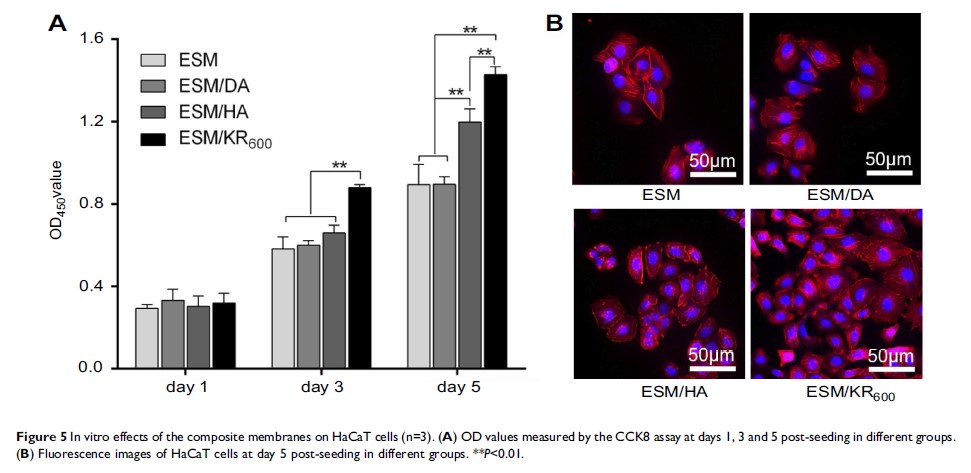
formation on its surface. Additionally, it promoted the proliferation of
keratinocytes and human umbilical vein endothelial cells and increased the
secretion of VEGF. Finally, an in vivo animal study indicated that the
composite membrane could promote wound healing via accelerating angiogenesis
and re-epithelialization, which were demonstrated by the enhanced expression of
angiogenetic markers (CD31 and VEGF) and keratinocyte proliferation marker
(PCNA), respectively.
Conclusion: These
results indicated that the composite membrane is a potential candidate of wound
dressings.
Keywords: antimicrobial
peptides, hyaluronic acid, fibrous eggshell membrane, antibacterial activity,
angiogenesis, re-epithelialization