117333
论文已发表
注册即可获取德孚的最新动态
IF 收录期刊
- 3.6 Breast Cancer (Dove Med Press)
- 4.3 Clin Epidemiol
- 2.6 Cancer Manag Res
- 3.2 Infect Drug Resist
- 4.1 Clin Interv Aging
- 6.1 Drug Des Dev Ther
- 4.1 Int J Chronic Obstr
- 8.7 Int J Nanomed
- 2.5 Int J Women's Health
- 3.2 Neuropsych Dis Treat
- 2.4 OncoTargets Ther
- 2.6 Patient Prefer Adher
- 2.6 Ther Clin Risk Manag
- 3.1 J Pain Res
- 3.5 Diabet Metab Synd Ob
- 4.5 Psychol Res Behav Ma
- 3.4 Nat Sci Sleep
- 2.4 Pharmgenomics Pers Med
- 2.6 Risk Manag Healthc Policy
- 4.6 J Inflamm Res
- 2.3 Int J Gen Med
- 3.9 J Hepatocell Carcinoma
- 3.3 J Asthma Allergy
- 2.5 Clin Cosmet Investig Dermatol
- 3.0 J Multidiscip Healthc

子宫内膜异位症相关疼痛的中枢致敏研究:一个系统的文献综述
Authors Zheng P, Zhang W, Leng J, Lang J
Received 10 December 2018
Accepted for publication 23 March 2019
Published 8 May 2019 Volume 2019:12 Pages 1447—1456
DOI https://doi.org/10.2147/JPR.S197667
Checked for plagiarism Yes
Review by Single-blind
Peer reviewers approved by Ms Justinn Cochran
Peer reviewer comments 2
Editor who approved publication: Dr Katherine Hanlon
Abstract: Endometriosis-associated
pain afflicts an enormous number of women who suffer from endometriosis. There
is an urgent need to explore the pathogenesis of endometriosis-associated pain
to identify targets for treatment of hyperalgesia. A search was conducted in
PubMed, Web of Science, Embase, and the Cochrane Library using the search terms
“endometriosis” AND (“pain” OR “hyperalgesia” OR “nociception” OR “allodynia”)
AND “central sensitization”. The search was limited to articles published in
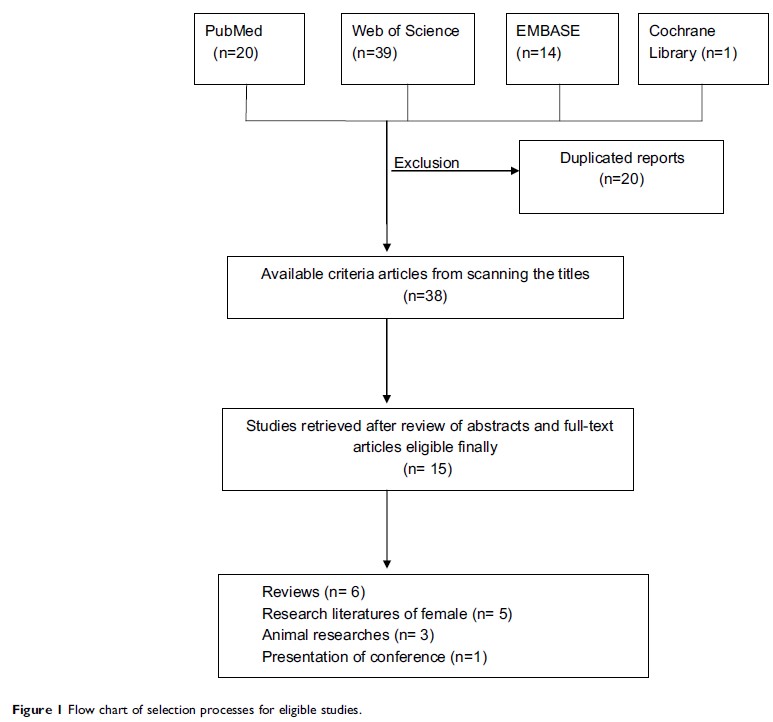
English from 01/01/2008 to the present. Among the search results, 15 articles
were eligible for systematic review, including 6 reviews, 6 human studies (one
in the form of a conference abstract only), and 3 animal studies. The articles
were classified into 4 lists to describe the mechanism of
endometriosis-associated pain and synthesize different aspects of research on
it. In conclusion, there is a need to explore the mechanism of
endometriosis-associated pain in terms of innervation, vascularization, local
inflammation, cross-correlated visceral sensitization, and central
sensitization to identify the target molecules and signaling pathways of key
genes and relevant biomarkers through new techniques, all with the goal of
developing a more comprehensive treatment strategy for endometriosis than is
currently available.
Keywords: endometriosis-associated
pain, neurogenic inflammation, mechanism, central sensitization