115195
论文已发表
注册即可获取德孚的最新动态
IF 收录期刊
- 3.6 Breast Cancer (Dove Med Press)
- 4.3 Clin Epidemiol
- 2.6 Cancer Manag Res
- 3.2 Infect Drug Resist
- 4.1 Clin Interv Aging
- 6.1 Drug Des Dev Ther
- 4.1 Int J Chronic Obstr
- 8.7 Int J Nanomed
- 2.5 Int J Women's Health
- 3.2 Neuropsych Dis Treat
- 2.4 OncoTargets Ther
- 2.6 Patient Prefer Adher
- 2.6 Ther Clin Risk Manag
- 3.1 J Pain Res
- 3.5 Diabet Metab Synd Ob
- 4.5 Psychol Res Behav Ma
- 3.4 Nat Sci Sleep
- 2.4 Pharmgenomics Pers Med
- 2.6 Risk Manag Healthc Policy
- 4.6 J Inflamm Res
- 2.3 Int J Gen Med
- 3.9 J Hepatocell Carcinoma
- 3.3 J Asthma Allergy
- 2.5 Clin Cosmet Investig Dermatol
- 3.0 J Multidiscip Healthc

慢性应激通过增加伏隔核中 DR2 和 MOR 的水平来增加对食物成瘾的易感性
Authors Wei NL, Quan ZF, Zhao T, Yu XD, Xie Q, Zeng J, Ma FK, Wang F, Tang QS, Wu H, Zhu JH
Received 11 February 2019
Accepted for publication 28 March 2019
Published 8 May 2019 Volume 2019:15 Pages 1211—1229
DOI https://doi.org/10.2147/NDT.S204818
Checked for plagiarism Yes
Review by Single-blind
Peer reviewers approved by Dr Colin Mak
Peer reviewer comments 2
Editor who approved publication: Dr Yu-Ping Ning
Background: Stress-related
obesity might be related to the suppression of the hypothalamic-pituitary-
adrenocortical axis and dysregulation of the metabolic system. Chronic stress
also induces the dysregulation of the reward system and increases the risk of
food addiction, according to recent clinical findings. However, few studies
have tested the effect of chronic stress on food addiction in animal models.
Purpose: The
objective of this study was to identify whether chronic stress promotes food
addiction or not and explore the possible mechanisms.
Method: We
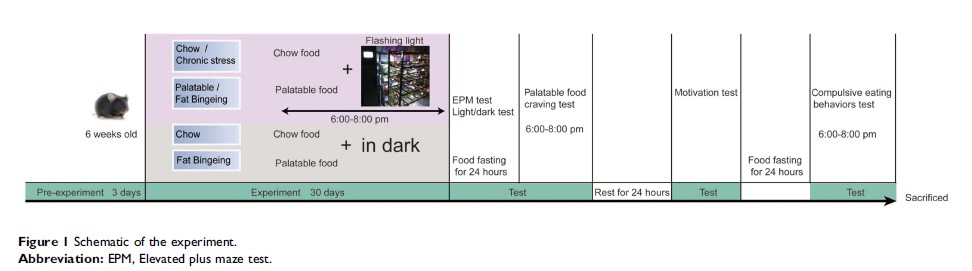
applied adaily 2 hrsflashing LED irradiation stress to mice fed chow or
palatable food to mimic the effect of chronic stress on feeding. After 1 month
of chronic stress exposure, we tested their binge eating behaviors, cravings
for palatable food, responses for palatable food, and compulsive eating
behaviors to evaluate the effect of chronic stress on food addiction-like
behaviors. We detected changes in the levels of various genes and proteins in
the nucleus accumbens (NAc), ventral tegmental area (VTA) and lateral
hypothalamus using qPCR and immunofluorescence staining, respectively.
Results: Behaviors
results indicated chronic stress obviously increased food addiction score (FAS)
in the palatable food feeding mice. Moreover, the FAS had astrong relationship
with the extent of the increase in body weight. Chronic stress increased the
expression of corticotropin-releasing factor receptor 1(CRFR1) was increased in
the NAc shell and core but decreased in the VTA of the mice fed with palatable
food. Chronic stress also increased expression of both dopamine receptor 2
(DR2) and mu-opioid receptor (MOR) in the NAc.
Conclusion: Chronic
stress aggravates the FAS and contributed to the development of stress-related
obesity. Chronic stress drives the dysregulation of the CRF signaling pathway
in the reward system and increases the expression of DR2 and MOR in the nucleus
accumbens.
Keywords: chronic
stress, obesity, food addiction, dopamine receptor 2, mu-opioid receptor,
nucleus accumbens