117333
论文已发表
注册即可获取德孚的最新动态
IF 收录期刊
- 3.6 Breast Cancer (Dove Med Press)
- 4.3 Clin Epidemiol
- 2.6 Cancer Manag Res
- 3.2 Infect Drug Resist
- 4.1 Clin Interv Aging
- 6.1 Drug Des Dev Ther
- 4.1 Int J Chronic Obstr
- 8.7 Int J Nanomed
- 2.5 Int J Women's Health
- 3.2 Neuropsych Dis Treat
- 2.4 OncoTargets Ther
- 2.6 Patient Prefer Adher
- 2.6 Ther Clin Risk Manag
- 3.1 J Pain Res
- 3.5 Diabet Metab Synd Ob
- 4.5 Psychol Res Behav Ma
- 3.4 Nat Sci Sleep
- 2.4 Pharmgenomics Pers Med
- 2.6 Risk Manag Healthc Policy
- 4.6 J Inflamm Res
- 2.3 Int J Gen Med
- 3.9 J Hepatocell Carcinoma
- 3.3 J Asthma Allergy
- 2.5 Clin Cosmet Investig Dermatol
- 3.0 J Multidiscip Healthc

细颗粒物质通过 COPD 中的 Wnt5a-ERK 途径加重香烟烟雾提取物诱导的气道炎症
Authors Wang Z, Zhao J, Wang T, Du X, Xie J
Received 23 November 2018
Accepted for publication 11 February 2019
Published 9 May 2019 Volume 2019:14 Pages 979—994
DOI https://doi.org/10.2147/COPD.S195794
Checked for plagiarism Yes
Review by Single-blind
Peer reviewers approved by Dr Cristina Weinberg
Peer reviewer comments 3
Editor who approved publication: Prof. Dr. Chunxue Bai
Background: Exposure
to environmental particulate matter (PM) ≤2.5 µm in diameter (PM2.5) and smoking
are common contributors to COPD, and pertinent research implicates both factors
in pulmonary inflammation. Using in vivo mouse and in vitro human cellular
models, we investigated the joint impact of PM2.5 pollution,
and cigarette smoke (CS) in mice or cigarette-smoke extract (CSE) in cells on
COPD inflammation, and explored potential mechanisms.
Methods: Tissue
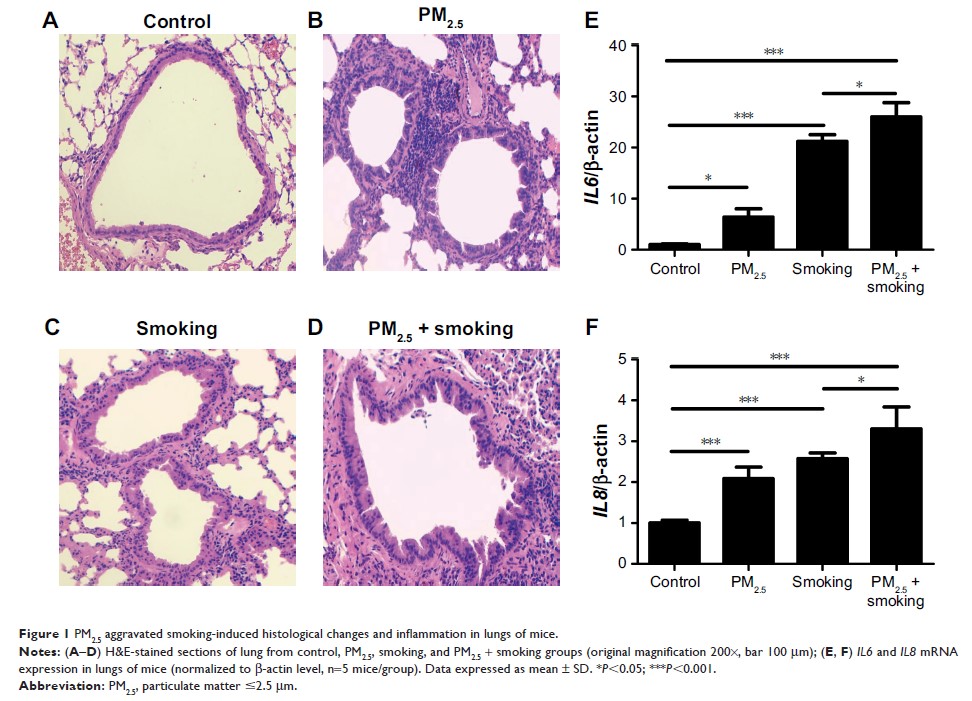
changes in lungs of C57BL/6 mice exposed to PM2.5 and CS
were studied by light microscopy, H&E, immunochemistry, and
immunofluorescence-stained sections. Levels of inflammatory factors induced by
PM2.5/CS in mice and PM2.5/CSE in 16HBE
cells were also monitored by quantitative reverse-transcription (qRT)-PCR and
ELISA. Expression of genes related to the Wnt5a-signaling pathway was assessed
at transcriptional and protein levels using immunofluorescence, qRT-PCR, and
Western blotting.
Results: Inflammatory
response to combined exposure of PM2.5 and CS or
CSE in mouse and 16HBE cells surpassed responses incited separately. Although
separate PM2.5 and CS/CSE exposure upregulated the
expression of Wnt5a (a member of the Wnt-secreted glycoprotein family),
combined PM2.5 and CS/CSE exposure produced a steeper
rise in Wnt5a levels. Use of a Wnt5a antagonist (BOX5) successfully blocked
related inflammatory effects. ERK phosphorylation appeared to mediate the
effects of Wnt5a in the COPD model, promoting PM2.5 aggravation
of CS/CSE-induced airway inflammation.
Conclusion: Our
findings suggest that combined PM2.5 and
CS/CSE exposure induce airway inflammation and Wnt5a expression in vivo in mice
and in vitro in 16HBE cells. Furthermore, PM2.5 seems to
aggravate CS/CSE-induced inflammation via the Wnt5a–ERK pathway in the context
of COPD.
Keywords: COPD,
airway inflammation, PM2.5, Wnt5a