117333
论文已发表
注册即可获取德孚的最新动态
IF 收录期刊
- 3.6 Breast Cancer (Dove Med Press)
- 4.3 Clin Epidemiol
- 2.6 Cancer Manag Res
- 3.2 Infect Drug Resist
- 4.1 Clin Interv Aging
- 6.1 Drug Des Dev Ther
- 4.1 Int J Chronic Obstr
- 8.7 Int J Nanomed
- 2.5 Int J Women's Health
- 3.2 Neuropsych Dis Treat
- 2.4 OncoTargets Ther
- 2.6 Patient Prefer Adher
- 2.6 Ther Clin Risk Manag
- 3.1 J Pain Res
- 3.5 Diabet Metab Synd Ob
- 4.5 Psychol Res Behav Ma
- 3.4 Nat Sci Sleep
- 2.4 Pharmgenomics Pers Med
- 2.6 Risk Manag Healthc Policy
- 4.6 J Inflamm Res
- 2.3 Int J Gen Med
- 3.9 J Hepatocell Carcinoma
- 3.3 J Asthma Allergy
- 2.5 Clin Cosmet Investig Dermatol
- 3.0 J Multidiscip Healthc

新辅助激素治疗对局部高危或有限进展性前列腺癌患者的短期益处
Authors Ma BL, Yao L, Fan Y, Wang Y, Meng YS, Zhang Q, He ZS, Jin J, Zhou LQ
Received 29 November 2018
Accepted for publication 2 April 2019
Published 10 May 2019 Volume 2019:11 Pages 4143—4151
DOI https://doi.org/10.2147/CMAR.S196378
Checked for plagiarism Yes
Review by Single-blind
Peer reviewers approved by Dr Andrew Yee
Peer reviewer comments 3
Editor who approved publication: Dr Ahmet Emre Eskazan
Purpose: Radical
surgery is the preferred method for local high-risk and limited progressive
prostate cancer in the routine clinical setting. However, current guidelines do
not recommend neoadjuvant hormone therapy (NHT). Opinions regarding NHT vary
among individual clinicians. According to the experience gained at our center,
we explored the benefits of NHT for patients with prostate cancer during the
perioperative period in this study.
Methods: In this
retrospective study, we explored the perioperative benefits of NHT among 189
patients with local high-risk or limited progressive prostate cancer who
underwent radical prostatectomy and divided them into two groups: the NHT group
and the non-NHT group. The NHT regimens were a gonadotropin-releasing hormone
(GnRH) agonist alone (3.75/11.25 mg of leuprolide or 3.6/10.8 mg of goserelin
acetate), an androgen receptor antagonist (ARA) alone, or a combination of the
two. The duration of treatment was <3 months, 3 to 6 months, or
>6 months.
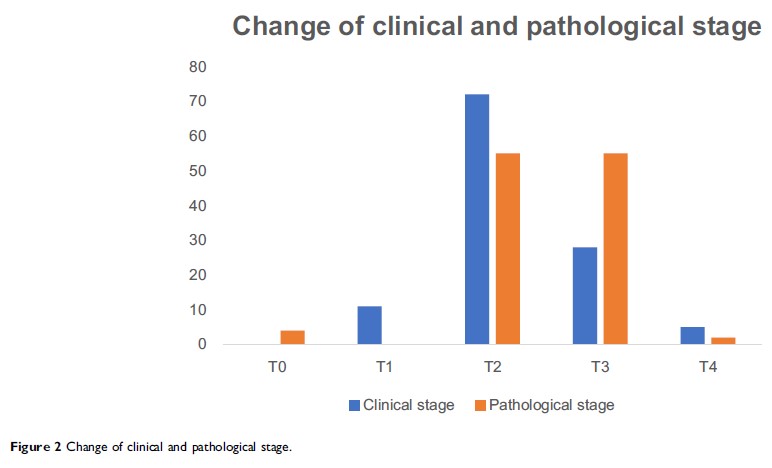
Results: We found
that NHT could reduce the surgery time and intraoperative hemorrhage, thus
reducing the difficulty of surgery; NHT could also improve the postoperative
recovery of patients. However, it did not reduce the stage of prostate cancer
or positive surgical margin rate.
Conclusions: Neoadjuvant
therapy is optional for some patients. We believe that NHT will improve the
overall prognosis of patients as progress continues in the medical field in the
future.
Keywords: localized
high-risk, limited advanced, prostate cancer, neoadjuvant hormone therapy,
short-term benefit