117333
论文已发表
注册即可获取德孚的最新动态
IF 收录期刊
- 3.6 Breast Cancer (Dove Med Press)
- 4.3 Clin Epidemiol
- 2.6 Cancer Manag Res
- 3.2 Infect Drug Resist
- 4.1 Clin Interv Aging
- 6.1 Drug Des Dev Ther
- 4.1 Int J Chronic Obstr
- 8.7 Int J Nanomed
- 2.5 Int J Women's Health
- 3.2 Neuropsych Dis Treat
- 2.4 OncoTargets Ther
- 2.6 Patient Prefer Adher
- 2.6 Ther Clin Risk Manag
- 3.1 J Pain Res
- 3.5 Diabet Metab Synd Ob
- 4.5 Psychol Res Behav Ma
- 3.4 Nat Sci Sleep
- 2.4 Pharmgenomics Pers Med
- 2.6 Risk Manag Healthc Policy
- 4.6 J Inflamm Res
- 2.3 Int J Gen Med
- 3.9 J Hepatocell Carcinoma
- 3.3 J Asthma Allergy
- 2.5 Clin Cosmet Investig Dermatol
- 3.0 J Multidiscip Healthc

循环 microRNA 作为血液癌症的诊断生物标志物: 系统评价和荟萃分析
Authors Drokow EK, Sun K, Ahmed HAW, Akpabla GS, Song J, Shi M
Received 24 December 2018
Accepted for publication 10 March 2019
Published 10 May 2019 Volume 2019:11 Pages 4313—4326
DOI https://doi.org/10.2147/CMAR.S199126
Checked for plagiarism Yes
Review by Single-blind
Peer reviewers approved by Dr Cristina Weinberg
Peer reviewer comments 3
Editor who approved publication: Dr Alexandra Fernandes
Purpose: Recent
studies have validated microRNAs (miRNAs) as a diagnostic biomarker for
haematological cancers. This study aimed to estimate the overall diagnostic
accuracy of circulating miRNAs in haematological malignancies.
Materials and Methods: Multiple
databases (Google Scholar, PubMed, EMBASE, Cochrane Library,) were searched
until 19th, August 2017.
Results: The
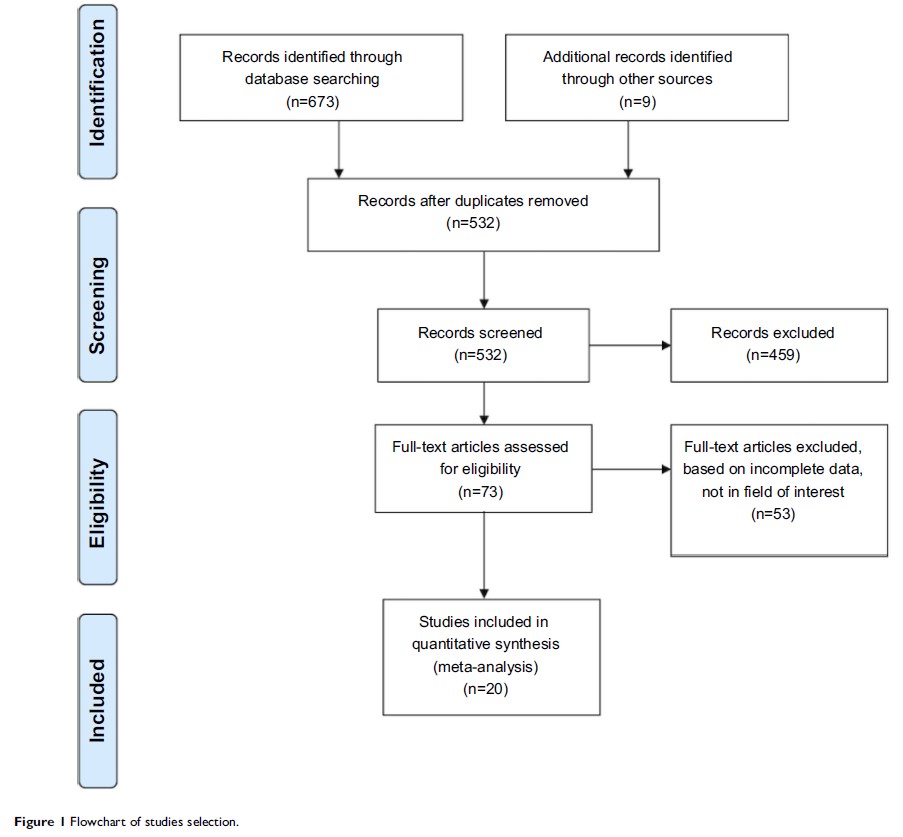
meta-analysis included 50 studies from 20 publications. The diagnostic accuracy
was assessed by pooled specificity, sensitivity, positive likelihood ratio
(PLR), negative likelihood ratio (NLR), diagnostic odds ratio (DOR) and area
under the curve area (AUC) by random effect model. We used QUADAS (Quality
Assessment for diagnostic accuracy studies) to evaluate the quality of the
included studies. To perform the meta-analysis, we used Meta-Disk 1.4, Revman
5.3 and Stata 12.0 software. High diagnostic accuracy was demonstrated, with a
sensitivity of 0.81, a specificity of 0.85, a PLR of 5.28, an NLR of 0.22, a
DOR of 30.39, and an AUC of 0.91. Subgroup analyses showed better outcomes for
the African population, combined miRNAs and leukaemia patients compared with
other subgroups.
Conclusion: Our
results indicated that circulating miRNAs especially combined miRNA can be used
as a diagnostic marker in haematological cancers.
Keywords: Specificity,
sensitivity, diagnostic biomarkers, miRNA, haematological cancers